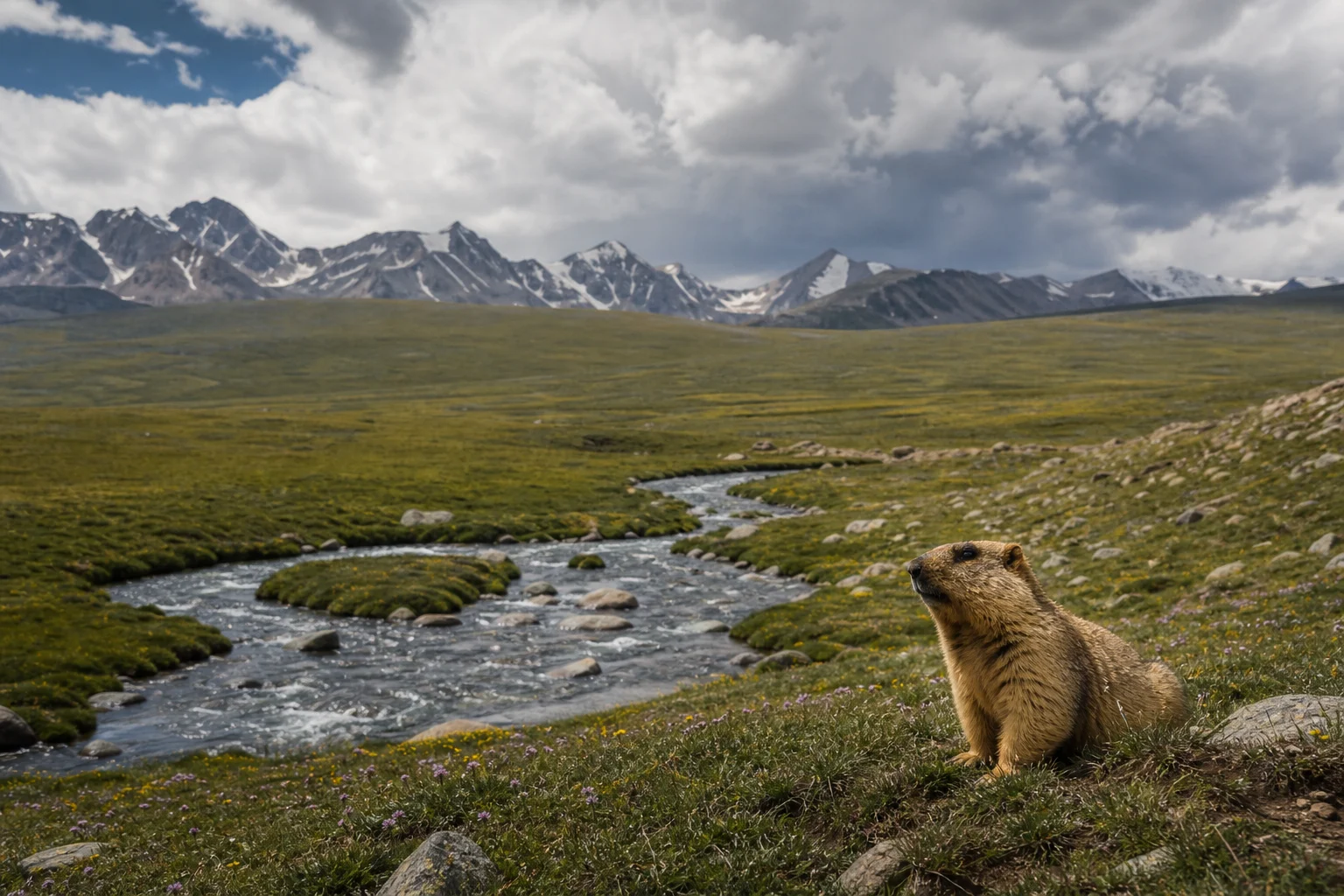
From Skardu, the road to Deosai rises beyond the settled landscape with startling speed. Fields, poplars and village walls fall away; Sadpara Lake becomes a blue landmark below; then the road enters a country of wind, stone and distance. The change is not merely scenic. Deosai is an alpine world with its own severe logic, where long winters govern movement, water arrives with snowmelt, and summer has only a brief interval in which to unfold.
Known locally in Balti as Ghbiarsa, often translated as “summer’s place”, Deosai is a vast high-altitude plateau shared across the wider landscapes of Skardu and Astore in Gilgit-Baltistan. Its average elevation is commonly given as more than 4,000 metres above sea level. That figure is not an abstract boast: it can be felt in the shortened breath, the fierce sun, the sudden chill when clouds move in and the remarkable clarity of a far horizon.
For visitors, Deosai is sometimes reduced to a famous lake, a bumpy jeep route or a photograph of a marmot standing alert beside the road. Those moments are real, but they are fragments of a much larger place. The significance of the plains lies in their ecological scale. Grasslands, marshes, streams, lakes, rocky slopes and rolling ground form a protected wilderness that is especially important for the Himalayan brown bear. Deosai National Park was established in 1993 principally to protect the bear and its habitat; the plateau remains one of Pakistan’s most important landscapes for high-mountain wildlife conservation.
A plateau made by weather
Deosai does not behave like a conventional meadow. For much of the year it is buried under deep snow and largely inaccessible. When warmer months finally arrive, meltwater begins to thread across the plain. Pools gather in hollows, streams cut through turf, and wet ground supports a burst of plant life. The landscape can look gentle from a distance, with soft hills and open grass, yet its climate is uncompromising. Wind can sweep across the plateau with little warning, and a clear morning can turn raw and stormy by afternoon.
This seasonal rhythm explains both Deosai’s beauty and its vulnerability. Alpine flowers appear during a compressed growing season, lending colour to ground that only recently lay under snow. In wetter patches, sedges and other moisture-loving plants help create habitats that are very different from the stonier slopes nearby. The waterways support fish, while the surrounding land provides feeding and shelter for mammals and birds adapted to thin air and cold conditions.
It also explains why an encounter with Deosai can feel less like arriving at a destination than entering a weather system. Clouds travel visibly across the open country. Light changes the colour of grass from silver-green to ochre. A distant slope may disappear behind rain while another remains bright beneath a gap in the sky. The plateau rewards patience because its drama is often atmospheric rather than theatrical.
The bear at the centre of the story
The Himalayan brown bear is Deosai’s most celebrated resident, but it should not be treated as a mascot or a guaranteed sighting. Seeing one is rare, and that rarity is part of the point. A bear moving through an open valley is not performing for passing vehicles; it is an animal in a protected but still fragile habitat, searching for food across an immense landscape.
Conservation work at Deosai has made the plateau an important refuge for this distinctive high-altitude bear population. The national park also supports Tibetan wolves, red foxes, Himalayan ibex, golden marmots and a rich birdlife that includes raptors and mountain species. Some animals remain elusive even to regular observers. The most memorable wildlife experience may be quieter: an eagle circling on an updraft, the sharp warning call of a marmot, or a line of small prints near a stream.
Wildlife viewing here calls for restraint. Visitors should remain in vehicles where park guidance requires it, keep a generous distance, never offer food and avoid gathering around an animal for photographs. Food waste is particularly damaging in a wilderness where wild animals must not learn to associate people with easy meals. A photograph is never worth changing an animal’s behaviour or blocking its route across the grassland.
Water, wetlands and Sheosar
Deosai’s lakes are among the plateau’s most visible features, but water is present everywhere if one looks closely. Snow-fed channels cross the plains, feeding marshy ground and joining larger streams. These high-altitude wetlands are essential to the character of the park: they support plant communities, create feeding areas for birds and animals, and hold the summer’s brief abundance in a landscape otherwise defined by exposure.
Sheosar Lake is the best known of these waters. Its name is often rendered as “Blind Lake”, although visitors need not rely on a single translation to understand its appeal. Set among broad, treeless terrain, the lake seems to concentrate the open scale of Deosai: a clear basin of water, an immense field of sky and ridges fading into the distance. In favourable summer conditions, flowers and grasses soften its shoreline. In colder weather, its beauty becomes starker, marked by wind and hard light.
The lake deserves more than a hurried stop. Its setting offers a lesson in proportion. At this elevation, the temptation is to seek one dramatic viewpoint after another. Yet Deosai is best understood by slowing down: watching the wind roughen the lake’s surface, noticing the change from dry grassland to wet ground, and recognising how little of the plateau is built around human convenience.
Skardu as the threshold
Skardu is the principal gateway for many journeys to Deosai. The approach commonly passes Sadpara Lake before climbing onto the plateau, while another route connects through Astore. In practical terms, a high-clearance four-wheel-drive vehicle and an experienced local driver are sensible requirements rather than luxuries. Road conditions, snow, rain and administrative arrangements can change from one season to the next, so travellers should confirm current access, park requirements and weather locally before setting out.
But Skardu is more than a logistical starting point. It provides the human scale that Deosai itself largely withholds. In and around the town, visitors can see the irrigated valley life that makes settlement possible in Baltistan: cultivated plots, fruit trees, bazaars, homes and the steady labour of managing water in an arid mountain environment. The transition from Skardu to Deosai makes the contrast vivid. One is a lived-in valley shaped by cultivation and exchange; the other is a high, seasonal expanse where nature’s timetable remains decisive.
This relationship matters. The park is not separate from local life simply because it feels remote. Guides, drivers, rangers, shopkeepers and families in the surrounding region are connected to the routes, weather and visitor economy of the plateau. Travelling with local knowledge is not only practical at high altitude; it is a way of treating Deosai as part of a living regional landscape rather than an empty backdrop.
Folklore, names and the discipline of uncertainty
The name Deosai is often interpreted as “the land of giants”, and stories of giants, fairies and dangerous presences have long circulated around this formidable country. Such tales belong to the cultural atmosphere of the plateau, expressing the awe that a vast, snowbound and historically difficult-to-reach place can inspire. They should be received as local tradition and storytelling, not presented as documented history.
That distinction adds rather than subtracts from Deosai’s richness. Mountain landscapes everywhere accumulate stories because they exceed ordinary human scale. On Deosai, folklore sits beside natural history: beside the bear’s seasonal search for food, the marmot’s burrow, the annual opening of mountain roads and the temporary blaze of alpine flowers. The plains do not need exaggeration. Their real conditions are extraordinary enough.
How to travel lightly on the plains
Deosai is most often accessible in the warmer months, broadly from late spring or early summer into early autumn, but the actual opening period depends on snow and road conditions. Even in peak summer, warm layers, rain protection, sun protection, drinking water and a basic understanding of altitude illness are essential. Visitors coming directly from lower elevations should allow time to acclimatise in Skardu rather than treating the plateau as a casual day excursion.
- Stay on established roads and tracks. Driving across open grassland scars fragile soil and vegetation that can take a long time to recover.
- Carry all rubbish back out. This includes food scraps, plastic bottles, tissues and disposable packaging.
- Keep wildlife wild. Do not feed marmots or approach bears, foxes or nesting birds.
- Camp only where permitted and leave no trace. Avoid polluting streams, damaging vegetation or collecting flowers.
- Respect weather and altitude. Turn back if conditions worsen, and seek medical advice promptly if severe altitude symptoms appear.
- Choose local expertise. A responsible local driver or guide brings route awareness, weather judgement and regional knowledge that maps alone cannot provide.
Responsible travel is particularly important because the apparent emptiness of Deosai can be misleading. Its ecosystems are not empty at all; they are finely balanced and slow to repair. The guest who leaves the least visible trace is often the one who has understood the place best.
The value of open country
Pakistan is frequently represented through its great peaks: the sharp granite towers of the Karakoram, the glacier routes of famous expeditions, the dramatic flanks of Nanga Parbat. Deosai offers another mountain truth. Here, grandeur is horizontal. It is found in a horizon that keeps widening, in a watercourse crossing turf, in weather advancing over a plain with no sheltering forest or city beyond it.
That openness gives Deosai an unusual emotional force. It asks visitors to pay attention to what is small: a flower close to the ground, a bird lifting from marshland, a marmot returning to its burrow. It also asks them to recognise what is vast: seasonal snow, headwaters, wildlife ranges and the protection of a landscape whose value cannot be measured by how quickly it can be crossed.
To leave Deosai for Skardu is to descend back into walls, roads, trees and conversation. Yet the plateau tends to remain in the mind as an expanse rather than a single view. Its enduring story is one of endurance—of animals surviving a harsh climate, wetlands briefly flourishing after snowmelt, and a national park holding space for wilderness on one of Pakistan’s highest inhabited frontiers.