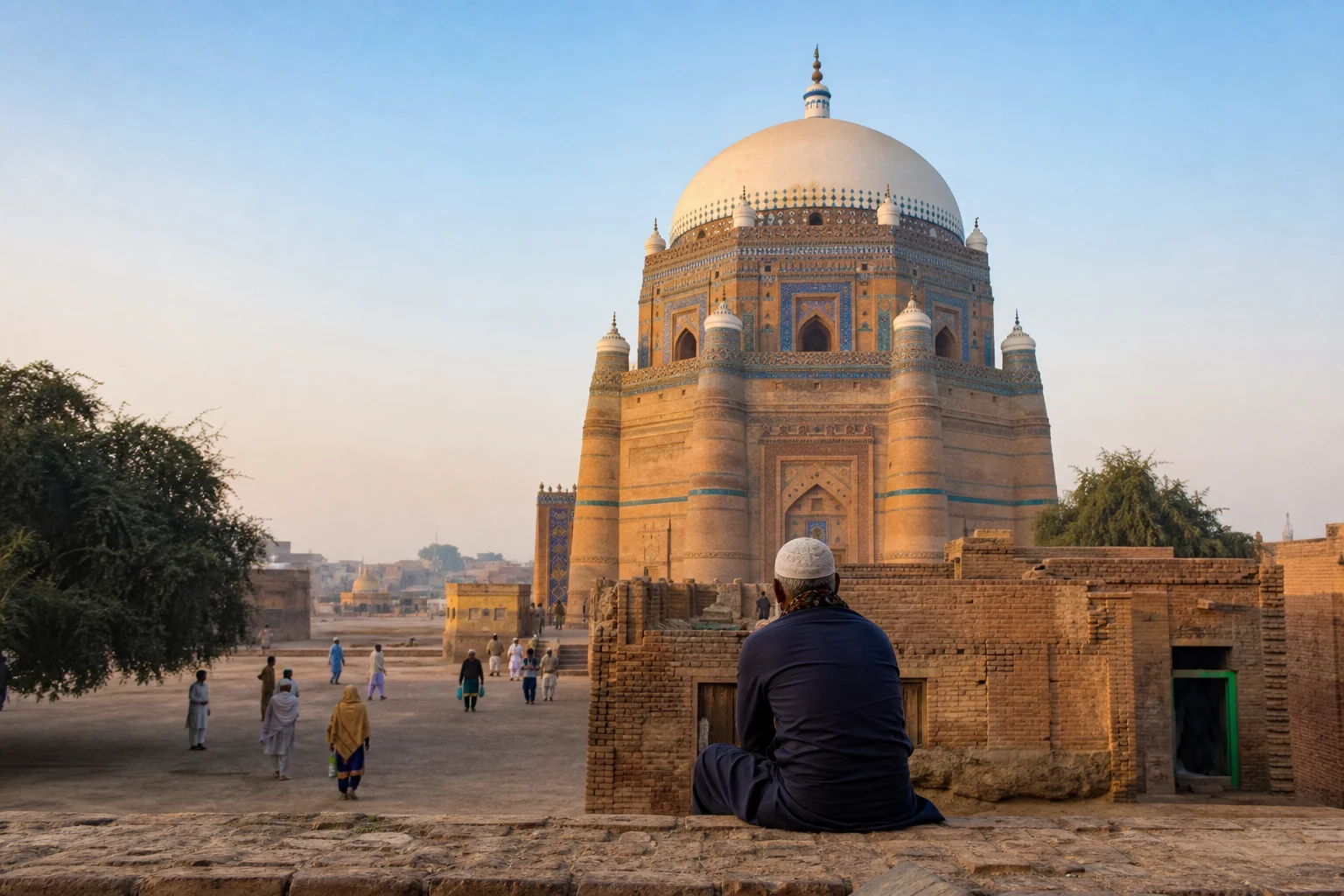
Multan announces itself in colour. Above the warm dust tones of southern Punjab, the domes and walls of its great mausoleums rise in bands of deep cobalt, turquoise and white. Their glazed tiles catch the strong light with a brightness that feels almost improbable against the baked brick beneath. In the streets below, shops display painted ceramics, carved wood, embroidered cloth and the familiar camel-skin lamps that have become part of the city’s visual vocabulary.
Yet colour is only the surface of Multan. The city is widely known as Madinat al-Auliya, the City of Saints, because generations of Sufi teachers, scholars and devotees made it a major centre of spiritual life in the region. Its shrines are not simply historic monuments. They remain places of prayer, remembrance, charity, family visits, seasonal gathering and private hope. To understand Multan is to understand that its finest buildings were never intended to be silent objects. They are part of a city where faith, craftsmanship and daily life continue to meet.
A city made by crossings
Multan stands in the plains of southern Punjab, in a landscape long shaped by the movements of the Chenab and the wider Indus river system. Its history reaches far into antiquity, although the precise beginnings of settlement are difficult to fix. Over many centuries it was connected to routes running across Punjab, Sindh, Rajasthan, Central Asia and the Persianate world. Trade, migration, scholarship and successive political powers all left their marks.
This depth matters because Multan is sometimes reduced to a handful of postcard images: a tomb, a blue plate, a box of sohan halwa. Each is real, but none is sufficient on its own. The city has repeatedly been remade while retaining an unusually strong sense of place. Old neighbourhoods still gather around bazaars and religious landmarks; the fort mound continues to shape the city’s skyline; and craft traditions preserve visual languages that link domestic objects to monumental architecture.
Multan’s past includes ancient religious traditions, medieval Muslim dynasties, the Delhi Sultanate, Mughal administration, Sikh rule and the colonial period. Rather than imagining these as cleanly separate chapters, it is more useful to see them as layers. The city’s cultural life developed through contact: between rural and urban communities, between travelling scholars and local patrons, and between the demands of trade and the desires of devotion.
Why Multan became the City of Saints
The title City of Saints is rooted above all in the influence of Sufi lineages whose tombs and institutions helped make Multan a centre of religious learning in the thirteenth and fourteenth centuries. Among the most important figures is Sheikh Bahauddin Zakariya, associated with the Suhrawardi order. After study and travel, he settled in Multan in the early thirteenth century and established a major centre for teaching. His legacy was intellectual as well as spiritual: he is remembered as a scholar whose presence drew students and visitors to the city.
His shrine, near the old fort area, has the clarity and gravity of early Indo-Islamic brick architecture. A square lower structure rises to an octagonal stage and dome, while glazed ornament enlivens the brickwork. The building is an important reminder that a mausoleum can be both an architectural statement and the centre of a continuing devotional community.
Nearby stands the more commanding mausoleum of Shah Rukn-e-Alam, Bahauddin Zakariya’s grandson and successor in the local Suhrawardi tradition. Shah Rukn-e-Alam, whose name is often translated as “Pillar of the World,” lived from 1251 to 1335. His tomb, associated with the Tughluq period, is one of the defining works of medieval architecture in Pakistan. Its immense octagonal form, tapering walls, timber structural elements and broad dome give it a rare monumentality. But it is the marriage of red brick and blue-and-white tile that makes the building unforgettable.
The shrine’s meaning extends well beyond its silhouette. Pilgrims come with prayers, offerings and memories; families bring children; visitors pause beneath the dome to absorb its scale. In such settings, reverence is not an abstract idea. It is visible in the covering of heads, the removal of shoes where required, the careful movement through crowded spaces and the work of those who keep the complex functioning every day.
Multan’s sacred geography is broader than these two celebrated mausoleums. The city is also associated with the shrine of Shah Shams Sabzwari and with many smaller tombs, mosques and neighbourhood religious sites. Together, they have made the city a landscape of remembrance rather than a collection of isolated monuments.
Architecture that teaches the eye
The mausoleums of Multan are often described through their domes, but their most persuasive feature may be their surfaces. Brick is structural, local and earthy. Tile is luminous, intricate and mobile across the facade. The contrast creates architecture that is at once grounded and transcendent.
Blue has a particular force here. It frames inscriptions, outlines arches, fills geometric borders and turns floral forms into disciplined ornament. Turquoise softens the intensity of cobalt; white gives the compositions air and legibility. The effect is neither merely decorative nor accidental. Repeated patterns create rhythm across the walls, directing the eye upward and around the structure. In a city known for intense summer light, glaze also gives architecture a changing character: sombre in shade, electric in the sun.
These monuments belong to a wider tradition of glazed tilework across the Indus regions, including the historic towns and shrines of southern Punjab and Sindh. But Multan’s brick-and-tile vocabulary has a distinct authority. It is a visual language in which structural mass and delicate ornament do not compete. They depend on one another.
From mausoleum tile to workshop pottery
Multani blue pottery, often described locally as kashikari, carries this architectural colour into domestic scale. A plate, vase, tile, bowl or decorative panel may hold the same family of cobalt and turquoise associated with the city’s shrines. The connection is not only aesthetic. It reflects a long tradition in which makers translated the visual world of sacred architecture into objects that could live in homes, courtyards and shops.
The process demands patience. Clay is prepared and shaped; pieces are dried, refined and coated for decoration; outlines and colours are applied; then glazing and firing bring the surface to life. Cobalt produces the familiar blue, while copper compounds are traditionally used for turquoise and greenish tones. Small variations in heat, glaze and handwork mean that handmade pieces retain individual character. A brush line that appears effortless may represent years of practiced control.
Traditional motifs include flowers, curling vines, stars, repeated leaves and geometric divisions. Some designs are densely patterned; others use open fields of white to let a single blue form breathe. The most satisfying work does not imitate old fragments mechanically. It understands proportion, colour and the discipline of repetition, then applies that knowledge to the object at hand.
For visitors, blue pottery is best approached as skilled labour rather than as an anonymous souvenir. Buying directly from a maker or a reputable craft outlet, asking whether an item is handmade, and accepting the slight irregularities of kiln-fired work are simple ways to value the craft honestly. Fragile ceramics also deserve practical care: packing, transport and customs rules should be considered before a large purchase is made.
A wider world of Multani craft
Blue pottery is only one strand of the city’s craft heritage. Multan is also known for camel-skin lamps, in which treated hide is shaped over a mould and painted with luminous floral designs. When lit from within, the surface becomes softly translucent, transforming an animal material into a glowing decorative object. This is a highly specialised form of work, dependent on the knowledge of artisans who prepare, shape, paint and finish each piece.
Woodwork, embroidery, metalware and textile traditions also belong to the city’s cultural ecosystem. In the bazaars, practical goods and ceremonial objects sit side by side: kitchen vessels, prayer items, embroidered coverings, painted lamps, ceramics and sweets prepared for journeys or gifts. This is not a museum arrangement. It is the commerce of a city where beauty has long been made for use as well as display.
Multani sohan halwa is another expression of this gift culture. Rich, dense and usually cut into small portions, it is carried home by travellers and offered to guests. Like blue pottery, it has become emblematic of the city, yet its real significance lies in the social gesture of sharing: a box bought for relatives, neighbours or colleagues is a small continuation of hospitality.
The ethics of visiting a living sacred city
Multan rewards an unhurried approach. Its most important places are not stages set for quick consumption. At shrines, modest dress and quiet attentiveness are appropriate; local guidance should be followed on photography, entry areas and times of worship. Visitors should avoid blocking pilgrims, treating prayer as spectacle or pressing a camera into intimate moments of devotion. A respectful visit begins by recognising that one has entered a space that belongs first to its worshippers.
The same principle applies in craft neighbourhoods and bazaars. Ask before photographing artisans. Do not bargain in a way that dismisses the work involved. Choose durable, fairly priced pieces over mass-produced imitations when possible. In the heat and density of the old city, move patiently, carry water, reduce disposable waste and check local conditions before making travel plans.
Multan does not need to be romanticised to be admired. It is a large, working Pakistani city with traffic, pressure, noise and the unevenness of urban growth. Its power lies in the way monumental heritage and ordinary life remain intertwined. A saint’s shrine may be seen from a market lane; a tile pattern on a tomb may reappear on a small plate; a centuries-old name may live on in the identity of a university, a neighbourhood or a family’s habitual route through town.
What Multan reveals about Pakistan
For anyone seeking a fuller understanding of Pakistan, Multan offers an essential correction to narrow images of the country. It reveals Pakistan as a place of long urban memory, sophisticated regional craft, devotional plurality within Muslim life and enduring connections across South Asia and beyond. Its heritage is not frozen in an earlier century. It is renewed whenever a potter draws a cobalt line, a caretaker opens a shrine, a family shares sweets with guests or a pilgrim enters beneath the tiled dome.
The City of Saints is, finally, not only about saints. It is about the people who have carried their memory forward: artisans, students, shopkeepers, custodians, worshippers and residents whose lives give Multan its continuity. The blue on its walls is beautiful because it is more than colour. It is the visible trace of a city that has learned, across centuries, how to make devotion endure in brick, glaze and human care.