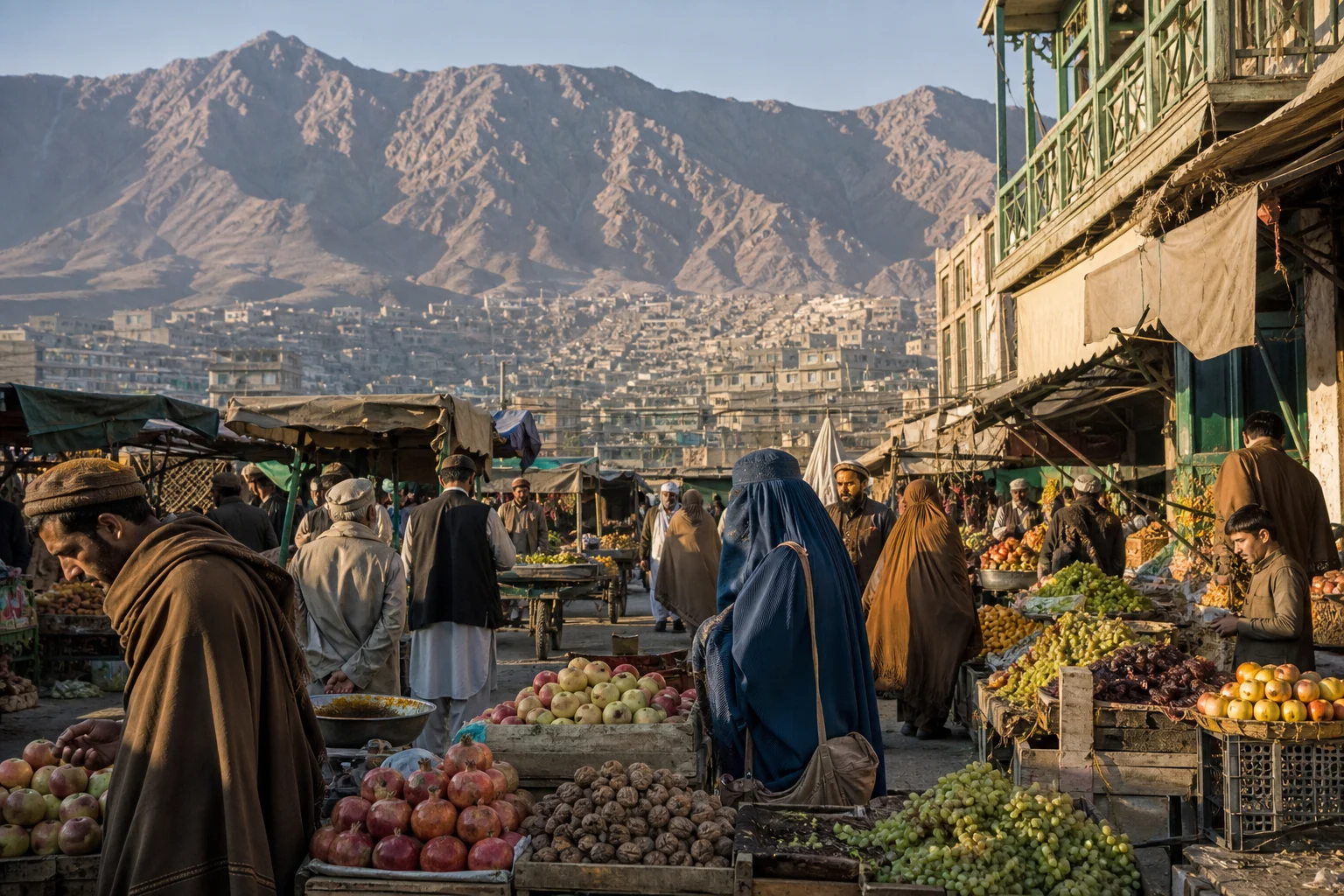
Quetta sits high in a broad basin of northern Balochistan, at roughly 1,680 metres above sea level, with mountains rising around it like the rim of an immense bowl. Takatu, Murdar and Chiltan are not distant scenery here. They determine the city’s light, its winter cold, the direction of roads and the feeling of arrival. In a country often imagined through river plains, humid coasts and great northern peaks, Quetta offers another Pakistan: dry, elevated, spacious and closely tied to the rhythms of mountain weather.
It is a city best understood not as a single preserved historic quarter but as a working highland capital. Its identity is carried in fruit crates and tea glasses, in embroidered cloth and woollen shawls, in the call and movement of bazaars, and in the coexistence of Baloch, Pashtun, Hazara, Brahui and many other communities. Languages, family histories and food traditions overlap in the same streets. That complexity is Quetta’s great cultural fact.
A City Made by Its Setting
The Quetta valley belongs to the western highlands of Pakistan: semi-arid country where rainfall is limited, winters can be severe and water has always shaped settlement. Yet the altitude, sun and seasonal cold also support temperate fruit cultivation. Apples, grapes, apricots, peaches, plums, cherries and pomegranates have long been associated with the valleys and districts around Quetta, Pishin, Mastung, Ziarat and Qilla Abdullah.
This is why Quetta is widely known as Pakistan’s fruit garden. The phrase can sound decorative until one encounters the practical world behind it: growers watching the weather, labourers sorting harvests, merchants arranging wooden boxes, families preserving fruit, and traders sending fresh and dried produce onwards through national markets. A bowl of raisins or almonds in a Quetta shop is not merely a souvenir. It is a compact record of highland agriculture, patient cultivation and water management in a dry landscape.
The old systems of channels, springs and karezes that sustained cultivation across parts of Balochistan are reminders that orchards do not emerge from generous rainfall alone. They depend on accumulated local knowledge about soil, shade, irrigation and seasonal timing. Today, as water pressure and climate variability affect many parts of the province, the orchard should be seen not as an inexhaustible emblem of abundance, but as a landscape requiring care.
From Shal to a Modern Highland Capital
Quetta has long occupied a useful position between highland valleys and routes leading towards Kandahar, Pishin, the Bolan Pass and the plains beyond. Its older name, Shal or Shalkot, survives in local usage and historical writing; the name Quetta is commonly linked to a word for a fort. The city’s location made it a place of exchange well before modern borders and highways gave such routes their present meaning.
Its urban form, however, bears the marks of more recent upheaval. The devastating earthquake of May 31, 1935 destroyed much of Quetta and the surrounding region. Reconstruction changed the city’s built environment profoundly. Visitors looking for an uninterrupted old city of carved façades and medieval lanes will miss the point. Quetta’s history is visible less in a continuous architectural skin than in its geography, institutions, markets, neighbourhood names and collective memory of rebuilding.
This makes the city’s modest-looking streets worth reading carefully. A bazaar lane may contain a tailoring shop, a fruit wholesaler, a traditional bread oven, a pharmacy, a carpet seller and a tea stall within a short walk. The city is not arranged as a museum display. Its heritage remains embedded in commerce and routine.
The Bazaar as a Map of the Region
Quetta’s bazaars are among the most immediate ways to understand its place in Balochistan. Liaquat Bazaar, Suraj Ganj Bazaar, Kandahari Bazaar and the commercial stretches around Jinnah Road are remembered less as separate attractions than as parts of a larger market world. They bring together household goods, textiles, dried fruit, spices, footwear, metalware, prayer caps, shawls, rugs and the practical necessities of urban life.
Dry-fruit stalls are a natural starting point. Walnuts, almonds, pistachios, raisins and dried apricots are displayed in heaps whose colours range from pale gold to deep brown. Ask what is local, what is seasonal and how a particular item is used at home. A respectful conversation with a shopkeeper often teaches more than a hurried purchase. Prices and provenance can vary, and it is wiser to buy thoughtfully than to assume that every product is made nearby.
Textiles offer another route into the city’s cultural plurality. Balochi, Brahui, Pashtun and Hazaragi traditions all have distinct visual languages, although individual garments and stitches vary by family, maker and locality. In the markets, one may see dense geometric embroidery, richly patterned dress panels, handwoven shawls, carpet work and silver-coloured jewellery. These are not interchangeable symbols of an undifferentiated ‘tribal’ past. They are living craft practices, often sustained by women’s skilled handwork and by long networks of material supply, design knowledge and trade.
When purchasing embroidery or carpets, it is worth asking who made the item, whether the work is handmade, and how much time it took. Bargaining is common in markets, but it need not become a performance of squeezing the maker’s labour to its lowest possible value. Good travel begins with curiosity and ends with fairness.
A Table Shaped by Fire, Grain and Cold Weather
Quetta’s food culture is as layered as its market life. Balochistan’s celebrated sajji is an essential reference point: lamb or chicken is slow-roasted over coals, traditionally with restrained seasoning that lets the flavour of the meat remain central. It is commonly served with bread, and recipes differ from one cook and household to another. The city’s restaurants have helped make sajji famous across Pakistan, but the dish belongs to a wider regional culinary inheritance rather than to a single shop or fixed formula.
Rosh, another meat preparation associated with Balochistan, similarly values clarity of flavour and slow cooking. In colder weather, bowls of soup, tea and substantial meat dishes speak to the demands of the plateau more directly than any restaurant slogan could. Afghan-influenced foods, including rice dishes and breads, are also part of the city’s everyday culinary conversation, reflecting the historic movement of people and goods through the region.
For a quieter introduction, begin with bread and tea. Fresh naan from a tandoor, sometimes eaten with eggs, beans, yoghurt or a simple stew, reveals the importance of warmth and immediacy in daily food. Fruit should be approached seasonally: the point is not to hunt for a famous apple in every month, but to notice what the market is actually offering. In summer and autumn especially, Quetta’s connection to its surrounding valleys becomes deliciously visible.
A City of Several Cultural Homes
It is easy to assign a place a single cultural label from a distance. Quetta resists that simplification. It is the capital of Balochistan and an important centre of Baloch culture, but it is also deeply shaped by Pashtun life and by Hazara communities, as well as Brahui, Punjabi, Sindhi, Urdu-speaking and other residents. Pashto, Balochi, Brahui, Hazaragi, Urdu and English may be heard in different settings, with multilingualism forming part of the city’s everyday intelligence.
This diversity is not a tourist spectacle. It is expressed in family networks, neighbourhoods, religious and social calendars, clothing, cuisines, business ties and forms of hospitality. Visitors should resist the urge to treat people as representatives of a type. Clothing may suggest a cultural affiliation, but it does not explain a person’s language, history or beliefs. A courteous greeting, clear permission before photographing anyone, and a willingness to listen go much further than assumptions.
Quetta’s universities, colleges and cultural institutions add another dimension. The city is not only a staging point for journeys into the province; it is a place where students, teachers, researchers, artists and writers consider Balochistan from within. Its conversations are often more varied and more contemporary than the familiar travel image of a frontier outpost allows.
Beyond the City: Water, Stone and Open Ground
The landscapes immediately around Quetta sharpen one’s sense of the plateau. Hanna Lake, east of the city, is known for its stark setting beneath bare hills. Urak Valley leads towards orchards and seasonal green, offering a contrast to the urban basin. Hazarganji-Chiltan National Park protects a dramatic stretch of rugged ground and is associated with the endangered Chiltan ibex. These places are more meaningful when approached as ecological landscapes, not merely backdrops for photographs.
The mountain roads and valleys of Balochistan require realistic planning. Conditions can shift with weather, roadwork, local regulations and water availability. Before travelling beyond the city, check current local advice, use appropriate transport, avoid leaving marked routes and take all litter back with you. In dry country, small acts of care matter: refill a bottle rather than buying repeated single-use plastic, do not disturb wildlife, and never treat scarce water as scenery.
How to Read Quetta Well
Quetta rewards an unhurried gaze. Stand in a bazaar long enough to notice its working order: the porter carrying a sack, the fruit seller trimming a display, the tailor measuring fabric, the tea being poured from height into a glass. Look up at the mountains before dawn or near sunset, when the basin’s scale becomes clear. Eat what is in season. Ask before taking photographs. Let a market be a market rather than an obstacle between named sights.
The city’s beauty is not soft or ornamental. It lies in contrast: orchards against arid slopes, bright textiles in dusty streets, the warmth of a tandoor in sharp winter air, and a cosmopolitan urban life shaped by the high plateau. To understand Quetta is to see how landscape becomes culture—not abstractly, but through the fruit people grow, the goods they trade, the meals they share and the many ways they make a home beneath the mountains.