Islamabad is often introduced as Pakistan’s planned capital: orderly, spacious and set against the rising line of the Margalla Hills. That description is accurate, but incomplete. To see Islamabad only as a city of embassies, ministries and measured avenues is to miss the texture that gives it meaning. The capital lies where the Potohar Plateau begins to lift towards the Himalayan foothills, beside an older urban world shaped by Rawalpindi, village settlements, seasonal streams and routes that have carried people through this region for centuries.
Its character is formed by a productive contrast. Islamabad is a modern city designed in the early 1960s, organised in numbered sectors and broad green corridors. Yet it is also a gateway to a much older cultural geography: the Gandharan remains of Taxila, the living craft traditions represented in its museums, and the hills that remain remarkably close to daily city life. For a visitor, Islamabad is best understood not as a checklist of monuments but as a place where Pakistan’s contemporary aspirations meet landscapes and memories far older than the capital itself.
A Capital Drawn Around a Landscape
When Islamabad was conceived as the new federal capital, its planners did not begin with a blank plain. They worked with the slopes, ravines and open views of the Potohar region. The master plan associated with the Greek planner Constantinos A. Doxiadis arranged the city in sectors, separating administrative, diplomatic, residential, educational, commercial, industrial and rural functions. The result is a city whose geometry is unusually legible: wide roads, neighbourhood markets, planted avenues and low-rise districts framed by distant ridges.
That plan can sometimes make Islamabad feel formal at first encounter. Its life is not concentrated in one historic core in the way it is in Lahore or Peshawar. Instead, it unfolds across distinct neighbourhoods: morning walkers beneath rain trees, families gathering in parks, students spilling out of campuses, and shopkeepers opening the compact markets that anchor each sector. The city’s rhythm is often most visible in these everyday spaces rather than in its official buildings.
Rawalpindi, immediately beside Islamabad, provides an important counterpoint. Long established before the new capital, it has denser bazaars, older commercial streets and a different urban tempo. Together, the two cities show two faces of the metropolitan region: one planned around a post-independence vision of administration and growth, the other shaped by older trade, migration and settlement.
The Margalla Hills: Nature at the City’s Edge
The Margalla Hills are not simply Islamabad’s scenic backdrop. They are part of the city’s identity and ecological breathing space. Protected within Margalla Hills National Park, the wooded slopes, rocky outcrops and ravines begin close to residential areas and continue towards the wider Himalayan foothills. Their proximity changes the scale of the capital: even from busy roads, the horizon is rarely entirely urban.
Walking trails are among the most direct ways to understand this relationship. A hike here is not a wilderness expedition detached from the city; it is an encounter with a protected landscape that shares a boundary with it. The terrain can be steep, weather can change quickly and seasonal heat can be intense, so visitors should choose routes suited to their experience, carry water, avoid leaving litter and check local conditions before setting out. The hills are habitat, not merely a viewpoint. Staying on established paths and keeping noise low is part of travelling responsibly.
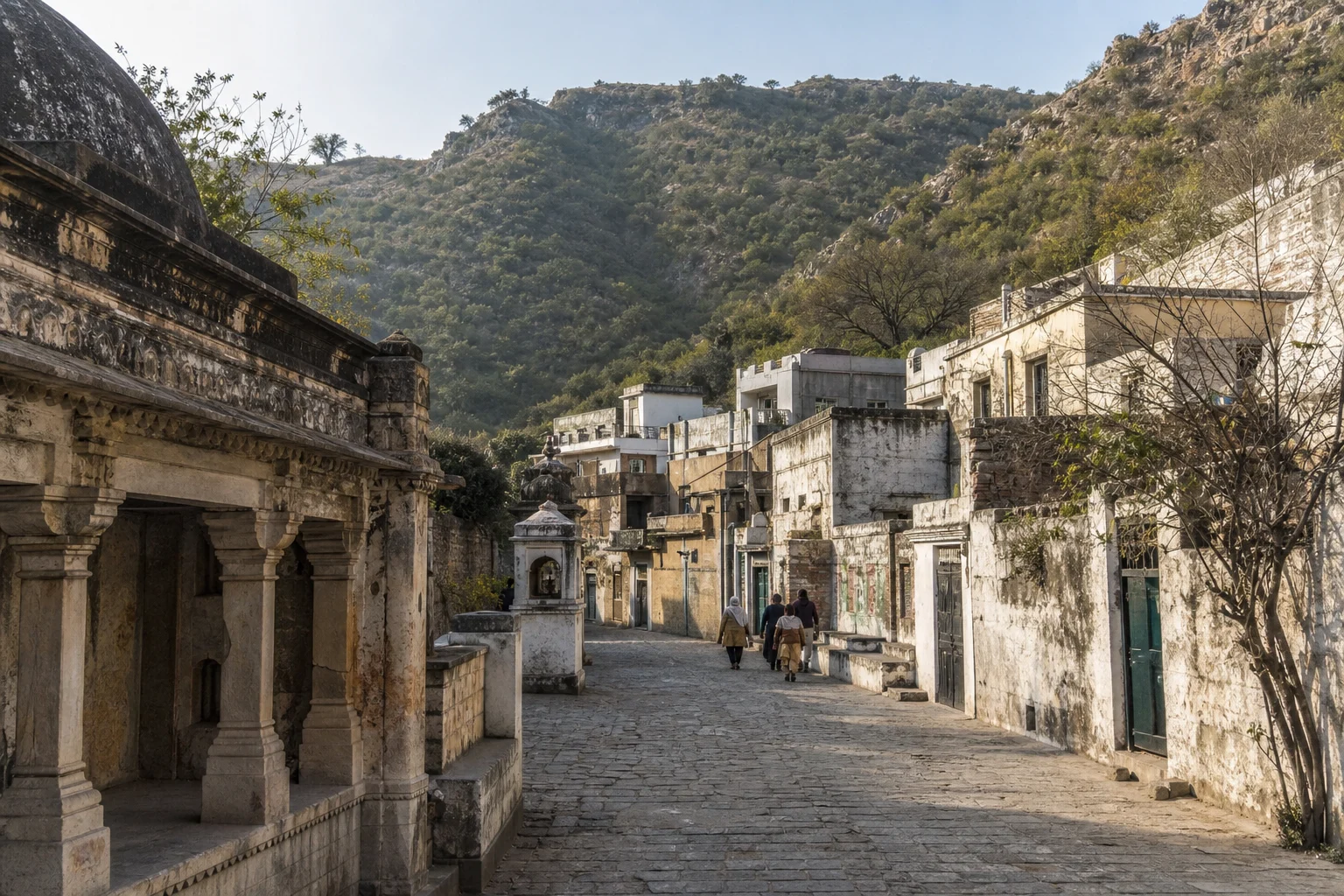
At the base of the hills, the atmosphere shifts between city and countryside. Small settlements, roadside tea stops and cultivated patches remind visitors that Islamabad’s green image has always depended on a wider lived landscape, not on landscaping alone. This is especially clear around the older village areas that sit close to the foothills. Their appeal is less about staged nostalgia than about noticing how quickly the planned city gives way to older patterns of dwelling and work.
Faisal Mosque and the Language of Modern Faith
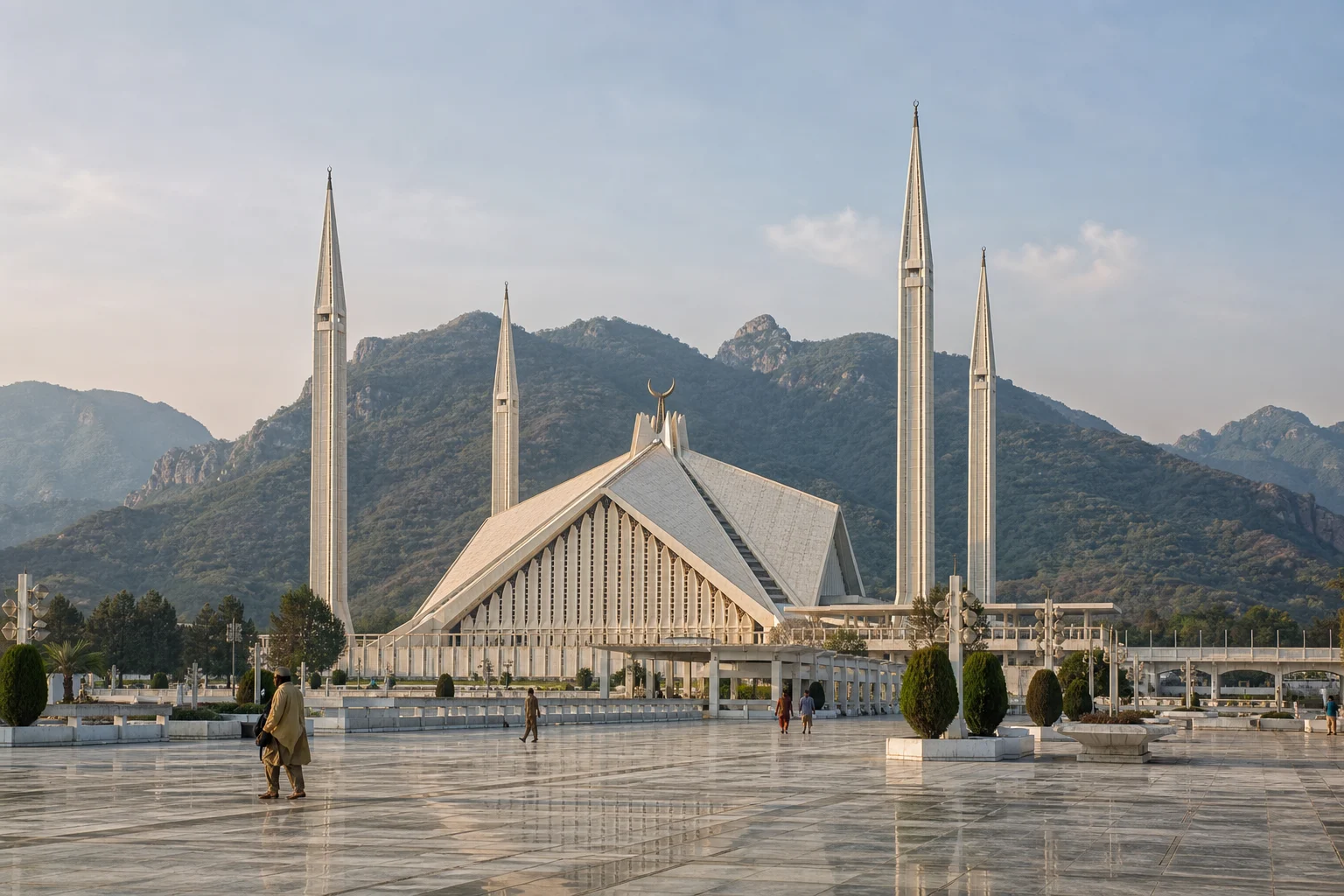
No building has shaped Islamabad’s visual identity more decisively than Faisal Mosque. Completed in 1986 to a design by Turkish architect Vedat Dalokay, it stands beneath the Margallas with a form that still feels startlingly modern. Instead of a large central dome, its prayer hall rises in sharply angled planes, often compared to a tent. Four slender minarets define the corners, giving the structure both vertical poise and an unmistakable silhouette.
The mosque is compelling because it does not imitate the past. Its design draws on an Islamic architectural vocabulary while responding to the dramatic geometry of its setting. The mountain ridge behind it is not incidental; it makes the building appear at once monumental and anchored. From a distance, the mosque reads almost as an extension of the landscape’s lines.
Visitors should remember that this is an active place of worship before it is a landmark. Modest dress, quiet conduct and sensitivity around prayer times are essential. A respectful visit is not hurried. Spend time observing how the open courtyards, pale surfaces and mountain light change the experience of the building, rather than treating it only as a photographic stop.
Places That Hold a National Story
Islamabad’s cultural institutions offer a useful correction to the idea that Pakistani heritage belongs only to ancient ruins or imperial monuments. At Lok Virsa, the National Institute of Folk and Traditional Heritage, the focus is on the country’s living cultural practices: regional dress, domestic objects, music, crafts and the visual languages of communities from across Pakistan. Its importance lies in the breadth of that frame. Pakistan is not a single cultural style, and the museum’s ethnographic approach invites visitors to see heritage as something made and remade in homes, workshops, festivals and performances.
The nearby Pakistan Monument, set on the Shakarparian Hills, presents a more symbolic national narrative. Its petal-like granite forms open around a central space, and its elevated setting looks over the Islamabad–Rawalpindi urban landscape. The monument is a product of the twenty-first century, but it uses the vocabulary of public memorial architecture to ask a longstanding question: how can a nation of many regions, languages and traditions picture itself as a whole? Whether one arrives for the structure, the museum or the view, it is a useful place to consider how public memory is created.
For a longer historical arc, the Islamabad Museum displays material from across the lands that now make up Pakistan, including prehistoric tools from the Soan Valley and objects associated with the Indus Valley and Gandharan worlds. Such collections are valuable precisely because they resist a narrow timeline. They show that the history of this region includes many faiths, artistic traditions, trade networks and forms of settlement.
Taxila: The Ancient Landscape Beyond the Capital
A visit to Islamabad becomes richer when it includes Taxila, in the wider Rawalpindi region. The archaeological landscape there is not a single ruin but a dispersed complex of settlement mounds, monasteries, stupas and later Islamic remains. Recognised as a World Heritage site, Taxila preserves evidence of a major centre whose development was shaped by connections between South Asia, Central Asia and the wider ancient world.
The scale of the place matters. At Taxila, history is not contained within one dramatic gateway or monument. The sites include the early city at Bhir Mound, the planned streets of Sirkap, the later fortified settlement of Sirsukh and Buddhist complexes such as Dharmarajika and Jaulian. Together they reveal changing models of urban life over many centuries. Hellenistic planning, Central Asian influences and Buddhist religious patronage appear not as isolated labels but as layers in a region of movement and exchange.
Approach Taxila with patience. Read site information carefully, avoid climbing on fragile masonry and resist the temptation to treat archaeological remains as theatrical scenery. Their power lies in their incompleteness: walls reduced to foundations, courtyards open to the sky and sculptural fragments that suggest the skill of lost workshops. The journey from Islamabad to Taxila also makes an important point about the capital itself. Islamabad may be young, but it stands within one of South Asia’s deepest historical landscapes.
A City Best Read Slowly
Islamabad rewards a slower itinerary. Begin with the hills in the early part of the day, when the air is often clearer and the city is still finding its pace. Visit Faisal Mosque with enough time to appreciate its setting. Give a separate afternoon to Lok Virsa and the Pakistan Monument, not because they offer a complete account of Pakistan, but because they reveal contrasting ways of representing it: through lived traditions on one hand, and national symbolism on the other.
Leave room for the ordinary city. Browse a sector market, pause for tea, notice how fruit sellers, bookshops, tailors and small restaurants give the planned grid its human scale. Food in Islamabad is shaped by the city’s role as a meeting point: one can find dishes and culinary influences associated with Punjab, Khyber Pakhtunkhwa, Kashmir and communities from elsewhere in Pakistan. The best approach is curious rather than extractive: ask politely, follow local customs and value the people who make a meal possible as much as the meal itself.
In a country often presented through its grandest mountains, oldest ruins or busiest historic cities, Islamabad offers another truth. Pakistan is also a place of careful planning, ecological pressure and possibility, modern design, everyday mobility and cultural plurality. Between the Margalla Hills and the ancient ground of Taxila, the capital becomes less a polished administrative image and more a meaningful threshold: one that opens onto the many histories and living landscapes of Pakistan.