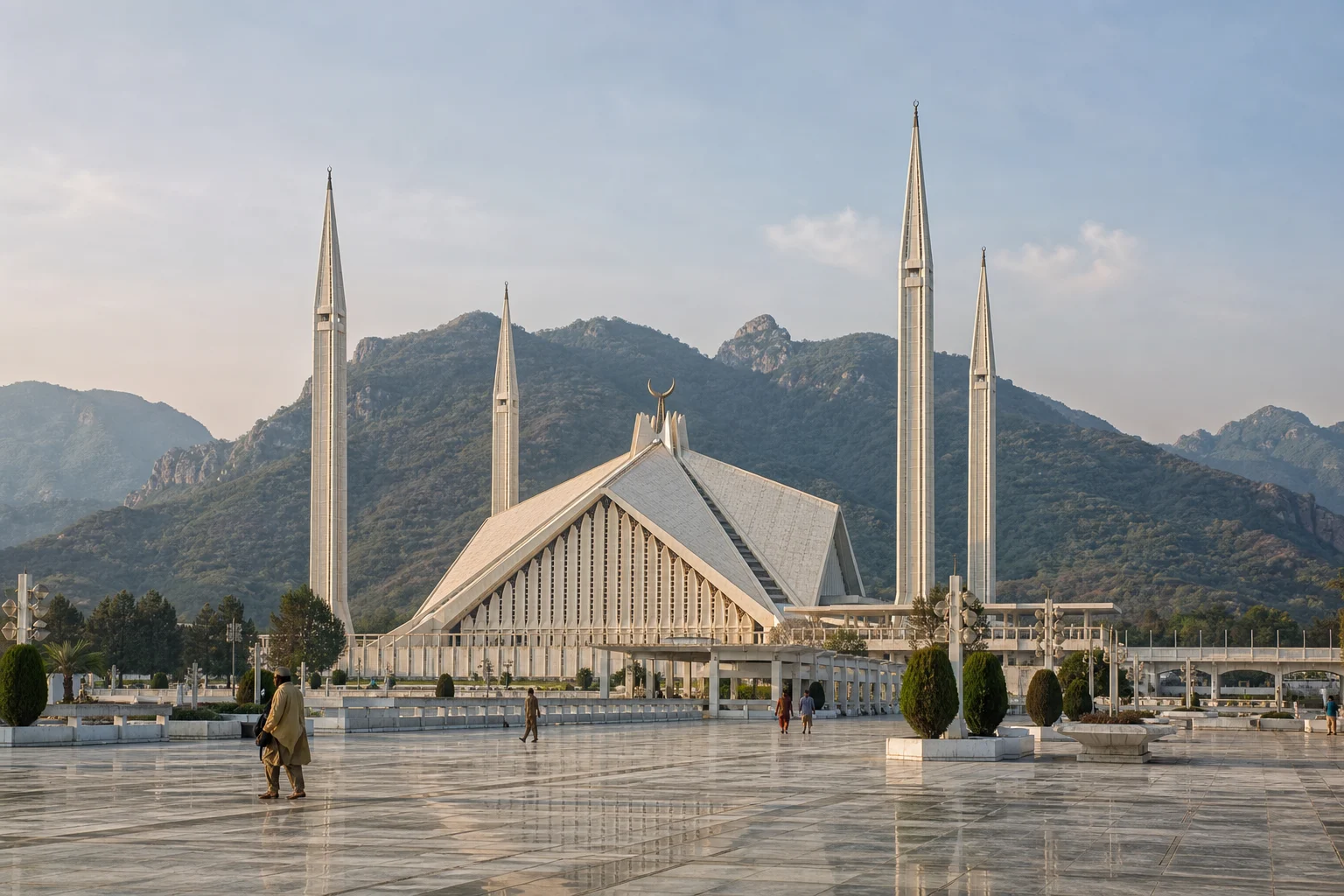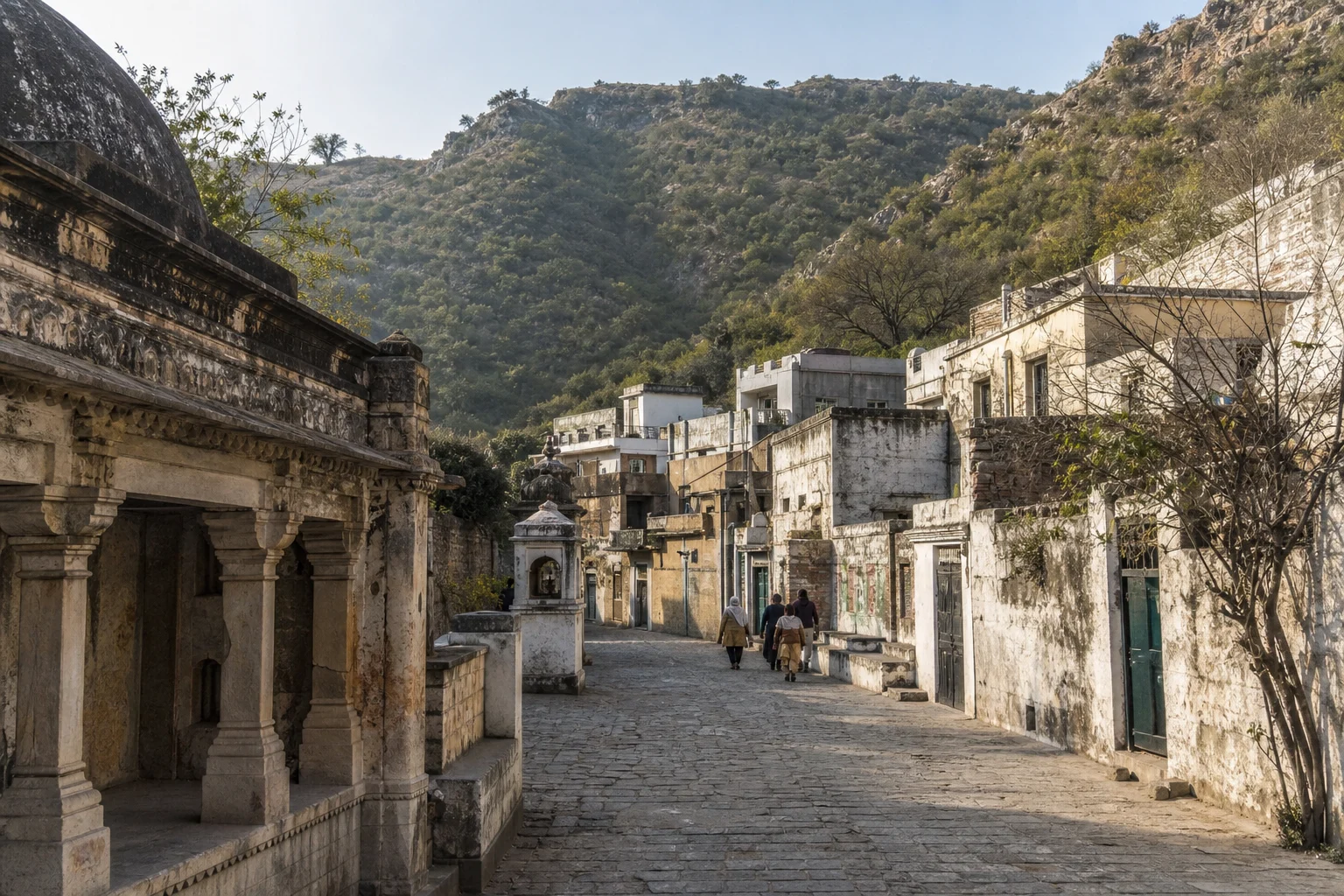
At the northern edge of Islamabad, where the ordered geometry of the capital begins to give way to the folds of the Margalla Hills, Saidpur Village occupies a different rhythm of time. Its lanes rise and turn beneath wooded slopes; watercourses, old masonry and low domestic buildings interrupt the modern city’s broad avenues. Here, Islamabad does not feel newly made. It feels layered.
Saidpur is frequently described as a heritage village, and the phrase is useful only if it is understood fully. This is not simply a preserved backdrop for an afternoon outing. It is a settlement with residents, routines and memories, shaped by centuries of change and by its later absorption into a capital city planned in the twentieth century. Its appeal lies in that tension: between village and metropolis, conservation and commerce, remembered past and daily life.
A village older than the capital
Islamabad is one of South Asia’s most recognisable planned cities, developed after Pakistan selected this region for a new federal capital in the late 1950s. Yet the territory in which it was built was never empty ground. It contained farms, shrines, small settlements and routes that belonged to the wider Potohar Plateau. Saidpur is among the places that make this earlier landscape visible.
The village is generally understood to have Mughal-era roots, and local accounts commonly connect its name with Said Khan of the Gakhar community, whose leaders held influence in the Potohar region during the Mughal period. Such narratives are important as part of the village’s inherited memory, though precise details of its early foundation are difficult to establish with certainty. What is clearer is that Saidpur developed as a long-inhabited rural settlement at the foot of the hills, with the kind of mixed agricultural, craft and trading life that sustained villages around Rawalpindi and the northern Punjab plateau.
Its setting mattered. The Margallas supplied a dramatic natural boundary, while the lower slopes and seasonal water channels created a sheltered environment for habitation. In an age before Islamabad’s sectors and boulevards, Saidpur belonged to a network of villages rather than to a city. That older geography remains legible in the way the settlement follows the contours of the land rather than a planner’s grid.
A small place with many inheritances
Saidpur’s best-known heritage structures include a Hindu temple complex, a gurdwara-associated building and a dharamshala, or travellers’ rest house. Together, they recall a time when Hindu, Sikh and Muslim communities formed part of the social fabric of the area. The buildings are modest in scale, but their presence has large meaning: they make visible the religious plurality that once marked many towns and villages across northern South Asia.
The surviving structures should not be treated as simple relics of separate, sealed communities. Villages are made through shared streets, labour, markets, wells, festivities and neighbourhood obligations. Saidpur’s architectural traces point to that intertwined civic life. They also ask visitors to recognise that heritage in Pakistan includes not only grand mosques, forts and mausoleums, but also the quieter evidence of communities that once worshipped, rested and gathered in the same locality.
Some popular retellings attach the village to prominent Mughal figures or describe ancient sacred ponds in its precincts. These stories circulate widely and contribute to Saidpur’s atmosphere, but they should be approached as local tradition unless supported by firm historical documentation. The deeper truth of the place does not depend on embellishment. Its value is already considerable: an old settlement, still inhabited, bearing material signs of a multi-faith past within sight of a modern national capital.
The texture of Potohar
To understand Saidpur, it helps to look beyond its most photographed corners. The village belongs culturally to the Potohar region, a plateau landscape extending around Rawalpindi and Islamabad, known for undulating terrain, rain-fed cultivation, stone, scrub forest and a vocabulary of domestic architecture adapted to slope and season.
Traditional buildings here were rarely designed as isolated monuments. Thick walls moderated temperature; courtyards created spaces for work and family life; narrow passages offered shade; thresholds and verandas negotiated the boundary between household and street. Decorative details could be restrained but expressive: carved or moulded openings, painted surfaces, timber doors and brickwork that gained character through weather rather than polish.
Much of this vernacular fabric has changed over time, as it has in villages across Pakistan. Concrete construction, altered property needs and tourism-related development have transformed the visual character of parts of Saidpur. Still, its spatial logic survives in the compressed scale of its lanes and the sense that buildings are part of a collective settlement rather than independent objects. The village is best read slowly, on foot, with attention to level changes, old walls and the ways a hillside settlement makes room for everyday life.
Restoration, reinvention and the question of authenticity
In the early twenty-first century, Saidpur was redeveloped as a heritage and visitor destination. The initiative repaired and repurposed parts of the historic core, improved public-facing spaces and brought new commercial activity to an area that had long been part of Islamabad’s expanding urban edge. For many residents of the capital, it offered a rare encounter with an older built environment close to the city centre.
But preservation is never neutral, especially when a living village becomes a destination. Architectural researchers who have examined Saidpur’s redevelopment have raised important questions about commercialisation, altered building character and the extent to which local residents participated in decisions affecting their neighbourhood. These questions matter because heritage is not merely the restoration of surfaces. It is also continuity: who remains, whose stories are heard, what forms of work survive and whether the everyday life of a place can endure alongside its new public image.
Saidpur therefore offers a useful lesson in the complexity of conservation. A repaired façade may invite visitors to notice a historic place; it cannot alone preserve the social world that produced it. Good heritage care must make room for both. It should protect significant structures, support residents, respect the setting of the Margalla foothills and avoid turning history into a decorative theme.
The Margallas as a presence, not a backdrop
The village’s relationship with the Margalla Hills is central to its character. The hills do more than provide a scenic horizon. They determine the scale, weather and mood of the place. Light changes quickly across their ridges; after rain, the greenery intensifies; in drier months, stone and dust become more prominent. The rise of the terrain gives Saidpur a sense of enclosure unusual in the open, planned expanse of Islamabad.
This proximity also calls for care. The Margallas are an ecologically significant landscape, and development at their foot must be attentive to natural drainage, vegetation and the pressures created by heavy visitation. In a place where ravines and seasonal flows are part of the terrain, water is not an inconvenience to be hidden; it is part of the landscape’s original design.
For visitors, this is a reminder to look beyond the village’s built heritage. Notice the hillside above the roofs, the sound of birds and running water when conditions allow, the vegetation in crevices and along paths, and the way settlement and mountain meet. Saidpur makes most sense when understood as part of a larger cultural landscape rather than a self-contained attraction.
How to visit with attention
Saidpur rewards curiosity more than haste. Arrive with time to walk, observe and allow the place to be more than a dining stop. The heritage buildings deserve quiet respect; they are connected to living religious traditions and to communities whose histories extend beyond the visible structures. Dress and behave with consideration, ask before photographing people or private homes, and remember that a village street is not a stage set.
It is also worth resisting the urge to judge Saidpur by an impossible standard of untouched antiquity. It is neither a frozen medieval settlement nor simply a leisure precinct. It is a changing urban village, carrying the marks of repair, adaptation and contest. That is precisely what makes it instructive. Pakistan’s heritage is often found not in perfect preservation, but in the coexistence of old forms and new needs.
Before travelling, visitors should check current access arrangements and local conditions, particularly during periods of heavy rain. They should avoid leaving litter, keep noise modest and support small local enterprises thoughtfully. The most meaningful visit is one that leaves the village’s dignity intact.
What Saidpur reveals about Islamabad
For all its modernity, Islamabad has never been only a modern city. Its formal avenues, diplomatic enclaves and public institutions sit within a territory shaped by older villages, pilgrimage routes, agricultural memory and the long human history of the Potohar Plateau. Saidpur is one of the clearest places in which those layers come into view.
It challenges the familiar image of the capital as a city without a past. Beneath the Margallas, the village holds a more complicated account: of shared religious inheritance, local building knowledge, migration and change, and the difficult work of conserving a place while people continue to live around it. Its lanes may be small, but they open onto a larger understanding of Pakistan.
To stand in Saidpur is to see that history is not always distant or monumental. Sometimes it survives in a slope, a courtyard, a temple wall, a remembered name and the stubborn continuity of a village at the edge of a growing city.