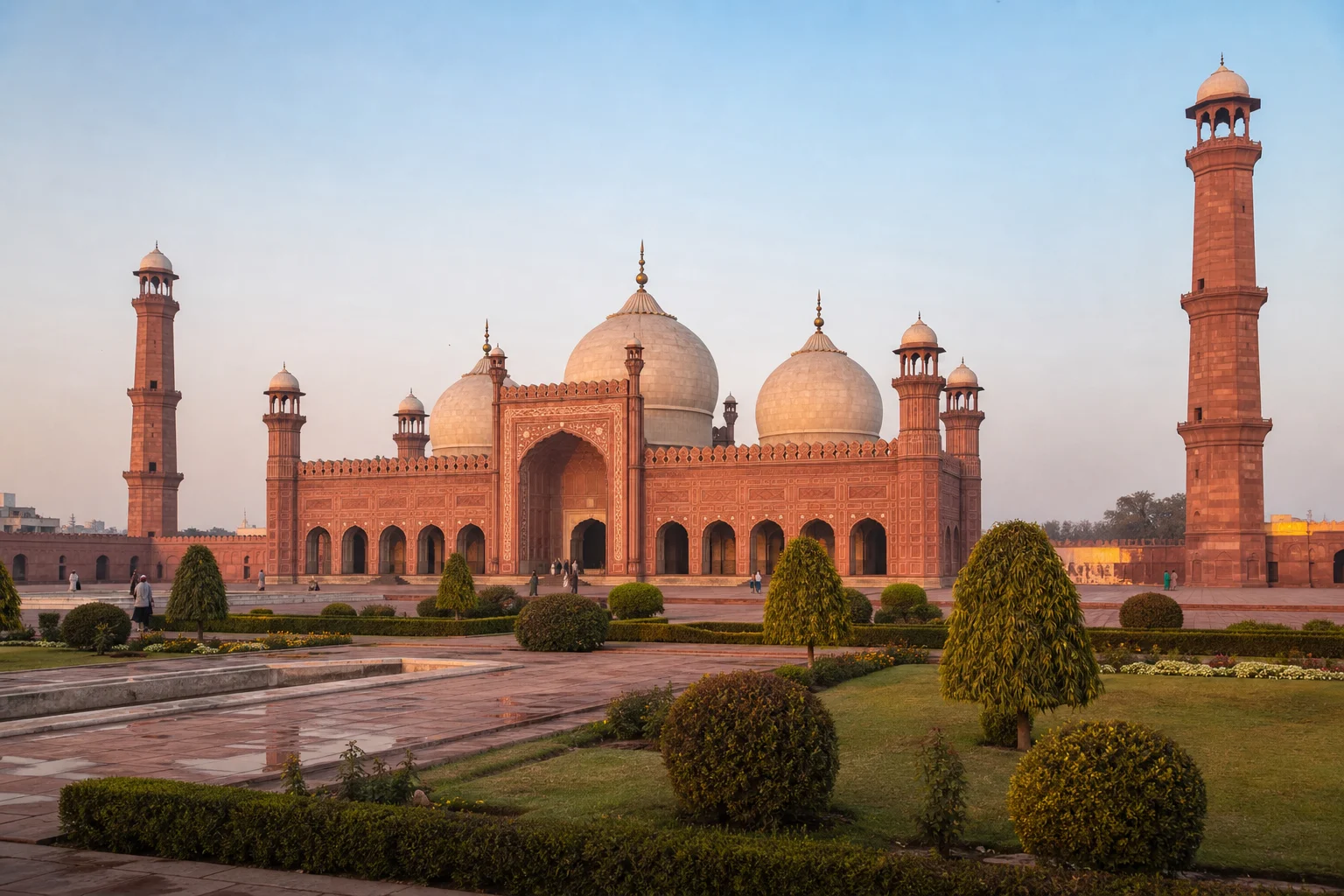
Few buildings announce Lahore with such assurance as the Badshahi Mosque. Its great red sandstone mass rises beside the old city, crowned by three pale marble domes and framed by lofty minarets. From a distance, it appears almost elemental: a field of warm stone, a sweep of sky, an outline that has become inseparable from the city’s image of itself.
Yet the Badshahi Mosque is not simply an object to be admired from afar. It is a working place of worship, a masterpiece of late Mughal architecture and a structure marked by the changing fortunes of Lahore. Its story moves from imperial confidence to neglect and military use, then to major twentieth-century restoration. To stand in its courtyard is to encounter not one frozen past, but several centuries of the city’s layered life.
An imperial mosque for Lahore
Badshahi means “imperial” or “royal”, and the name signals the scale of the ambition behind the mosque. It was commissioned by the Mughal emperor Aurangzeb Alamgir in 1671, under the supervision of Muzaffar Hussain, widely known as Fidai Khan Koka. The building was completed in the early 1670s; an inscription on the gateway records the year 1084 AH, corresponding to 1673–74.
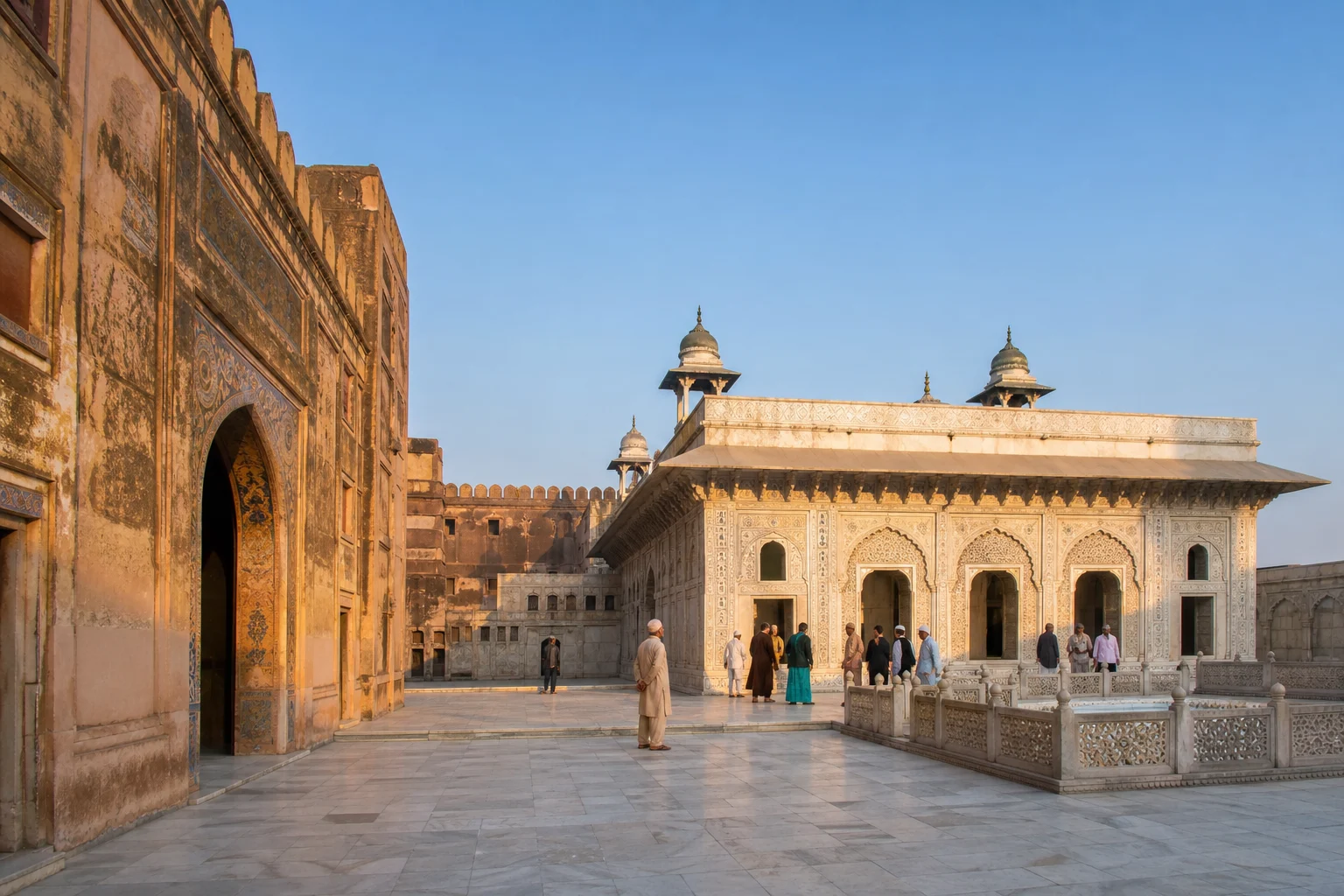
Lahore was already one of the great cities of the Mughal world. For generations, emperors and nobles had enriched it with gardens, caravanserais, tombs, gateways, mosques and additions to the fort. Across Hazuri Bagh stands the Alamgiri Gate of Lahore Fort, also associated with Aurangzeb’s reign. Together, gate, garden enclosure, fort and mosque make a carefully composed historical setting rather than a collection of isolated monuments.
The mosque came late in the Mughal architectural tradition, after the celebrated age of Akbar, Jahangir and Shah Jahan. It does not pursue delicacy at every turn. Instead, it uses disciplined symmetry and monumental scale to create its effect. The result is an architecture of ceremony: broad, legible and made for a large congregational community.
The journey from gate to prayer hall
The experience begins with ascent. A flight of 22 steps leads to the vast eastern gateway, itself a substantial, multi-level building rather than a mere entrance. Its red sandstone surfaces are articulated with carved panels and restrained marble details. The gateway prepares the visitor for a change of pace: Lahore’s streets and traffic recede, while the space beyond opens with remarkable calm.
Passing through the gate, one enters a huge rectangular courtyard. The scale can be difficult to grasp in photographs, where the court often appears as empty foreground. On foot, it is understood as a carefully controlled public space. Its broad sandstone floor creates room for worshippers to gather, while arcades along the edges give the enclosure a firm architectural boundary. At its centre sits the ablution pool, a reminder that water, cleansing and preparation are integral to the mosque’s ritual life.
At the western side of the courtyard, the prayer hall forms the visual and spiritual focus. The direction is not accidental: Muslim worshippers face the qibla, toward the Kaaba in Makkah, and the building’s entire sequence—gate, court, hall—draws the body and the eye toward that orientation. The central entrance to the hall is set within a tall rectangular frame, while a series of arches extends outward on either side. Above, the three marble-clad domes form the mosque’s most familiar silhouette.
Red sandstone, white marble, living surfaces
The Badshahi Mosque’s power lies partly in contrast. Its principal exterior material is red sandstone, a favoured Mughal medium whose deep colour gives the building gravity even under Lahore’s changing light. White marble is used for domes, cupolas, borders and inlaid ornament. The meeting of red and white is not merely decorative: it establishes a rhythm of weight and brightness, solidity and lift.
The four great octagonal minarets stand at the corners of the outer enclosure, anchoring the whole composition. Smaller octagonal minarets rise at the prayer hall. Their repetition makes the mosque feel balanced from every angle. This is architecture that works at a distance as well as close up: the minarets establish the skyline, while the inlay, carving and moulded details reward slower observation.
Inside the prayer hall, monumentality gives way to intricacy. Marble inlay, carved plasterwork and fresco decoration animate the surfaces. Floral and geometric patterns move across arches and ceilings, showing that Mughal grandeur was never only a matter of size. The handwork invites a nearer gaze, while the spacious hall keeps the atmosphere composed rather than crowded with ornament.
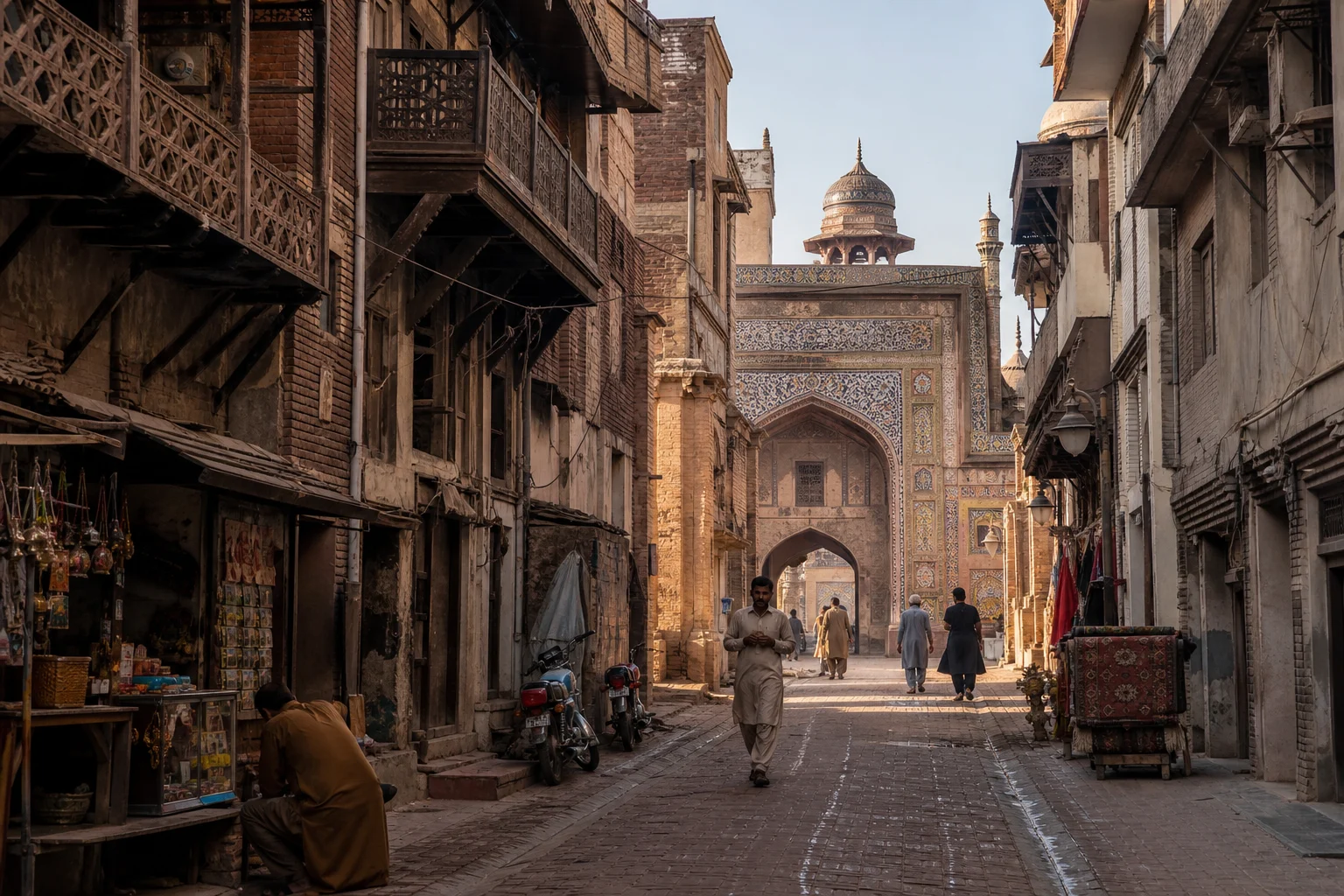
It is useful to see the mosque not as a solitary achievement but as part of Lahore’s wider architectural conversation. The nearby Wazir Khan Mosque is celebrated for its intensely coloured tilework and decorative richness. Badshahi, by comparison, is more austere in its palette, but no less expressive. One offers intimacy and intricate colour; the other commands space through proportion, stone and light. Together they reveal the range of seventeenth-century Lahore.
A monument shaped by changing rule
Like much of Lahore’s heritage, the mosque passed through periods when its original purpose was interrupted. After Mughal authority weakened, it was used for military purposes under successive Sikh and British administrations. Such changes affected the building and altered its relationship with the city around it. The mosque’s survival should not be mistaken for an uninterrupted condition of care.
Its recovery was gradual. A substantial restoration programme undertaken between 1939 and 1960 sought to revive the mosque’s historic form, including extensive work to its surfaces and courtyard. Restoration cannot turn time backwards: a living monument inevitably bears the record of repair, replacement and changing stewardship. But this work helped return the Badshahi Mosque to the dignified presence that visitors recognise today.
The site also belongs to a broader heritage precinct. Lahore Fort and the Shalimar Gardens are recognised together for their outstanding Mughal artistic and aesthetic achievements, while the Badshahi Mosque—immediately beside the fort—forms an essential part of that historic setting. The proximity matters. The fort speaks of courtly power and administration; the mosque speaks of public worship and imperial ceremony. Hazuri Bagh, between them, is the quiet hinge that allows these histories to face one another.
More than a postcard view
For many visitors, the most familiar image is from across Hazuri Bagh: the mosque’s domes beyond the garden, the fort’s Alamgiri Gate nearby, pigeons crossing the air. It is a beautiful view, but it can flatten the place into scenery. The more revealing encounter happens slowly—watching how the massive gateway frames the courtyard, noticing marble lines against red stone, listening to footsteps soften in the prayer hall, or seeing worshippers and families move through a space built more than three centuries ago.
Badshahi Mosque also sits near the tomb of Muhammad Iqbal, whose poetry remains central to Pakistan’s literary and intellectual life. The tomb’s modest scale beside the mosque’s vast architecture creates a telling contrast. Lahore’s historic quarter does not arrange its memories into a single narrative. Mughal architecture, Sikh-era monuments, colonial traces, modern national memory and everyday religious life exist within walking distance of one another.
This density is one reason Lahore cannot be understood through one monument alone. Still, the Badshahi Mosque offers an unusually clear entrance into the city’s character: confident yet layered, ceremonial yet lived in, capable of carrying beauty alongside difficult histories of change.
How to encounter it respectfully
The mosque remains an active religious space, not a museum set apart from daily life. Visitors should dress modestly, remove shoes where required, keep voices low and avoid walking in front of people at prayer. Photography may be restricted in certain areas or at particular times, so it is best to ask attendants before taking close portraits or entering sensitive spaces. Congregational prayer periods deserve particular care.
It is equally important to look beyond the dramatic façade. Notice the worn thresholds, the geometry of the paving, the changing tones of sandstone after rain or at late afternoon, and the work of maintenance that allows a centuries-old building to remain in use. Heritage survives not only through grand restoration campaigns, but through ordinary habits of respect: leaving no litter, avoiding damage to carved surfaces, and recognising that sacred places are shared with the people who pray there.
The grandeur that endures
The Badshahi Mosque was built to project imperial magnificence, and it still does. But its deepest meaning now lies in what it has outlived. Dynasties ended, uses changed, stone weathered and restorers intervened. Through it all, the mosque remained present in Lahore’s physical and emotional landscape.
Its grandeur is therefore not only Mughal. It is also Lahori: carried forward by worshippers, craftspeople, conservators, caretakers and generations of citizens who continue to recognise the building as part of their city’s inheritance. In the vast courtyard, beneath the white domes, the past is not distant. It remains open to the sky.