The Walled City of Lahore is not a sealed historical quarter, nor a museum arranged around a single glorious period. It is an inhabited urban world: dense, resourceful, noisy, devotional, commercial and deeply layered. Behind its celebrated gateways lie streets that contract into lanes, lanes that open unexpectedly into chowks, and courtyard houses whose worn brick, carved timber and shaded verandas carry traces of many generations.
For visitors, the temptation is to treat the old city as a sequence of landmarks: a gate, a mosque, a fort, a market. But Lahore’s historic core is better understood as a living fabric. Its heritage is found as much in the practical choreography of neighbourhood life as in monumental architecture: shopkeepers lifting shutters, deliveries threading through narrow passages, families meeting at doorways, worshippers entering a mosque courtyard, and craftspeople maintaining skills that still belong to the city’s everyday economy.
The walls that once defined this place have largely disappeared, but the idea of the enclosed city remains powerful. It survives in names, routes, habits of movement and the enduring pull of the gates.
A city shaped by passage
Lahore has occupied a strategic place in the Punjab for centuries, and its historic core was repeatedly rebuilt, expanded and transformed under successive rulers. The city acquired particular architectural and cultural importance under the Mughals, when Lahore served at times as an imperial centre. Fortifications in baked brick, a network of gates, major mosques, gardens, caravan facilities and market streets gave the city a formal urban presence while also supporting a large and active population.
The familiar account of Lahore’s thirteen gates belongs principally to this fortified Mughal city. Gates were not merely ornamental thresholds. They regulated movement, marked routes to other towns and regions, accommodated guards and travellers, and connected the urban interior with roads, markets and surrounding settlements. Their names still function as an everyday map of old Lahore, even where the original architecture has vanished.
Later periods changed the city profoundly. Under Sikh rule, Lahore gained new buildings, residences and religious sites, while existing Mughal structures continued to shape its urban setting. During the British period, much of the defensive wall was removed and the Circular Road was developed around the old city. Several gates were rebuilt or altered, often in forms that differed from their Mughal predecessors. The Walled City seen today is therefore not an untouched imperial enclosure. It is a historical palimpsest, carrying Mughal, Sikh, colonial and post-Partition layers within one intensely inhabited area.
The gates: memory at the edge of the old city
The gates offer a useful beginning, but they should not be mistaken for a complete boundary line still standing in stone. Some survive as substantial structures; others endure chiefly as place names, market districts or neighbourhood identities. Their varied condition is itself part of Lahore’s story.
Delhi Gate, on the eastern side of the historic city, remains one of the most important entrances for understanding the old urban landscape. Its name recalls the route towards Delhi, while the streets beyond it lead towards one of Lahore’s most significant Mughal ensembles. The gate is a reminder that cities were once read through roads: a gateway announced not only where one entered, but also the larger world to which a city was connected.
From Delhi Gate, the route known as the Shahi Guzargah, or Royal Trail, moves through a sequence of commercial and religious spaces associated with Mughal Lahore. It is a short distance on a map, yet its density makes it feel expansive. Shop fronts, balconies, traffic, pedestrians and historic facades share a limited width. This is an urban route in the fullest sense: not a ceremonial corridor preserved apart from life, but a street where heritage and ordinary business must coexist.
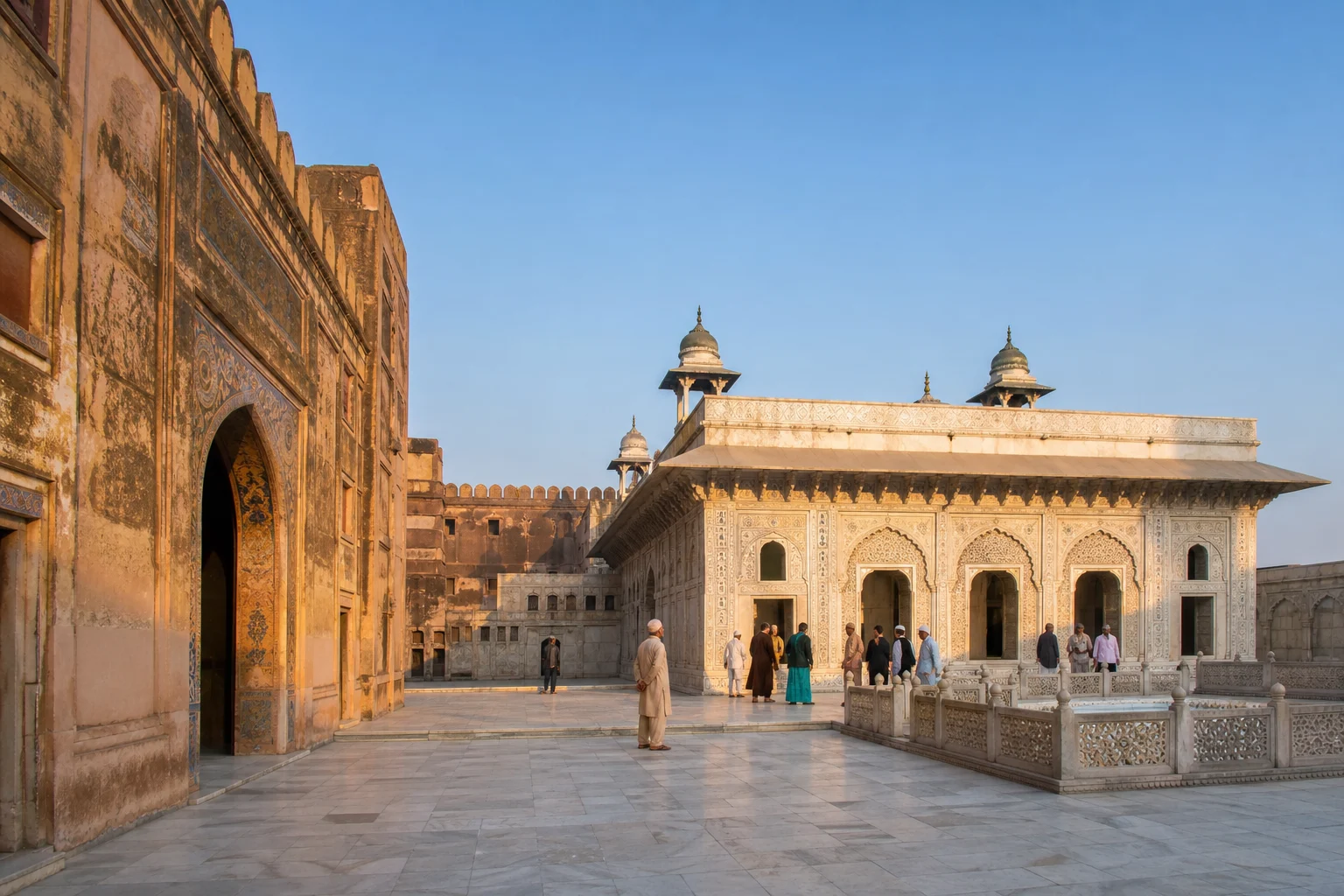
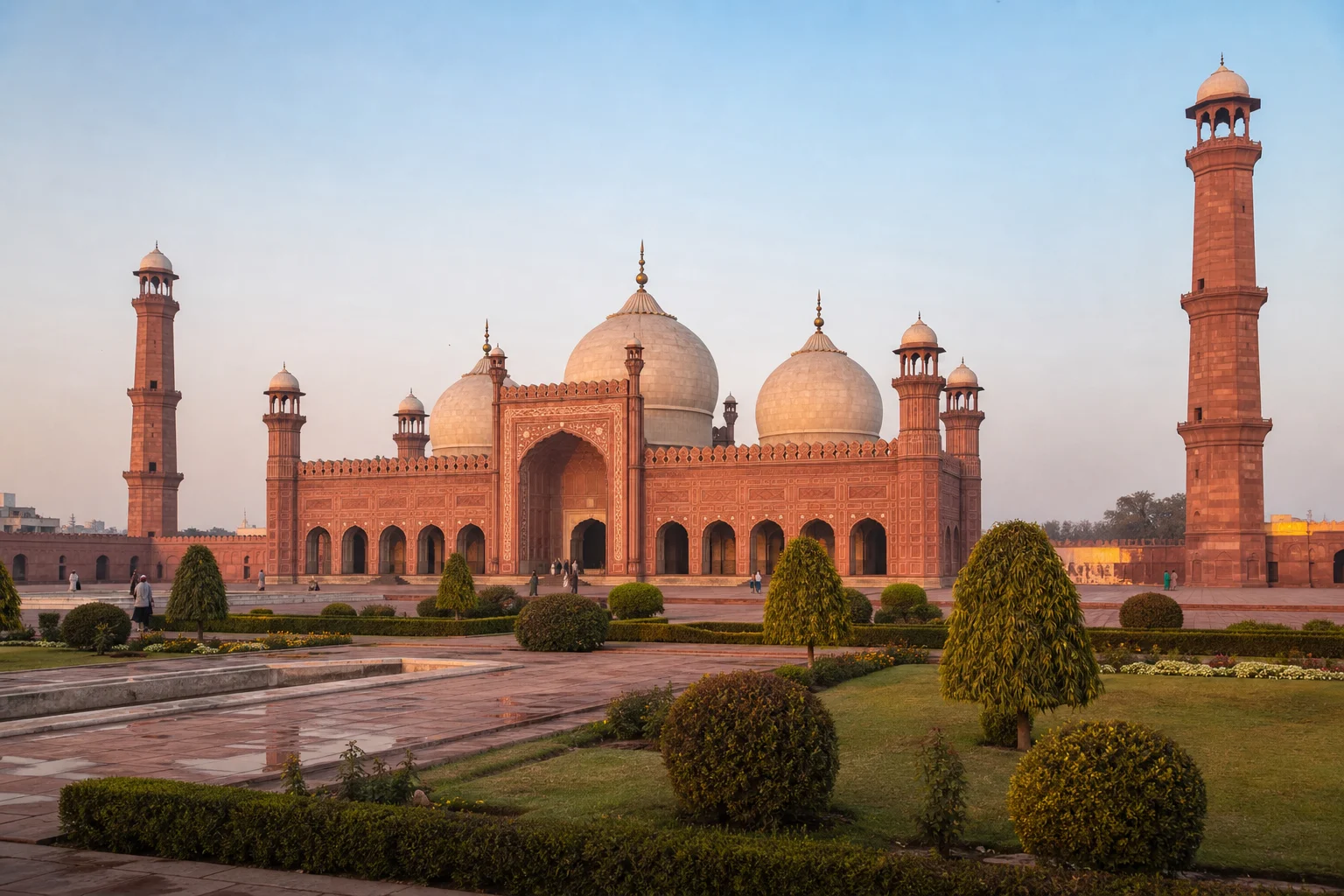
Roshnai Gate, near Lahore Fort and Badshahi Mosque, is especially evocative. Its name is commonly translated as the Gate of Lights, reflecting the tradition that this approach was illuminated in the evenings. It remains the clearest surviving reminder of the old fortified city’s monumental edge. Passing through it, one senses the proximity of several eras at once: the Mughal fort, the Badshahi Mosque, Hazuri Bagh, the samadhi of Maharaja Ranjit Singh and the dense quarters of the old city close by.
Lohari Gate and Bhatti Gate lead into districts where commerce, food and residential life are tightly interwoven. Kashmiri Gate recalls the road towards Kashmir; Sheranwala Gate preserves the memory of lions once associated with the entrance during the Sikh period. Elsewhere, names such as Akbari, Mochi, Shah Alami, Masti, Taxali and Yakki retain historical force even when their gate structures no longer survive intact. These names should be approached with care. Local explanations for their origins are often vivid, but some belong to oral tradition, disputed etymology or later retelling rather than settled historical fact.
The gates, then, are not a checklist of monuments. They are a vocabulary through which Lahore remembers its former walls.
Where the street becomes architecture
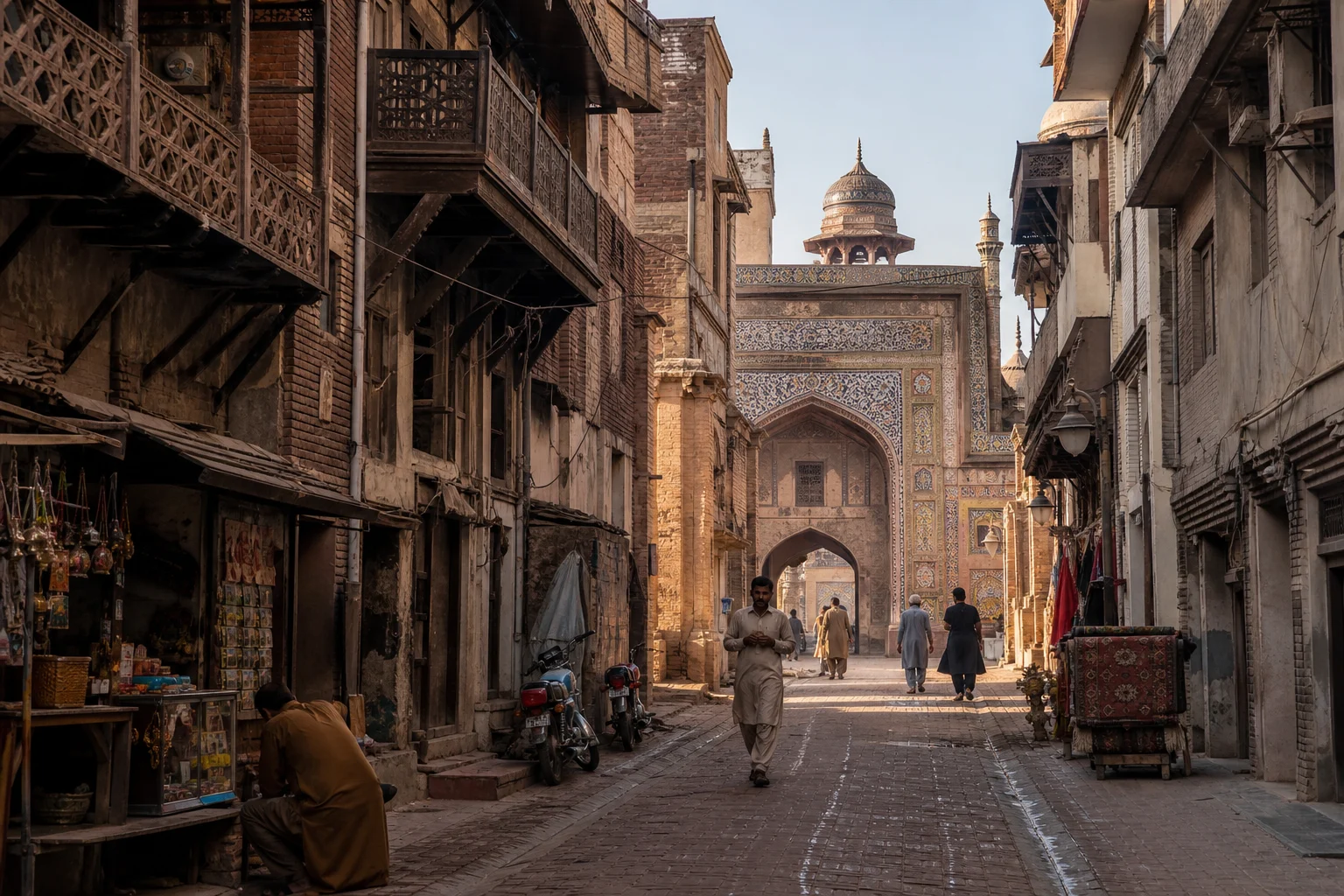
Inside the old city, the street is one of the great buildings. It provides shade, trade, drainage, social contact and access to homes, religious spaces and workshops. Its scale is intimate. Balconies lean above the lane, upper rooms catch light, and projecting eaves create a fluctuating line between private house and public passage.
This compactness is often described as congestion, and it can indeed create serious pressures on infrastructure, sanitation, accessibility and the maintenance of old buildings. Yet compactness is also part of the old city’s social intelligence. Neighbours live close enough to recognise one another’s routines. Shops serve both passing customers and nearby households. A small chowk can become a point of orientation, a meeting place, a site of worship, a delivery hub and an informal public room.
Historic havelis are among the most compelling features of this fabric. Their scale varies greatly, from ambitious residences associated with elites to more modest courtyard houses adapted over time for multiple households or commercial use. A haveli is not simply a grand old mansion. It is a way of organising life around light, air, family space and controlled access from the street. In many cases, the original domestic patterns have changed, but the architectural logic remains visible in internal courtyards, staircases, timber doors and layered façades.
The old city’s architectural character also depends on materials. Brick, lime plaster, timber, painted surfaces and glazed tile all require forms of knowledge that cannot be replaced by a quick coat of modern cement. Conservation is therefore not only about saving a picturesque facade. It depends on understanding how historic structures were made, how moisture moves through old walls, how decorative surfaces age, and how skilled craftspeople can repair rather than erase them.
Wazir Khan Mosque and the art of an urban monument
No building expresses the meeting of monument and neighbourhood more fully than the Wazir Khan Mosque. Commissioned in 1634 by Hakim Ilm al-Din Ansari, widely known as Wazir Khan, it stands along the historic royal route inside the Walled City. Its entrance, courtyard, minarets and prayer hall are celebrated for their fresco painting, tilework and calligraphy. Yet the mosque’s power also lies in its urban setting. It is not isolated behind a distant perimeter; it rises from a working quarter whose shops, passages and surrounding buildings give it a lived context.
The mosque includes the tomb of the Sufi saint Miran Badshah in its courtyard, a reminder that Lahore’s religious architecture has often brought together worship, memory, teaching, trade and patronage. Its decorative richness can appear overwhelming at first: floral panels, geometric arrangements, Quranic inscriptions and painted surfaces draw the eye in many directions. Looking slowly reveals a disciplined visual order, in which colour and calligraphy shape both devotion and movement through space.
Nearby stands the Shahi Hammam, a 17th-century public bath commissioned by Wazir Khan. Its survival is significant because it broadens the usual image of Mughal architecture beyond forts and mosques. A hammam belonged to civic life: cleansing, rest, sociability and the practical infrastructure of a major city. Its rooms, domes and carefully managed light suggest an urban culture in which public facilities could be architecturally sophisticated as well as useful.
Conservation work in this quarter has demonstrated what patient restoration can achieve, especially where it is linked to improved streets, drainage and public space. But the larger lesson is more demanding. Restoring an important monument is only one part of caring for a historic city. The homes, lanes, services and livelihoods around it matter just as much.
Markets, makers and the daily city
The Walled City’s bazaars are not decorative remnants of commerce; they are among the engines that keep the area alive. Wholesale trade, household goods, textiles, food ingredients, metalwork, jewellery, shoes, religious items and countless small services have long found space within the old city’s compact streets. The character of each market shifts according to its specialities, its connections to surrounding neighbourhoods and the rhythms of the day.
Craft traditions have also left their mark in the names of lanes and mohallas, some recalling occupations connected with metal, leather, bows, arrows, embroidery or other trades. Not every historical craft survives in its earlier form, and it would be misleading to suggest an unbroken world of unchanged tradition. Lahore is a modern metropolis, and its old city changes with consumer habits, technology and migration. Still, the concentration of specialised skill remains one of its defining qualities.
Food is another powerful expression of this living heritage, but it should be read beyond reputation. A breakfast stall, a milk shop, a sweetmaker or a kebab vendor can be part of a family livelihood, a neighbourhood routine and a local economy built on trust and repetition. The old city’s food culture is compelling precisely because it is embedded in daily life. Its value does not depend on turning every street into a spectacle.
Conservation without freezing the city
The central challenge of the Walled City is not whether it should change. It has always changed. The challenge is how change can respect the city’s inherited form while improving the lives of the people who live and work there.
Historic buildings need repair; residents need safe homes and reliable services; businesses need access; public spaces need to function for women, children, older people and workers as well as visitors. These aims can conflict when conservation is treated as surface beautification or when redevelopment treats historic neighbourhoods as empty land awaiting replacement. Good urban conservation begins by accepting that the old city is a home and workplace before it is a destination.
That principle also asks visitors to behave differently. Walk slowly, dress and speak respectfully around places of worship, ask permission before photographing people or private homes, and remember that narrow lanes are working spaces rather than open-air sets. Buy thoughtfully from small businesses when possible, avoid blocking entrances, and check current local conditions before planning a visit. The most meaningful encounter with the Walled City often comes from attention rather than speed.
Lahore’s unfinished inheritance
To enter the Walled City is to encounter Lahore at close range: not only its imperial imagination, but its ability to absorb time. A Mughal mosque faces a busy lane; a Sikh-era structure stands within a changing neighbourhood; a colonial intervention is folded into a much older street pattern; a restored monument depends on the labour of contemporary conservators and local residents.
This is why the Walled City matters far beyond nostalgia. It shows Pakistan as a place of urban continuity, craft knowledge, religious and architectural complexity, and everyday resilience. Its walls may no longer encircle Lahore in the way they once did, but its gates still lead into a city whose heritage is not behind glass. It is carried through the streets, renewed every morning by the people who keep them in use.