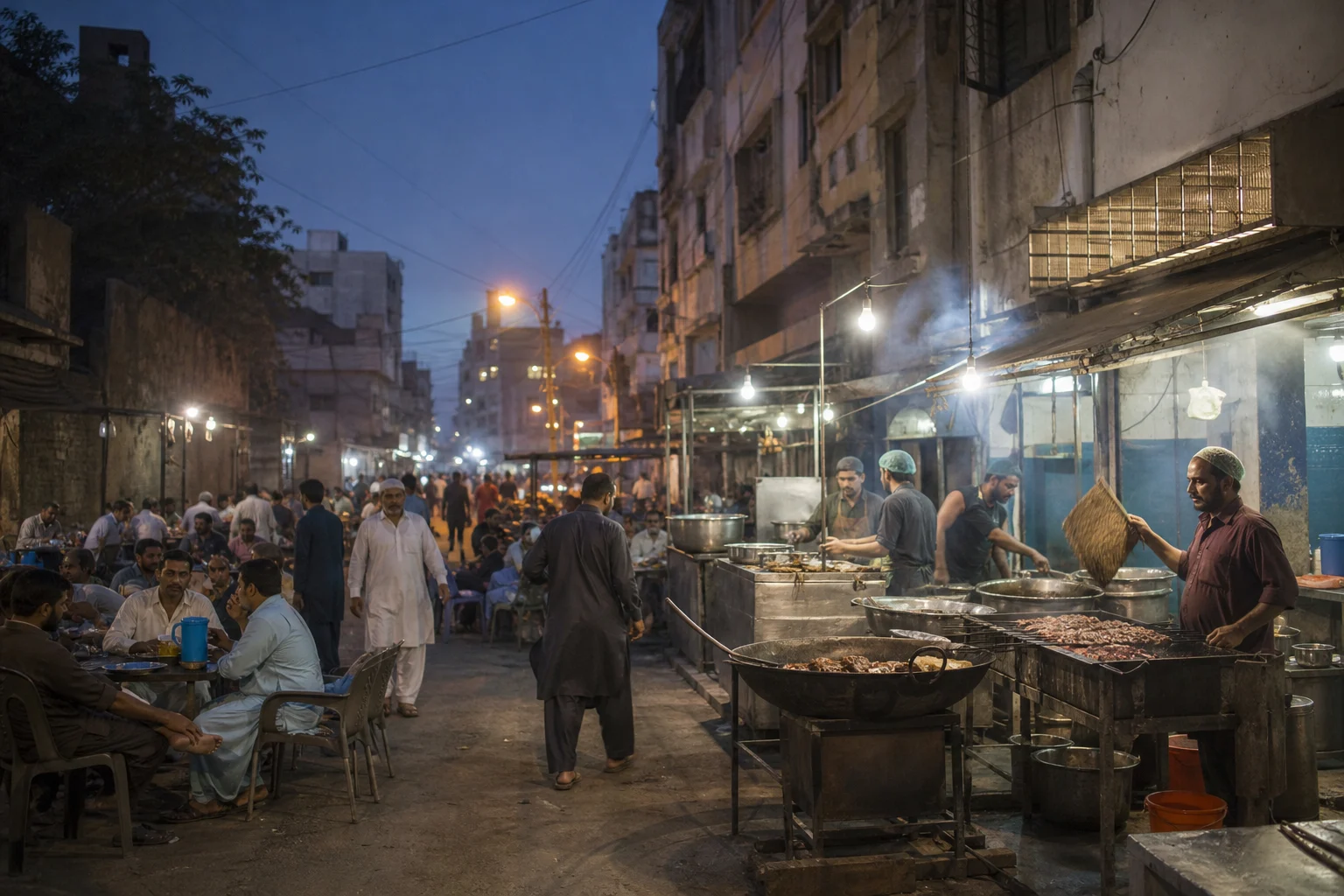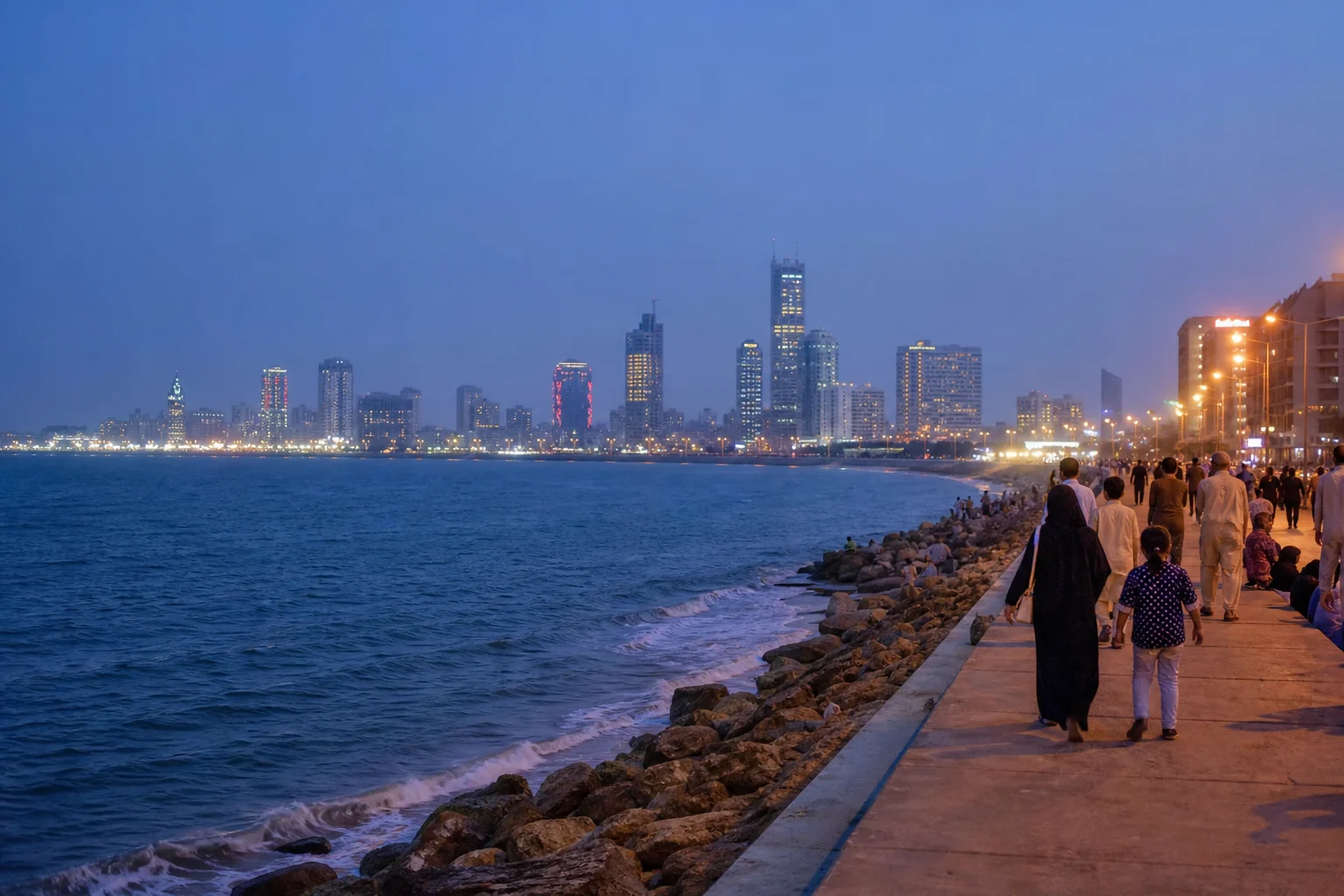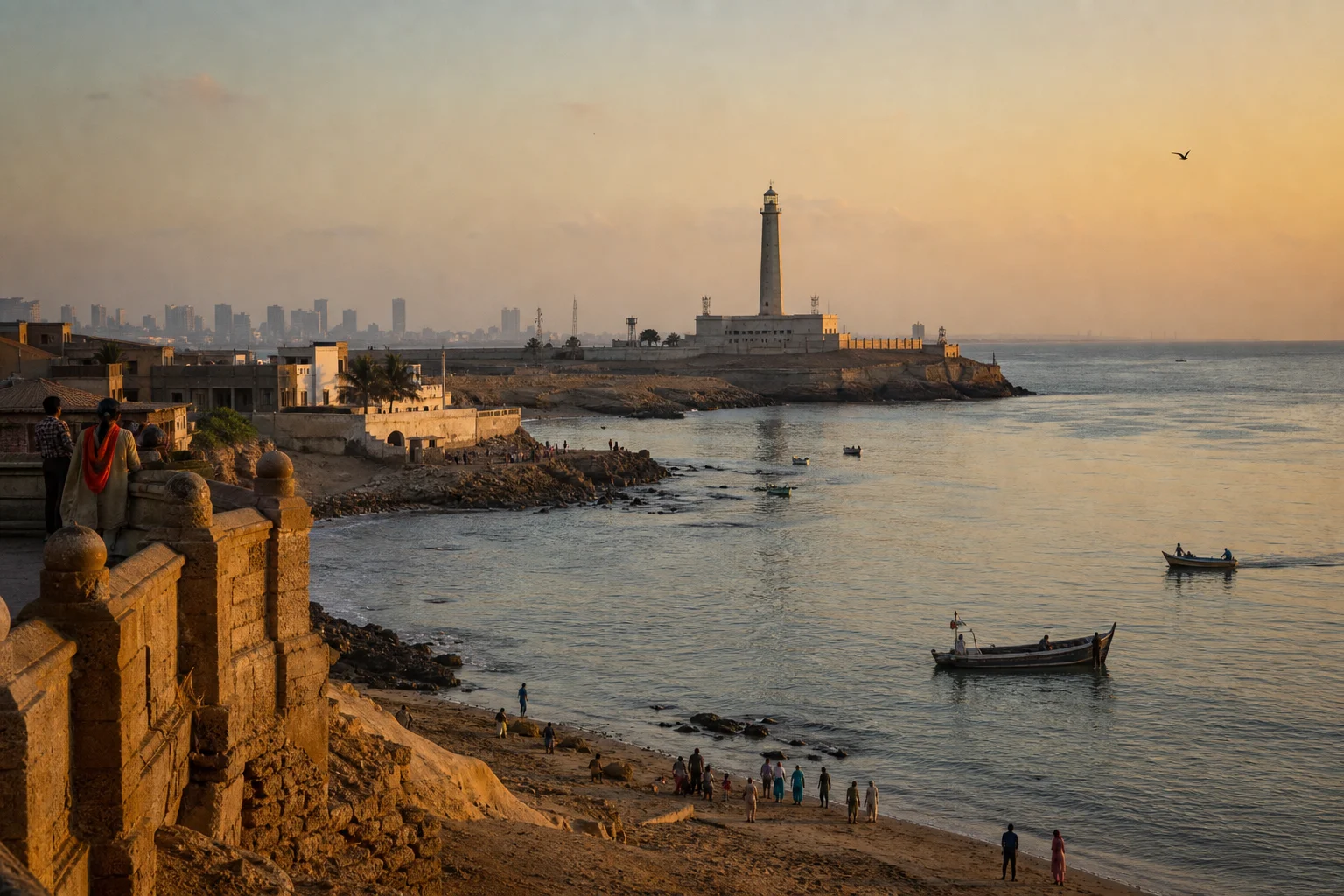
Karachi is often introduced through its scale: a vast metropolis, a commercial centre, a city of crowded roads and high-rises facing the Arabian Sea. Yet its coastline offers a different introduction. Here, at Clifton and farther west toward Manora, the city loosens its grip just enough for older rhythms to show through: tide, wind, prayer, fishing, shipping and the long approach of vessels toward a protected harbour.
This is not a polished resort coast, nor should it be understood as one. It is an urban shoreline, intensely used and continually changing. Families arrive at dusk for the sea air; vendors work the promenade; worshippers climb toward a hilltop shrine; fishing boats move through creeks and harbour channels; cargo ships wait beyond the horizon. A journey from Clifton to Manora is therefore less a dash between attractions than a way of reading Karachi through its waterline.
Clifton: Where the City Meets the Sea
Clifton’s Sea View is among Karachi’s most familiar public landscapes. Its wide beach, open sky and salt-heavy breeze make it a natural gathering place, especially in the cooler hours of the day. On busy evenings, the shoreline becomes a cross-section of the city: children on the sand, groups of friends sharing snacks, horse and camel handlers, tea sellers, photographers, runners and people who have come simply to sit facing the water.
The beach is often experienced as recreation, but its deeper significance lies in access. In a city where daily life can be defined by distance, heat and work, the sea creates an unusually democratic horizon. People arrive in formal clothes after family visits, in office wear after a long day, or in sandals and shalwar kameez for an unplanned walk. The appeal is not silence. It is participation: Karachi gathering at the edge of the Arabian Sea.
Clifton also carries traces of the city’s cosmopolitan civic history. The sandstone Jehangir Kothari Parade, opened to the public in 1920 after being endowed by Parsi philanthropist Seth Jehangir Hormusji Kothari, stands above the shore as a reminder that Karachi’s seafront was imagined not only as private property or commercial frontage, but as a place for public leisure. Its elevated walk and pavilion frame a view that has changed dramatically around it, yet the essential composition remains: stone, sea, sky and the city behind.
Nearby, the former Mohatta Palace adds another layer to the coastal district. Built in 1927 as a residence and now used as a museum, it speaks of the era when Clifton developed as a suburban seaside quarter. The palace and parade are not the coast itself, but they help explain why this stretch of Karachi became associated with both retreat and display. Their presence suggests that the shoreline has long been a place where public life, private wealth and civic aspiration meet.
A Shrine Above the Shore
Above Clifton stands the shrine of Abdullah Shah Ghazi, among Karachi’s most important places of devotion. The shrine occupies a powerful geographical position on a rise near the coast, where the soundscape shifts between traffic, prayer and the distant sea. Visitors come from across the city and beyond it, bringing flowers, hopes and private petitions. For many Karachiites, this is not simply a historic landmark but a place woven into the emotional map of the city.
Accounts of Abdullah Shah Ghazi’s life belong partly to devotional tradition, and details of his biography are not always presented consistently in historical writing. What is certain is the enduring importance of the shrine and the reverence it commands. Local belief has long linked the saint with Karachi’s protection from storms. That belief should be understood as an expression of faith and civic memory, rather than as a meteorological claim. It reveals how a coastal population has made meaning from vulnerability, weather and the immense unpredictability of the sea.
For a visitor, the shrine offers a lesson in attentiveness. Dress modestly, follow guidance at the entrance, and remember that this is an active sacred space rather than a scenic viewpoint. The best response is not hurried observation but respectful presence: notice the offerings, the devotional music when it is being performed, the steady movement of people through the courtyard, and the way the shrine remains connected to ordinary urban life below.
The Harbour’s Other Face
West of Clifton, the coastline begins to tell a more industrial and maritime story. Karachi Harbour is not a backdrop to the city; it is one of the forces that made the modern city possible. Its sheltered waters and strategic position drew commerce over centuries, while the nineteenth-century development of port infrastructure helped transform Karachi into a major trading centre.
Manora forms part of the natural barrier that shelters the harbour from the open Arabian Sea. Looking toward it from the water or the western shore, it is easy to understand why this narrow piece of land mattered. The harbour behind it offered protection; the sea in front of it opened toward the Gulf, the wider Indian Ocean and trading routes beyond.
In the nineteenth century, the port was reshaped by dredging, moles, wharves and breakwaters. These works were practical interventions, designed to make a difficult harbour more navigable and efficient. But they also changed the physical relationship between city and coast. Karachi’s maritime landscape is therefore partly natural and partly engineered: tidal flats, channels and sandy headlands alongside port walls, navigation systems and working docks.
When travelling toward Manora, it is worth resisting the temptation to see the harbour merely as an obstacle between beach and island. The passing vessels, cranes, pilot craft and waterfront settlements are part of the view. They make visible the labour that often disappears behind the idea of a port city: crews, mechanics, dock workers, fishers, navigators, cleaners, shopkeepers and families whose routines are tied to the water.
Manora: A Sentinel at the Harbour Mouth
Manora was once an island and is now connected to the mainland by a sandy strip. Its position between harbour and open sea has given it an identity distinct from central Karachi. The route there can feel like a change of tempo. The city is still close, but the skyline is replaced by harbour traffic, low-lying shore, naval and port infrastructure, and a more exposed meeting of sea and land.
Its history includes defence as well as navigation. A fort was established at Manora under the Talpur rulers toward the end of the eighteenth century to guard the harbour. The British capture of Manora in 1839 became an early episode in their takeover of Karachi and, later, Sindh. Much of the original fort no longer survives in a form that can be casually explored, and parts of Manora remain subject to security controls. This makes the place a reminder that heritage is not always a self-contained monument: sometimes it survives in fragments, settings and the continuing importance of a site.
The Manora Point Lighthouse is the coast’s most recognisable landmark. The present tower dates to the late nineteenth century, replacing an earlier light station, and it remains a navigational marker for vessels approaching Karachi. Its striped profile, visible above the low coastal landscape, is more than a picturesque relic. A lighthouse represents a practical promise: a fixed point for ships moving through uncertain water. In Karachi, that promise is inseparable from the city’s identity as a harbour.
Close by is St Paul’s Church, built in the nineteenth century, another sign of Manora’s layered colonial past. The area also contains the Varun Dev temple, associated in local tradition with the protection of those who go to sea. Together with mosques and shrines in the broader coastal landscape, these sites point to a truth often missed in simplified accounts of Karachi: its maritime world has been shaped by multiple religious communities, languages and trading connections.
Sea, Sand and the Work of Living Here
Manora’s beach is often described as an escape from the central city, but the word “escape” can hide the place’s lived reality. This is not an empty fringe. It is a coastal community with everyday needs, working people and a relationship to the harbour that is far more immediate than it is for most visitors. The beach, lanes and shoreline should be approached with the same courtesy one would bring to any inhabited neighbourhood.
Food is one of the gentlest ways to understand this relationship. Karachi’s coastal appetite is evident in fried fish, grilled seafood, masala-dusted snacks, chai and the salty tang that seems to settle on every outdoor meal. But a thoughtful visitor should favour clean, busy vendors, ask before photographing people or their catch, and avoid treating fishing activity as a performance. The sea provides livelihoods before it provides atmosphere.
The coast also demands environmental honesty. Plastic, untreated waste and intense development put pressure on Karachi’s waters. Around the harbour’s backwaters, mangroves remain vital habitats, helping to stabilise shorelines and providing nursery grounds for fish and other marine life. Their tangled roots may seem remote from Clifton’s evening crowds, but they belong to the same coastal system. A disposable cup dropped at the beach and a damaged mangrove stand are connected by tide and current.
Travellers can respond in simple, meaningful ways: carry reusable water, take rubbish away when bins are unavailable, avoid single-use decorations and balloons, do not disturb birds or shoreline life, and decline activities that leave animals exhausted or the beach littered. The aim is not moral perfection; it is to recognise that Karachi’s coast is a shared and working environment.
How to Experience the Journey Well
Begin at Clifton not with a packed itinerary but with time to walk. The light changes quickly near sunset, and the public character of the shore becomes most apparent as the heat eases. Pair the beach with the Jehangir Kothari Parade and, if it fits your interests, a visit to the museum at Mohatta Palace. Then make the shrine a separate, unhurried stop rather than an item squeezed between photographs.
A trip to Manora is best planned with flexibility. Boat services, public access arrangements and security rules can change, while weather and tides shape the experience of the coast. Check local conditions and authorised transport information before setting out, carry identification where required, and respect restricted areas without argument. Swimming conditions can be unpredictable, so follow local advice, stay close to supervised or commonly used areas, and do not enter rough water for the sake of a photograph.
The most rewarding way to leave this coast is with a wider idea of Karachi. Clifton and Manora show that the city is not only a skyline or a port, not only a beach or a business capital. It is a place where a shrine watches the sea, where a lighthouse still marks a harbour approach, where inherited stone promenades meet contemporary crowds, and where the ordinary act of facing the water can hold memory, work, faith and pleasure at once.
Karachi’s coastal story is unfinished, because the sea keeps revising it. Each tide redraws the edge. Each generation finds a different city there.