Karachi is Pakistan’s largest city, but size alone does not explain it. The city makes more sense when read from the water inward. Its harbour, beaches, fishing settlements and creek-lined coast have long connected Sindh to the Arabian Sea and to wider trading worlds. Behind that maritime edge lies a city assembled neighbourhood by neighbourhood: old mercantile quarters, colonial civic districts, working-class localities, post-Partition settlements, industrial expanses and newer residential enclaves.
This is why Karachi should not be approached as a collection of landmarks to tick off between traffic jams. It is a city of layers and thresholds. A morning can begin beside a stone building in Saddar, move through the old lanes of Kharadar, pause over a plate of biryani or nihari, and end with salt wind along the coast. The skyline is only one expression of Karachi. Its deeper character lives in its streets, its markets, its meals and its relationship with the sea.
Begin with the sea
The Arabian Sea is not a scenic backdrop added to Karachi’s urban life; it is one of the reasons the city exists. The protected harbour gave a small coastal settlement room to grow into a port. In the nineteenth century, new harbour works and rail connections accelerated that transformation, binding the city to inland commerce as well as overseas trade. Even today, the port’s cranes, vessels and warehouses remain part of Karachi’s visual vocabulary.
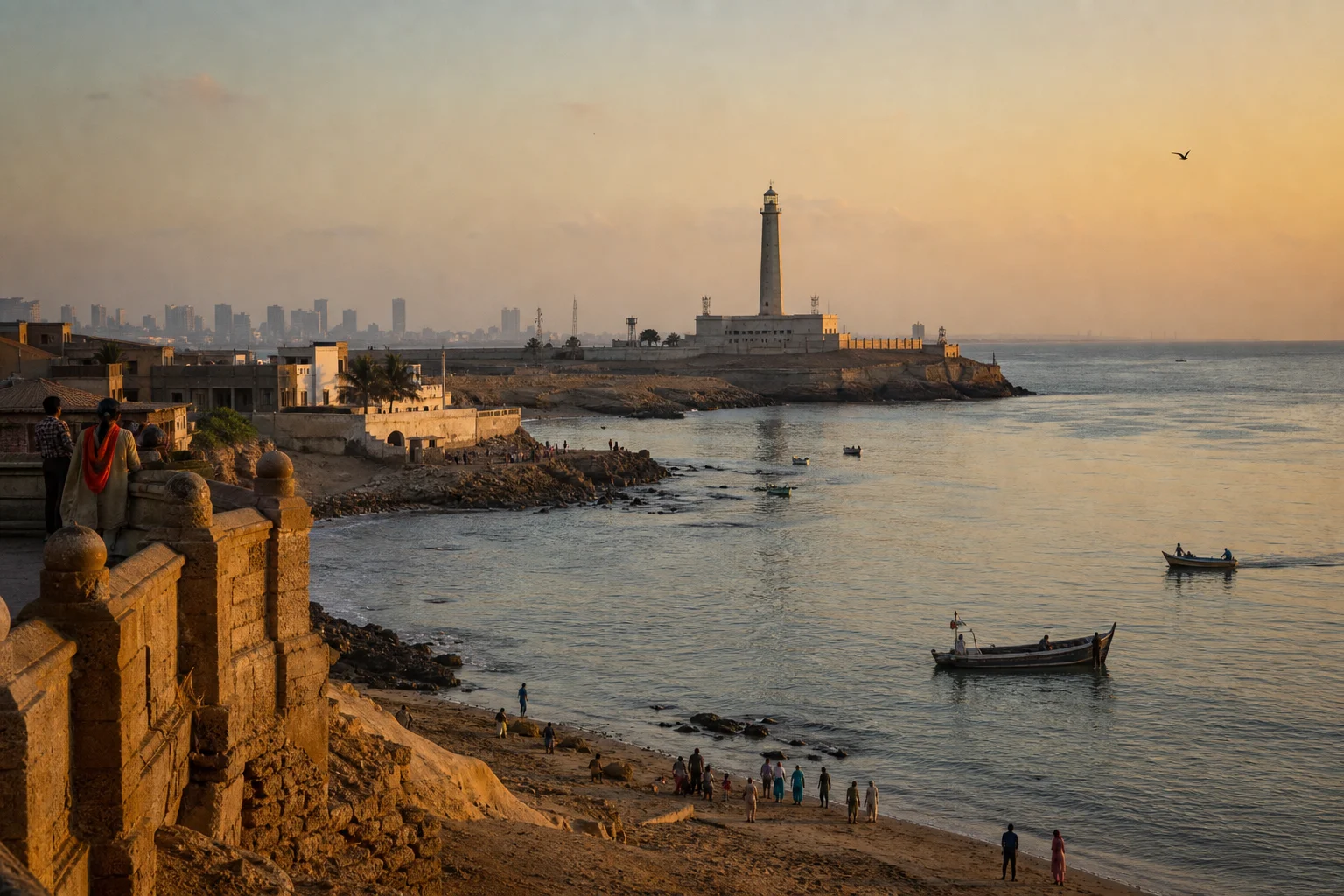
For a sense of this geography, look towards Manora, the headland that helps shelter Karachi Harbour from the open sea. Its lighthouse has guided vessels at the harbour entrance since the colonial period, while the surrounding waters reveal the city’s practical maritime life: cargo movement, fishing craft, naval activity and tidal currents. Access and conditions around the harbour can change, so it is wise to confirm local arrangements before planning a visit rather than treating the waterfront as a single, freely accessible promenade.
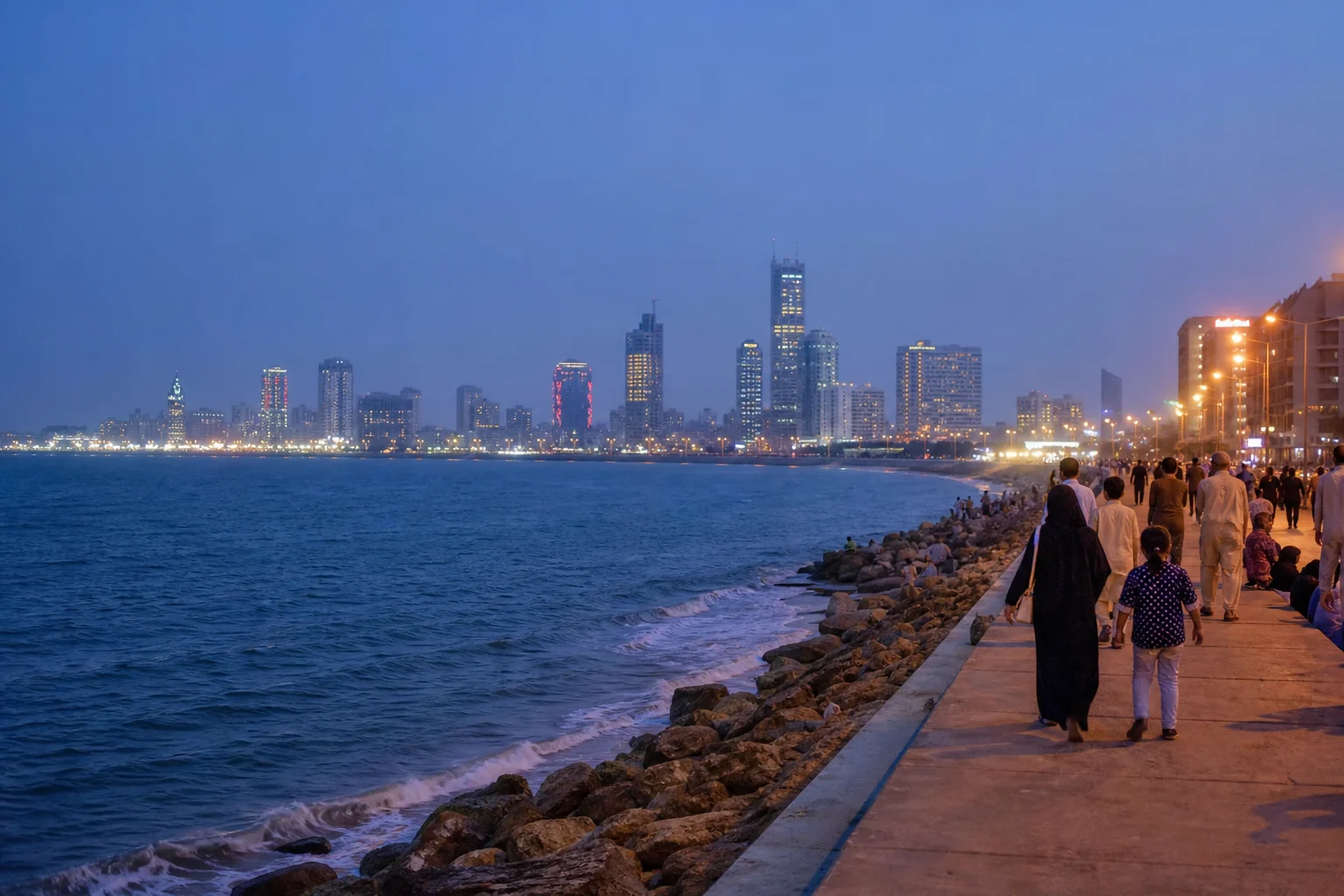
Clifton’s seafront offers a more urban encounter with the coast. It is a place for an evening walk, conversation and the simple theatre of a city turning out towards the water. But Karachi’s coastline extends well beyond this familiar frontage. West of the harbour, the beaches around Sandspit and Hawke’s Bay open into a more spacious coastal landscape of sand, rocky outcrops, tidal shallows and mangrove-lined backwaters. These shores are ecologically important: the Sandspit–Hawke’s Bay stretch is known as a nesting habitat for marine turtles. A thoughtful visitor leaves no litter, avoids disturbing wildlife or nests, and respects any local restrictions.
The sea also asks for humility. Tides, currents and weather can change quickly, especially during the monsoon season. Beachgoers should follow local guidance, avoid entering rough water and remember that a beach is both a public pleasure and a vulnerable coastal habitat.
Old Karachi: gates, markets and mercantile memory
To find the outline of pre-colonial Karachi, head towards Kharadar and Mithadar. Their names preserve the memory of the fortified settlement once known as Kolachi. Kharadar, or the “gate of salt water”, faced the sea; Mithadar, the “gate of sweet water”, faced towards the Lyari River. The walls and gates themselves are gone, but the names endure, carrying an older geography into everyday speech.
These are not museum quarters preserved under glass. They remain dense commercial and residential districts, alive with wholesale trade, workshops, mosques, small eateries, old houses and a constant movement of people. Their narrow streets reward patient walking, but they should be approached with the ordinary courtesy required in any busy neighbourhood: do not block shopfronts, ask before photographing people, dress with consideration, and accept that commerce here comes before sightseeing.
Kharadar and Mithadar also illuminate Karachi’s long history of migration. Merchant communities from across Sindh, Kutch, Rajasthan and the wider Indian Ocean world helped shape the old city’s commercial culture. After 1947, Karachi received large numbers of migrants from different parts of South Asia, adding new languages, cuisines and social networks to an already diverse port city. Karachi’s identity has never been singular. It has been made through arrivals, work and adaptation.
Nearby, the markets around Bolton Market, Jodia Bazaar and the older commercial streets offer a reminder that trade is one of Karachi’s oldest public languages. Spices, textiles, household goods, paper, hardware and food circulate through a landscape that can seem overwhelming at first glance. The point is not to conquer it in an hour. Pause, observe how a lane specialises, notice the hand-painted signs and goods piled high, and allow the city’s practical energy to set the pace.
Saddar and the architecture of a port city
Karachi’s colonial-era civic architecture is concentrated in and around Saddar, a district where the nineteenth- and early twentieth-century city still appears in fragments: Gothic arches, arcades, stone façades, clock towers, churches, schools, civic offices and markets. The buildings do not tell a simple story of empire. They also speak of local craftsmen, municipal ambition, mercantile wealth and the communities who used these public spaces every day.
Frere Hall, completed in 1865, is among the city’s most recognisable buildings. Its Venetian-Gothic form was made with local stone, giving the structure a colour and texture that belongs unmistakably to Karachi. Originally conceived as a town hall and library, it stands beside gardens now known as Bagh-e-Jinnah. It is worth lingering here not merely for a photograph, but to appreciate how public architecture once tried to create a civic centre in a rapidly expanding port.
Empress Market, built in the 1880s, remains another powerful marker of Saddar’s commercial life. Its tall tower and market hall were designed to be seen across the district. Around it, Saddar continues as a place of retail, repair, street commerce and everyday negotiation. The relationship between heritage and use is especially visible here: historic buildings are not separate from urban life, but embedded within it.
For a different architectural chapter, Mohatta Palace in Clifton reveals the cosmopolitan tastes of early twentieth-century Karachi. Commissioned in 1927 by the Marwari businessman Shiv Rattan Mohatta and designed by Ahmed Hussein Agha, the building combines local yellow Gizri stone with pink stone from Jodhpur in a Mughal-revival idiom. Its later association with Fatima Jinnah adds another layer to its history. As a museum, it offers a useful counterpoint to the crowded streets of the old city: a reminder that Karachi’s built heritage includes domestic, cultural and civic worlds as well as commerce.
Neighbourhoods are the real map
Karachi is best understood through its neighbourhoods, each with its own pace and memory. Saddar is central, commercial and architecturally layered. Clifton is a coastal district of broad roads, museums, restaurants and seafront life. Defence, once planned largely as a residential cantonment area, has developed into a major urban district with cafés, galleries, markets and a wide mix of domestic architecture. None of these areas can stand for the whole city, but each shows a different way Karachi has grown.
Lyari, one of Karachi’s oldest settlements, deserves to be understood beyond simplistic headlines. Its history is closely tied to fishing, dock work, migration and working-class life. Baloch, Sindhi, Katchi, Memon, Sheedi and many other communities have contributed to its social fabric over generations. The area is also associated with football, boxing, music and neighbourhood institutions. Visitors should not arrive expecting an exoticised version of hardship; they should arrive, if invited or guided locally, prepared to recognise a living community with its own dignity and complexity.
Elsewhere, areas such as Liaquatabad, Nazimabad, Korangi, Malir, Orangi and the many goths absorbed by the expanding city reveal how Karachi grew after independence through housing, industry, informal enterprise and successive waves of settlement. A city of this scale cannot be reduced to a single centre. The most revealing journeys may be short ones: a bus ride, a walk through a bazaar, a conversation over tea, or an afternoon spent noticing how one neighbourhood’s language and food differ from the next.
Eat Karachi as a record of movement
Karachi’s food is often celebrated for intensity, but its real distinction is range. The city gathers culinary traditions from Sindh, Punjab, Khyber Pakhtunkhwa, Balochistan, Gujarat, Delhi, Hyderabad Deccan and beyond, then makes them part of its own urban rhythm. Food here is not a single heritage; it is an archive of migration.
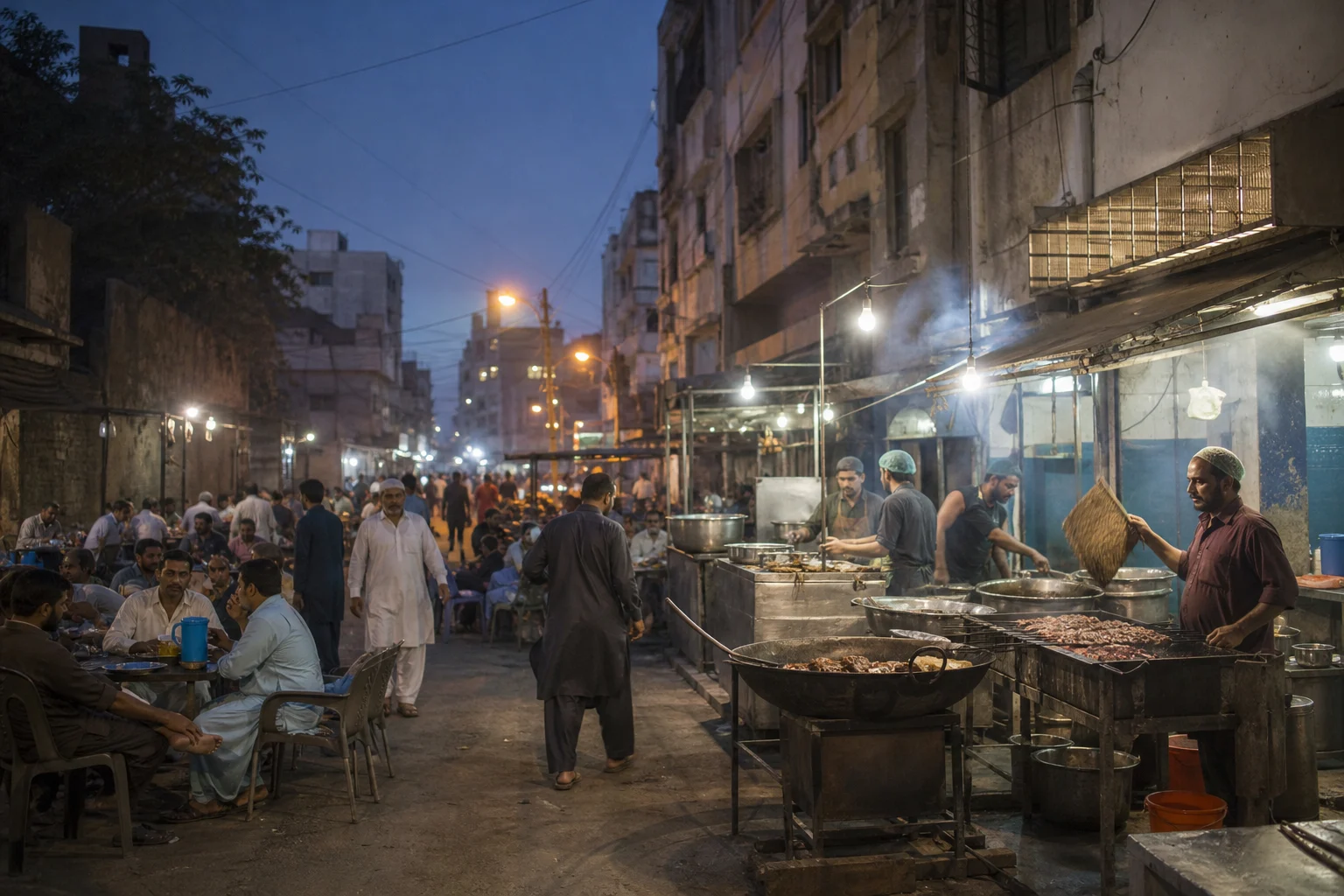
Burns Road is an essential place to understand this. It is one of Karachi’s best-known food streets, where the evening appetite of the city gathers around grills, pots and dessert counters. Nihari, slow-cooked and deeply spiced, is a classic choice; kebabs bring smoke and char to the table; dahi baray offer softness and tang; rabri turns reduced milk into a dense, celebratory sweet. The lesson of Burns Road is not that one stall can represent all Karachi. It is that shared eating remains one of the city’s most democratic rituals.
Then there is biryani, perhaps Karachi’s most fiercely debated dish. Versions vary from household to household and restaurant to restaurant, but the city’s style is often recognised for fragrant rice, potatoes, meat and an assertive balance of spice, sourness and heat. Order with curiosity rather than certainty: local loyalties matter, and every resident seems to know where the definitive plate is served.
The coast naturally shapes the table as well. Fried fish, grilled fish, prawns and crab dishes appear across the city, particularly in areas connected to fishing and the harbour. Choose vendors who handle seafood carefully, eat where there is visible turnover, and be mindful of seasonality. Karachi’s best meals often come with no elaborate setting: a metal table, a paper napkin, a busy pavement and the sound of a city still moving late into the night.
How to move through Karachi with care
Karachi rewards flexibility. Distances are large, traffic can reshape a day, and a plan that looks simple on a map may take longer than expected. Group nearby experiences together: Saddar, Frere Hall and old-city markets belong to one broad urban chapter; Clifton, Mohatta Palace and the seafront to another; the western beaches require their own time and attention.
More importantly, travel here should be relational rather than extractive. Use local guides where appropriate, support small businesses, carry drinking water, avoid disposable plastic at the coast and seek permission before taking close photographs in markets or residential lanes. Check current local conditions, access rules and transport arrangements before setting out. Karachi can be loud, demanding and contradictory, but it is also generous to the visitor willing to slow down.
Beyond the skyline, Karachi is not one story. It is the gull over the harbour, the old names of water gates, the carved stone of public buildings, the call of a food stall, the football ground, the fish market and the evening crowd facing the sea. To understand it is to accept its plurality. Karachi does not offer a neat portrait of Pakistan. It offers something more valuable: a vast, restless and deeply human cross-section of it.