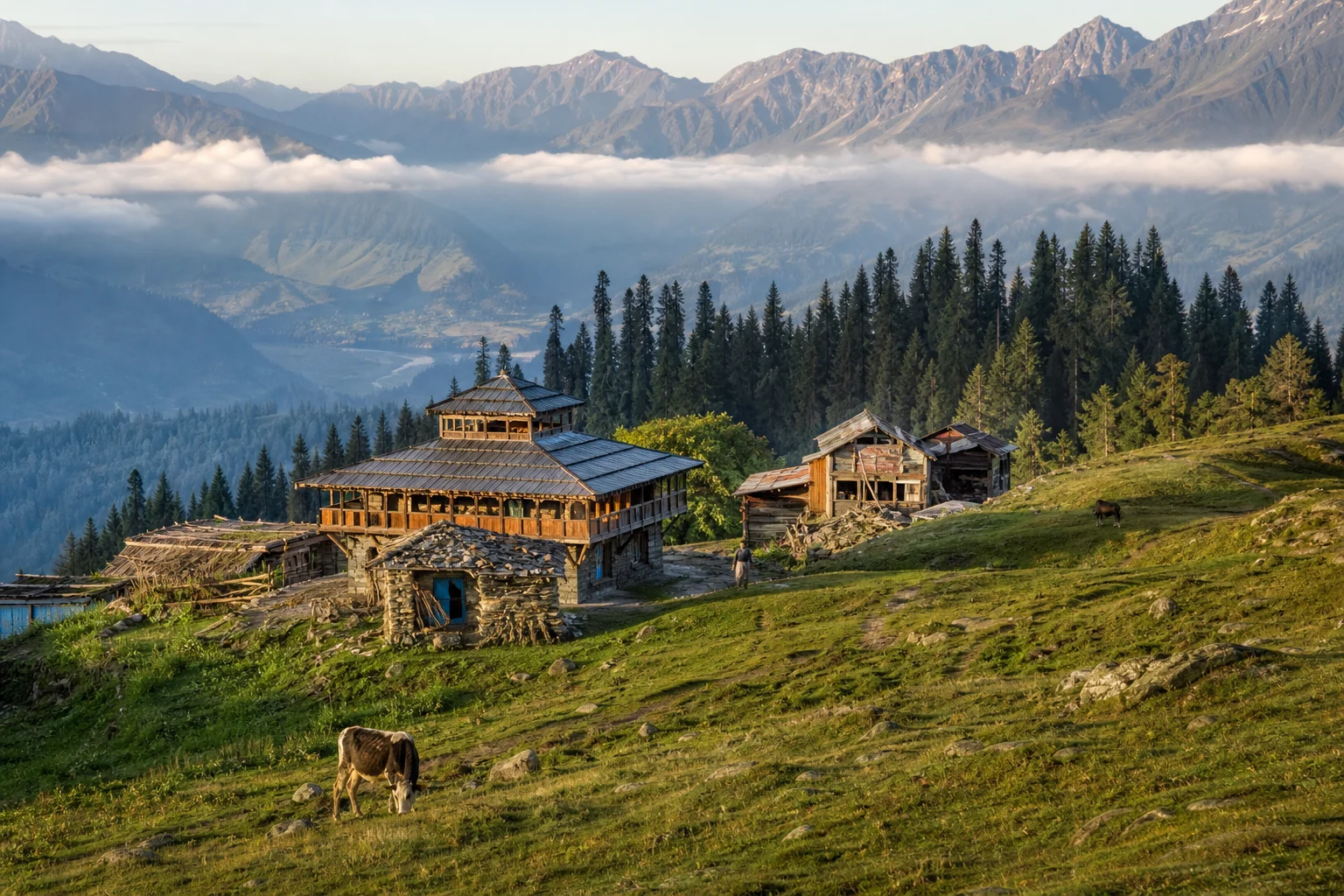
Arang Kel is often introduced with a single image: a sweep of green meadow suspended above the Neelum River, with wooden houses at its edge and dark conifer slopes rising behind. The image is accurate, but incomplete. What makes this small settlement memorable is not simply that it is beautiful from a distance. It is that reaching it changes the scale of the valley beneath it.
From Kel, the village appears to occupy a high, improbable shelf across the river. The road, the river and the clustered buildings of the lower settlement recede as visitors make their way upward. By the time the path reaches the meadow, the landscape no longer feels like a roadside destination. It feels like a mountain inhabited on mountain terms: open grassland, timber homes, steep woods, sudden cloud, long shadows and a horizon that shifts with every few steps.
At roughly 2,550 metres above sea level, Arang Kel lies in the upper Neelum Valley of Azad Jammu and Kashmir. It is close enough to Kel to be reached on foot after crossing the valley, yet its elevation gives it a distinct atmosphere. The river below is no longer the principal companion; the meadow, forest and surrounding ridges take over. This is the central pleasure of Arang Kel: a place that asks visitors to leave the road behind and arrive at walking pace.
A village reached by effort
The journey is part of the place’s meaning. Access from Kel commonly involves a chairlift crossing and an uphill walk, or a longer approach on foot. The exact experience varies with weather, trail conditions and local arrangements, but the essential fact remains: the final stretch is steep. It is not a promenade, and it should not be treated as one.
That climb has a useful effect. It slows the visitor down before the meadow appears. Along the way, the noise of vehicles fades; the body registers the altitude; bags feel heavier; the valley opens and closes through trees. In many mountain destinations, spectacular scenery is consumed from a roadside window. Arang Kel preserves a modest but important interval between seeing and arriving.
The effort need not be romanticised. Those unaccustomed to uphill walking should take their time, carry water, wear shoes with grip and avoid overloading themselves. Rain can make paths slippery, mist can narrow visibility, and mountain weather changes quickly. Travellers should check local conditions before setting out, particularly outside the warmer months, when snow and weather can affect access across the upper valley.
The meadow as a shared space
The heart of Arang Kel is its broad meadow. In the growing season, this open ground carries the colour that has made the village widely known: grass brightened by sun, patches of wild growth, and the deep green of forest beyond. Yet the meadow is more than scenery. It is the spatial centre around which village life and visitor activity meet.
Homes and small guesthouses sit around its edges. Footpaths link doorways, fields and viewpoints. Livestock may be part of the daily landscape, reminding visitors that these high pastures belong to a working rural environment rather than a landscaped park. In the wider Neelum region, livestock rearing and farming have long been significant to household livelihoods, while local knowledge of plants has supported animal care as well as domestic life. Such knowledge belongs to a larger mountain culture of close attention to seasons, grasses, forests and water.
This is why the meadow deserves more than a quick photograph. Its apparent simplicity is the result of a landscape in use. Visitors who walk quietly around its margins can notice the practical details that a panoramic view hides: woodpiles, kitchen gardens, animals moving through grass, paths worn by repeated use, and the careful positioning of buildings against rain, snow and slope.
Forest, pasture and the upper valley
Arang Kel stands within an ecological transition. The upper Neelum Valley is shaped by moist temperate forest, subalpine conditions and higher alpine terrain. Around Kel and Arang Kel, blue pine, fir and spruce are among the trees associated with these mountain forests, while open pastures and flowering herbs become increasingly important with altitude and exposure.
The distinction matters because Arang Kel’s beauty is often described as though it were only a meadow. In reality, the village is framed by a living relationship between grassland and woodland. The forest gives the slopes their depth and shade; the meadow opens the view; water and snow govern the growing season; grazing and foot traffic leave their marks. A visitor who looks beyond the central field begins to understand the village as part of a much larger Himalayan environment rather than a scenic platform above a river.
It also calls for care. Mountain vegetation recovers slowly from repeated trampling, litter is difficult to manage where transport is limited, and timber is not an inexhaustible backdrop for photographs. Staying on established paths, carrying waste back where possible, avoiding single-use plastics and not picking wild plants are small actions with real value. The most respectful traveller leaves no demand for the village to absorb the consequences of their visit.
Life beyond the view
It is tempting to describe Arang Kel as a village outside time. That would be misleading. It is a contemporary settlement whose residents negotiate the same pressures felt in many mountain communities: changing travel patterns, schooling, income needs, construction, communications and the uncertainty of severe weather. Tourism can bring work through transport, food, accommodation and guiding, but it can also place strain on space, water, waste systems and local routines.
For visitors, this means that hospitality should not be mistaken for unlimited access. A village is not a stage set. Ask before photographing people, homes or animals at close range. Dress with consideration for a rural community. Keep music low, especially in the evening. Do not enter private land merely to improve a camera angle, and be mindful that a footpath used by a visitor may also be someone’s route to a home, field or grazing area.
These courtesies are not restrictions on experience; they are what make a meaningful experience possible. They allow Arang Kel to remain recognisably itself rather than becoming an outdoor extension of the road below.
The wider human geography of Neelum
Arang Kel belongs to a valley with a rich and varied social landscape. Across Neelum, communities have been shaped by mountain movement, farming, pastoral life and connections between side valleys. Several languages are spoken in the district, including Hindko, Kashmiri, Gojri and Shina, alongside Urdu and other languages of wider communication. Such diversity should resist the easy urge to reduce the region to a single, uniform “mountain culture.”
What visitors may recognise instead is the shared discipline imposed by terrain. In a high valley, distance is measured not only in kilometres but in gradient, snow, water crossings and the hours of daylight left. Houses, fields and routes all reflect practical choices made in response to these conditions. The ordinary work of carrying supplies, tending animals, preparing for colder months and keeping paths usable is part of the landscape’s human story.
Seen in this light, Arang Kel is not isolated from the world; it is closely connected to its own valley systems. Kel is the immediate gateway, while the upper Neelum continues toward other settlements, forests, pastures and trekking routes. The village’s position above the river gives it a dramatic visual separation, but its life is woven into the wider geography below and beyond it.
How to spend time here well
The best approach to Arang Kel is unhurried. Arrive early if possible, before the meadow becomes busy and while the light still rests softly on the slopes. Walk its perimeter rather than limiting the visit to a single viewpoint. Sit somewhere that does not block a path or intrude on a household. Watch the weather travel across the valley. Notice how quickly the mood changes when clouds enter the forest or evening lowers the temperature.
An overnight stay, where suitable arrangements are available, can reveal the quieter hours after day visitors have descended. But simplicity should be expected. High-altitude villages are not defined by urban convenience, and visitors should plan accordingly: warm layers, rain protection, a torch, personal medicines and a restrained amount of luggage are sensible companions. It is equally sensible to confirm transport, trail and accommodation conditions locally rather than relying on old itineraries.
Arang Kel rewards attention more than consumption. The famous meadow is only the beginning. Beyond it lies an understanding of how village life is held between forest and pasture, how a river valley can be viewed from above rather than merely followed along, and how a short climb can create a genuine change in perspective.
A place that asks for humility
Pakistan’s mountain landscapes are often presented through superlatives: highest, grandest, wildest, most remote. Arang Kel suggests another vocabulary. Its power is not monumental in the manner of a great peak or glacier. It is intimate. The village offers a green clearing, a handful of paths, homes shaped by local materials and a view that makes the Neelum River seem both near and far away.
To stand here is to see the upper valley differently. The road becomes a thin line below. The river becomes part of a larger pattern of slope, forest and sky. And the village, rather than appearing as a picturesque interruption in nature, becomes what it has always been: a human place within a demanding mountain landscape, sustained by work, knowledge and attention to season.
That is the lasting story of Arang Kel. Not a meadow above the clouds, however poetic that description may be, but a real village above a river—one that deserves to be approached slowly, understood generously and left as quietly as it was found.