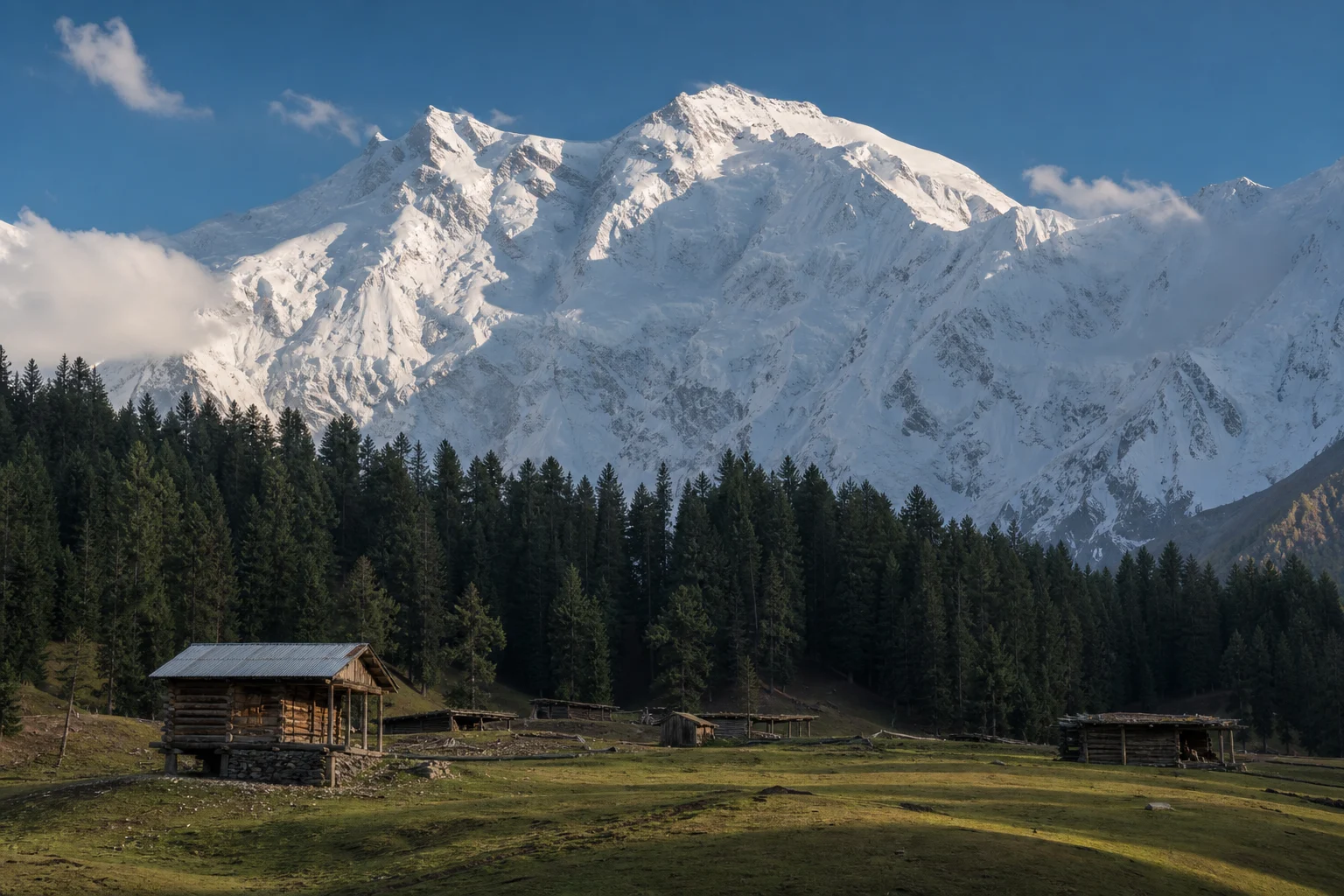
There are landscapes that seem designed for the wide-angle view, and then there are landscapes that ask to be understood slowly. Fairy Meadows belongs to the second kind. Its celebrated scene is simple enough to describe: a high green meadow, dark conifer slopes, wooden shelters, and beyond them the immense white-and-black wall of Nanga Parbat. Yet the place is more than a viewpoint. It is a mountain pasture, a walking country, a threshold to glacier terrain, and part of the lived geography of Diamer in Gilgit-Baltistan.
Known locally as Joot, Fairy Meadows lies at roughly 3,300 metres above sea level on the northern side of Nanga Parbat. The English name, linked to the German Märchenwiese, or “fairy-tale meadow,” emerged through the mountaineering world of the mid-twentieth century. It has endured because the contrast is so striking: soft grass beneath a peak whose scale and severity resist every postcard description.
Nanga Parbat rises to 8,126 metres, making it Pakistan’s second-highest mountain and the ninth-highest in the world. It is often described as the western anchor of the Himalaya. From Fairy Meadows, the mountain does not appear as a distant white triangle. Its northern Rakhiot side seems to occupy the whole horizon, a mass of glacier, snowfield, cliff and shadow. The meadow gives the visitor a place to stand still; the mountain makes stillness feel small.
A meadow with a working life
The word “meadow” can invite a misleading idea of untouched scenery. Joot is not an empty stage set beneath the summit. Like many high pastures in northern Pakistan, it belongs to a larger human landscape shaped by seasonal movement, footpaths, grazing traditions, forest edges and practical knowledge of weather. The walk into the area follows routes that have long connected settlements and upland ground. Today, local families and operators also provide much of the accommodation, guiding, transport and food that make a visit possible.
This matters because Fairy Meadows is sometimes framed as though it were discovered by travellers. In reality, the foreign name arrived after a place already known to people of the region. The name Joot reminds visitors that a famous view has a local geography and a local history, even when those histories are quieter than the drama of Himalayan climbing.
The approach is part of the experience. After the road journey toward Tato, visitors continue on foot through slopes of pine and fir, with the forest opening in intervals to reveal ridges, clouds and the pale distance of ice. The final arrival can feel theatrical, but the trail also establishes the basic truth of the place: Fairy Meadows is reached by effort. It is not a roadside attraction, and its character depends on that relative remoteness.
For travellers, this is an invitation to move at the pace of the terrain. The weather can change quickly, paths can be muddy or uneven, and conditions vary by season. A sensible journey begins with current local advice, suitable footwear, enough warm and waterproof clothing, and a willingness to adjust plans rather than treating the mountain as a schedule.
The naked mountain
The name Nanga Parbat is commonly translated as “Naked Mountain,” from Sanskrit-derived words for naked and mountain. In the region, the peak is also known as Diamer or Deo Mir, names that carry their own local resonance. Whatever name is used, the mountain has a formidable physical presence. It rises abruptly above valleys that are already high, and its glaciers and faces reveal the restless work of snow, wind, rockfall and ice.
From Fairy Meadows, the eye is drawn towards the Rakhiot Glacier and the northern flank associated with the mountain’s earliest successful ascent. The colour of the scene changes continually. Morning may show silver-blue shadow on the glacier. By afternoon, the lower forests turn deep green while the upper mountain becomes a hard white blaze. At dusk, cloud can erase the summit entirely, leaving only the suggestion of a giant behind the weather.
That uncertainty is central to Nanga Parbat’s character. Mountains of this scale are not decorative backdrops. The same forces that create their beauty make them hazardous: unstable snow, avalanche terrain, crevasses, rapidly changing visibility and extremes of cold at altitude. Nanga Parbat acquired a dark reputation in the history of Himalayan climbing after a series of early expeditions ended in tragedy. The label often attached to it can sound dramatic when repeated casually, but it points to a real history of risk and loss.
In 1953, the Austrian climber Hermann Buhl made the first recorded ascent of Nanga Parbat as part of a German-Austrian expedition, following the Rakhiot route. His summit push, completed alone after his companions turned back, became one of the defining stories of post-war Himalayan mountaineering. For those looking up from Fairy Meadows, that history is present not as a museum display but as a line of ridges and icefields rising beyond the trees.
Still, the mountain should not be reduced to a climbing legend. Most people who come to Fairy Meadows will never step onto a glacier or attempt a high-altitude route. Their encounter is more modest, and perhaps more lasting: observing the mountain’s weather, learning the names used for its landscape, and recognising how close human comfort sits to an environment that remains overwhelmingly powerful.
Forest, water and the edge of altitude
Fairy Meadows is memorable because it holds several Himalayan worlds in one frame. There is the pasture itself, bright in the growing season. There are stands of conifer forest, whose vertical dark forms make the snow slopes appear even larger. There are streams fed by snow and glacier melt, and above all of this the austere upper world of rock and ice.
The forests around Nanga Parbat are not merely scenic foreground. They shelter birds and smaller wildlife, stabilise slopes, provide shade and shape the moisture of the local environment. In the wider Diamer region, plants have long held practical value in household knowledge and traditional remedies. Visitors do not need to turn every walk into a catalogue of species to understand the essential point: the meadow and forest are living systems, not vacant land waiting to be admired.
The most responsible way to experience them is also the least complicated. Stay on established paths where possible. Carry back packaging and bottles. Avoid loud music, especially in wooded areas and shared camps. Use water carefully. Do not pick flowers, cut branches or treat campfire wood as an unlimited resource. In a high mountain setting, small careless acts accumulate quickly.
This ethic extends to photography. Fairy Meadows is visually generous, but a camera can encourage the idea that a place exists only from one famous angle. Look beyond the summit. Notice the worn trail underfoot, the changing line of the forest, the work behind a meal or a warm room, and the way clouds travel through a valley. These details are closer to the real texture of mountain life than a single perfect image.
Beyond the famous clearing
The meadow is often the beginning rather than the end of a visit. Walks continue toward Beyal Camp and, for properly prepared trekkers, farther in the direction of the Nanga Parbat base-camp area. Each stage alters the view. The trees thin, the scale of the glacier becomes easier to grasp, and the mountain ceases to look like a single wall. It breaks into ridges, gullies, hanging ice and complicated layers of rock.
These routes should be approached with humility. A short-looking line on a map can become demanding because of altitude, heat, rain, snow or fatigue. Local guides are valuable not only for navigation but for reading the ground and judging when conditions call for caution. Travellers should ask respectfully about expectations, agree on plans clearly, and understand that turning back can be the right decision.
There is also a social courtesy to mountain travel in Pakistan. Dress and behaviour should be considerate in villages and shared spaces. Ask before photographing people. Be patient when local priorities, weather or logistics alter the day’s plan. Support locally run services where possible, but do so without treating residents as part of the scenery. Hospitality is meaningful precisely because it is a relationship between people, not a commodity extracted from a remote landscape.
What Fairy Meadows reveals about Pakistan
Pakistan is often described through superlatives: highest peaks, vast glaciers, spectacular roads, ancient monuments. Fairy Meadows contains some of that grandeur, but it also corrects the habit of seeing the country only through extremes. Its lesson is one of scale and connection. The meadow is beautiful because of the mountain, but it is habitable because of the forest, water, paths and human care around it.
To sit there beneath Nanga Parbat is to encounter two kinds of time. One is geological: the patient upheaval that raised the Himalaya, the seasonal advance and retreat of snow, the slow carving of valleys by ice and water. The other is human: the movement of herders and walkers, the memory carried in local names, the labour of maintaining trails and shelters, and the ambitions of climbers who came seeking the summit.
Neither time cancels the other. Fairy Meadows is not a pristine emptiness beyond culture, nor is it simply a tourist stop beneath a famous mountain. It is a meeting place between a living upland community and one of the world’s great alpine landscapes. Its beauty becomes more meaningful when that relationship is seen clearly.
At night, when the lights of the camps are few and the meadow grows quiet, Nanga Parbat may disappear into darkness. The mountain remains there, of course, beyond the trees and cloud. By morning, it can return with startling clarity. That rhythm—concealment, revelation, and the need to wait—is perhaps the truest reason Fairy Meadows stays with those who reach it.