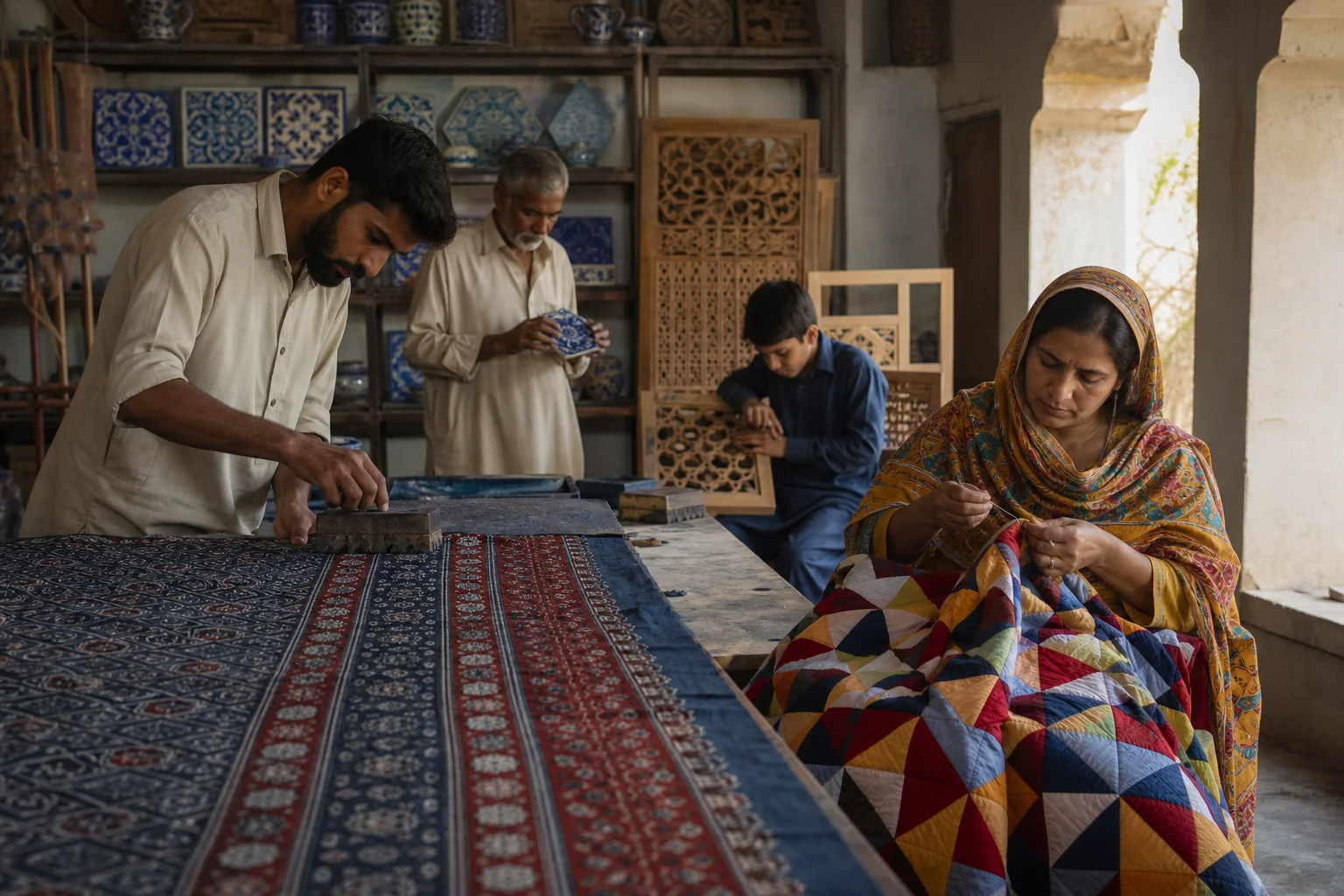
Pakistan is often described through its great archaeological sites, mountain ranges and historic cities. Yet another Pakistan exists at the scale of the hand: in a block pressed into cloth, a needle pulled through a quilt, a chisel guided along a wooden panel, and a brush carrying cobalt across a tile. These are not merely decorative gestures. They are forms of knowledge—practical, aesthetic and social—held by people whose work gives material shape to regional memory.
To speak of Pakistan’s traditional crafts is not to describe a single national style. It is to encounter many local vocabularies, shaped by climate, available materials, trade routes, faith, household life and the imagination of individual makers. In Sindh, resist-dyed cloth and patchwork quilts turn geometry into everyday utility. In south Punjab, tile painters and potters work in a luminous vocabulary of blue and turquoise. In Chiniot, woodworkers transform dense timber into pierced floral and geometric ornament. Across villages and towns, embroiderers make surfaces speak through colour, rhythm and patient repetition.
The country’s National Register of Intangible Cultural Heritage recognises traditional craftsmanship as a broad field, including Ajrak and Sindhi topi, Chiniot wooden furniture, Multan embroidery, Makli glazed tiles and rilli quilts. That range matters. It reminds us that a craft is not simply an object for sale; it is a chain of skills, materials, relationships and meanings that must remain active if it is to survive. ()
The workshop as a place of memory
In many craft traditions, learning does not begin with a certificate. It begins with looking. A child watches an elder measure cloth, prepare dye, sharpen a tool or judge the heat of a kiln. An apprentice first performs the least glamorous tasks: cleaning, tracing, sanding, preparing surfaces, winding thread or sorting scraps by colour. Only gradually does the work reveal its deeper demands—the steadiness of a hand, the discipline of repetition, the ability to recognise when a pattern is balanced and when it is not.
This form of learning is often described as “traditional,” but it should not be mistaken for static. The best makers constantly make decisions. They adjust a motif to the dimensions of a cloth, respond to a grain in the wood, alter the density of stitches, or balance a familiar pattern with a new colour. Tradition provides a grammar; artisans give it voice.
That is why the future of craft cannot be secured by placing finished objects behind glass alone. Museums and archives have an essential role in documenting and conserving material heritage, but living craft requires working hands, viable incomes and opportunities for knowledge to pass between generations. Pakistan’s heritage institutions have long documented artisans and folk practices, while more recent UNESCO-supported work in Sindh and Khyber Pakhtunkhwa has combined community-based inventorying with training intended to connect heritage knowledge and sustainable livelihoods. ()
Ajrak: precision beneath the colour
Few textiles announce Sindh as immediately as ajrak. Its deep indigo, red, black and white, arranged through intricate repeat patterns, may appear effortless when draped around a shoulder or spread across a charpoy. But its visual calm rests on a highly sequenced process. Cloth is washed and prepared, motifs are printed with carved blocks, and successive stages of resist application, dyeing and drying build the final design.
Ajrak is often admired for its palette, but its enduring power lies equally in its order. Borders, stars, rosettes and geometric fields create a surface in which repetition is never quite monotony. The cloth belongs to daily and ceremonial life alike: worn, gifted, used and recognised. A ralli quilt in the British Museum’s collection, for example, uses block-printed ajrak on its reverse side, showing how one textile tradition can enter another household form. ()
For block printers, the craft demands collaboration as much as individual skill. The block carver, dyer, washer and printer each affect the final cloth. To value ajrak properly is therefore to see beyond the finished scarf or shawl. Its price should reflect not only fabric and pigment, but also the time, water, specialised labour and accumulated knowledge embedded within it.
Rilli quilts: made for use, made with meaning
In the villages of Sindh and adjoining cultural regions, rilli—or ralli—quilts transform cut cloth into boldly structured surfaces. Patchwork, appliqué, embroidery and quilting can all enter the composition. A quilt may be made for bedding, as a covering, for a household occasion or as part of a woman’s preparation for married life. The forms are practical, but their colour and pattern make them unmistakably expressive.
The word is commonly linked to the idea of mixing or joining, an apt description for textiles that bring fragments into relation. The craft also makes visible an ethic of resourcefulness: cloth that might otherwise be discarded can find another life in a carefully composed whole. Museum and academic documentation describes rilli as a tradition associated with southern Pakistan and western India, rooted in patchwork, appliqué and embroidery, with strong local variation in technique and design. ()
It is tempting to call every handmade quilt a “story,” but that can become a vague compliment. A rilli is more precise than that. It records choices: which fabrics were available, which combinations pleased its maker, how densely it was stitched, and what a particular household considered useful or beautiful. The quilt’s intelligence lies in construction. Its beauty is inseparable from the labour that makes it durable.
Blue fired into permanence
In Multan and Hala, the tradition commonly called kashi or kashikari brings another kind of patience into view. The brilliant blue-and-turquoise tiles associated with shrines, tombs and domestic ornament are the result of material transformation: clay shaped and dried, designs transferred and painted, glaze applied, and colour fixed by firing.
Pakistan’s National Register describes blue pottery and tiles as a traditional craft of Punjab and Sindh, noting the role of cobalt in producing blue and copper in producing turquoise tones after firing. The register’s account is a useful corrective to the casual assumption that colour is simply painted on at the end. In kashikari, the kiln is a collaborator: heat completes the work and can also expose every earlier miscalculation. ()
Multan’s built heritage gives the craft an architectural scale. Glazed tilework is not only an object of collection; it is part of the visual atmosphere of the city’s historic religious monuments and old quarters. At the same time, contemporary makers work on smaller vessels, panels and decorative pieces, carrying the vocabulary of tiles into homes and new settings. The challenge is to adapt without flattening the craft into generic “blue pottery.” Its character lies in the discipline of line, glaze, proportion and regional visual memory.
Chiniot and the intelligence of wood
In Chiniot, woodwork is an art of removing material until a pattern appears to breathe. Carved furniture, screens, doors and architectural details are associated with elaborate floral scrolls, calligraphic panels and geometric lattices. The work asks for a different relationship with time: the craftsperson must read the grain, control the cut and accept that one impatient stroke can weaken a design that has taken days to build.
Chiniot’s association with woodworking has a material history as well as an artistic one. The city’s official history notes its position near the Chenab and the historic movement of timber from Kashmir downriver; it also identifies the city as a major centre for carved wooden furniture. Such context matters because no craft develops in isolation from its supply routes, tools and markets. ()
For contemporary woodworkers, the question is not whether a carved panel belongs only to the past. It is whether skilled carving can continue to find an honest place in present-day interiors, architecture and furniture—without being reduced to superficial ornament or copied mechanically. The answer depends on design literacy, access to good timber, fair commissioning and respect for the maker’s authorship.
Embroidery as a shared language
Across Pakistan, embroidery takes many forms. It can be densely worked or spare, geometric or floral, ceremonial or domestic. It may be practised in households, small workshops or cooperative groups. It is frequently women’s work, though men also participate in different parts of textile production and trade. What unites these diverse practices is the way needlework turns time into surface.
South Punjab’s embellished fabric traditions show how craft knowledge can be both cultural inheritance and income-generating skill. THAAP, a Pakistan-based heritage organisation accredited by UNESCO, has documented programmes involving women embellishers and master trainers across several districts of south Punjab. The broader lesson is simple: safeguarding becomes more durable when artisans are not treated as anonymous suppliers but as skilled professionals with agency in design, quality and markets. ()
Embroidery also carries a quiet social dimension. Work can be done beside conversation, childcare and household routines; techniques pass between relatives, neighbours and peers. This does not make the labour less exacting. On the contrary, the apparent ease of a finished sleeve, shawl or wall hanging can conceal weeks of concentrated attention.
What it means to keep a craft alive
“Keeping tradition alive” is a phrase easily used and easily emptied of meaning. Artisans do not preserve culture by repeating the past exactly. They preserve it by knowing which elements must remain—the technique, the pattern logic, the material discipline, the local significance—and which can change. New formats, contemporary colour choices and direct relationships with buyers may help a workshop endure. But change is not automatically renewal. When speed, imitation and low prices remove the need for skilled hands, the craft’s visible style may survive while its knowledge disappears.
For readers, the most meaningful encounter with Pakistani craft is not a race to collect souvenirs. It is an invitation to look longer. Ask how something was made. Notice whether the maker or workshop is identified. Learn the difference between a hand-block-printed textile and a printed imitation, between hand stitching and machine embellishment, between glazed tilework and a painted replica. Buy less, perhaps, but buy with attention.
Pakistan’s artisans are not custodians of a decorative past. They are contemporary makers working with inherited vocabularies, economic pressures and creative ambitions. Their work offers a truer way to understand the country: not as a fixed image, but as an intricate making and remaking of place. In cloth, clay, wood and thread, the hands remain visible—and so does the human patience behind them.