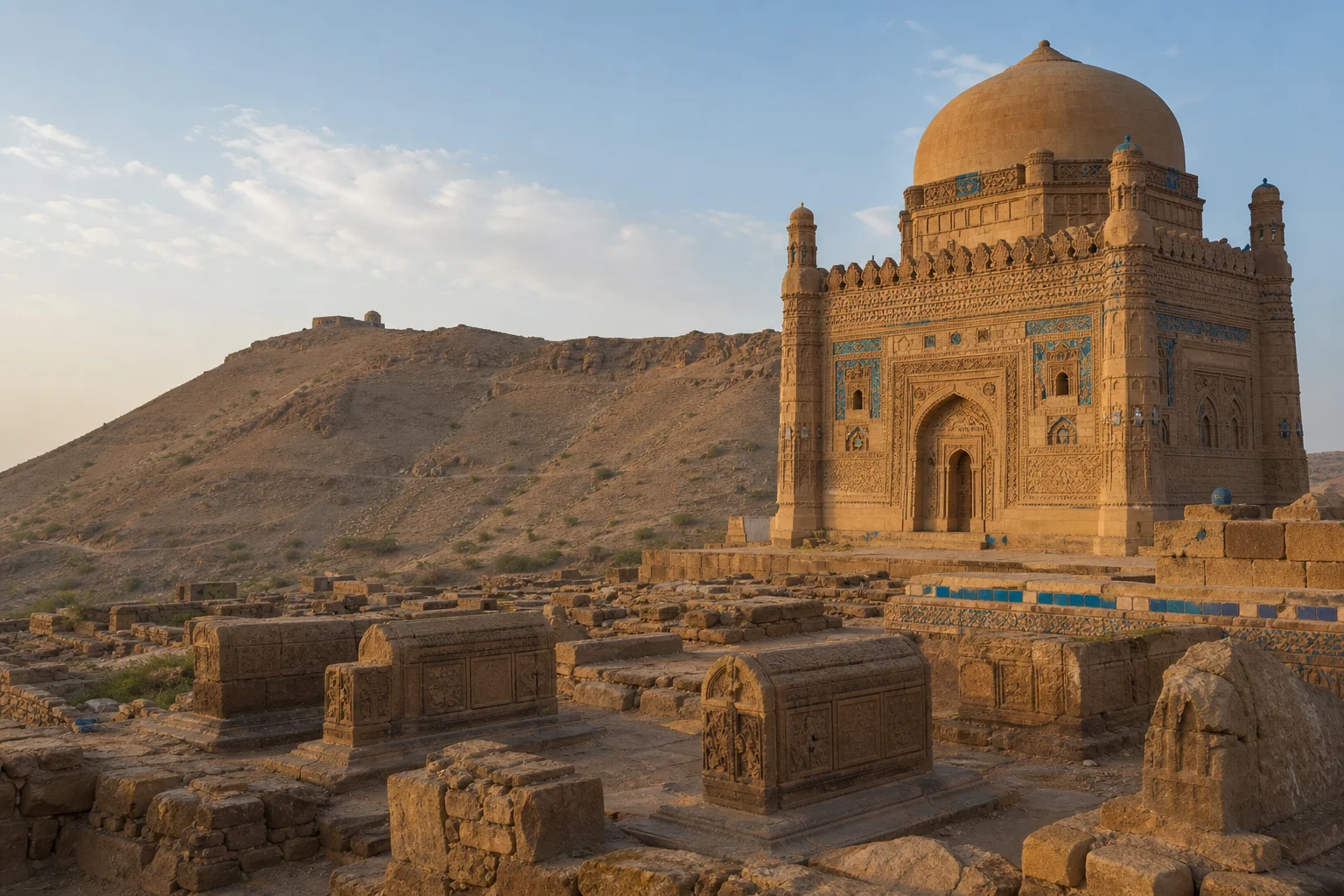
On the edge of Thatta, where the Indus delta opens towards the Arabian Sea, Makli Hill rises as a long, pale ridge above the plain. Across it extends Makli Necropolis: a vast funerary landscape of graves, platforms, canopies and mausoleums, many softened by weather yet still alive with line, colour and extraordinary detail. It is a place that asks for slowness. From a distance, the monuments seem to gather like a low-built city; up close, their surfaces reveal calligraphy, floral carving, geometric pattern and traces of blue tile.
Makli is often described as one of the world’s largest necropolises. Its scale matters, but it is not the whole story. The site is a stone chronicle of Sindh, recording the centuries when nearby Thatta was a major capital, riverine trading centre and seat of learning. Between the 14th and 18th centuries, people of very different standing were buried here: rulers, members of ruling households, governors, military figures, saints, scholars and ordinary families. Their monuments form not a single style, but an evolving archive of local craft and changing ideas of memory, authority and faith.
A city beside the city
Makli’s meaning is inseparable from Thatta. The historic city flourished in Lower Sindh at a moment when the Indus and its distributaries made the region a meeting place of inland agriculture, coastal exchange and intellectual life. As political power shifted through the Samma, Arghun, Tarkhan and Mughal periods, Thatta remained important enough for successive elites to build, patronise and be remembered there.
The necropolis occupied the high ground beyond the town. This separation gave burial a visible place in the landscape without removing it from the life of the city. Makli was a destination for remembrance, prayer and status, but it was also an extension of Thatta’s workshops. Stonecutters, tile-makers, calligraphers and builders transformed burial architecture into a public art. The dead were commemorated in structures that declared family connection, spiritual aspiration and, in some cases, political rank.
Its immense spread is one reason Makli can feel difficult to grasp on a first visit. There is no single façade that explains the whole. Instead, the eye moves from modest grave markers to great enclosures, from square tomb chambers to open pillared pavilions, from broad platforms to panels packed with ornament. The experience is less like entering a monument than walking through a historical landscape.
Four centuries in stone
The earliest monumental layers are associated with the Samma period, when Thatta emerged as a major centre in Sindh. Among the site’s most celebrated structures is the tomb of Jam Nizamuddin II, whose reign ended in 1509. Low, refined and intensely carved, it is a powerful example of how Makli’s craftsmen could make a monument feel both weighty and intricate. Its stone surfaces are articulated with bands, panels and a disciplined geometry that rewards close looking.
After the Sammas, the Arghuns and then the Tarkhans ruled from Thatta. Their tombs introduced new visual emphases while continuing local building traditions. At Makli, change rarely meant replacement. Instead, motifs and construction ideas were absorbed, adapted and placed beside older forms. The result is architecture that makes Sindh’s connected history visible: local stonework converses with forms associated with Gujarat, Persianate decorative traditions and, later, Mughal imperial taste.
The Mughal period added another layer to the necropolis. Tombs and mausoleums became more varied in scale and finish, with glazed tile, painted effects, inscriptions and ceremonial planning playing important roles. The mausolea of Jan Baba and Isa Khan Tarkhan the Younger are among the significant later monuments. The tomb of Diwan Shurfa Khan, who died in 1638, is especially noted for its colourful tile decoration.
To read Makli only as a catalogue of dynasties, however, is to miss its more human register. This was also a burial ground for people whose reputations were founded in learning, devotion or service. The presence of saints and scholars among political elites gives the site a broader social texture. It suggests a world in which religious learning, urban patronage and government were distinct but often closely intertwined.
The language of the monuments
Makli’s architecture is best understood as a language with many dialects. Some tombs are built as solid, temple-like masses, their walls worked with deep carving. Others stand as airy pavilions beneath canopies, using columns and brackets to create shade and rhythm. There are brick structures, stone structures and monuments where the colour of glazed tile once intensified the visual effect of the whole.
On many graves, inscriptions are central to the design. Quranic passages, names and commemorative texts turn the surface into a field of reading as well as seeing. Elsewhere, ornament carries the message. Rosettes, interlaced geometry, stylised vegetal forms and architectural frames give order to walls and cenotaphs. The carvings are not incidental decoration applied to an otherwise plain structure; they are integral to how the tombs speak.
One of Makli’s great artistic achievements is its ability to translate the effects of other materials into stone. Carved surfaces can resemble textile pattern, painted panels or glazed-tile grids. This does not make them imitations in any simple sense. It shows the confidence of local artisans, who developed a distinct visual vocabulary from a wide field of influences. At Makli, stone can seem almost light enough to be woven.
The monuments also reveal a practical intelligence. Their platforms, walls, openings and roofs respond to heat, rain and the demands of construction in a landscape shaped by wind and salt-laden moisture. Yet the environment that helped define the site now contributes to its fragility. Time has worn inscriptions, loosened masonry and faded decorative surfaces; heavy rains, temperature changes, salts, vegetation growth and ground conditions all pose serious challenges to its survival.
A heritage of care, not spectacle
Makli became a World Heritage Site in 1981 because it offers an exceptional testimony to the civilisation of Sindh from the 14th to the 18th centuries. That recognition does not place the site safely outside time. Conservation at Makli is ongoing, demanding careful documentation, sound drainage, compatible materials and decisions that respect both the monuments’ authenticity and their vulnerability.
In recent years, conservation work has focused particular attention on monuments damaged or threatened by severe weather, including the effects of the 2022 monsoon. The work is necessarily patient. Repairing an old tomb is not simply a matter of making it look new. It requires understanding how the original structure was assembled, how its stone and mortar have aged, and how intervention can support the monument without erasing the evidence of its long life.
This is why Makli should be approached as more than an atmospheric backdrop. The quiet that visitors often notice is not emptiness. It is the stillness of a place dense with craftsmanship, belief and historical evidence. Every carved panel is part of a larger record; every missing stone is also a reminder that heritage survives through stewardship, not inevitability.
How to encounter Makli thoughtfully
A visit is most rewarding when it allows time for looking rather than rushing between named tombs. Begin by taking in the hill as a whole, then pause at individual monuments to notice their changing materials and proportions. Look for the relationship between broad architectural form and minute surface work: the carving around an opening, the balance of a canopy, the remaining fragments of tile, the changing script across centuries.
Makli is a burial ground as well as a historic site, so respectful conduct matters. Dress modestly, avoid climbing on structures or touching fragile carvings, and do not remove even small fragments of stone or tile. Photography should never come at the cost of damage or disturbance. Local guides and heritage staff, when available, can help make sense of the site’s scale and its less immediately visible details.
It is also worth placing Makli within the wider cultural landscape of Thatta. The city’s historic mosque, its old urban fabric and the waterways of the Indus delta give context to the necropolis. Together, they show a Sindh shaped not by one fixed identity but by movement: of rivers, artisans, ideas, rulers and trading connections. Makli preserves that movement in durable material.
The endurance of a shared memory
Pakistan is often introduced through dramatic mountains, grand forts or ancient ruins. Makli offers another way of seeing the country: through a landscape of remembrance made collectively over generations. Its greatest monuments commemorate prominent individuals, but its deeper achievement is communal. Thousands of graves and structures tell of an urban society that invested meaning in memory and expressed it through craft.
There is no need to romanticise decay at Makli. The weathered tombs are beautiful, but their erosion is also a call for care. What endures here is not merely stone. It is a record of Sindh’s ability to absorb influence without losing its own artistic voice, and to turn the universal human act of burial into an architecture of astonishing richness.
To stand among Makli’s tombs is to encounter history without a single narrator. The hill speaks in inscriptions, shadows, broken tiles and carved stone. Its story is unfinished because its preservation remains a living responsibility—one shared by the people of Sindh, by heritage professionals and by every visitor who chooses to look with attention.