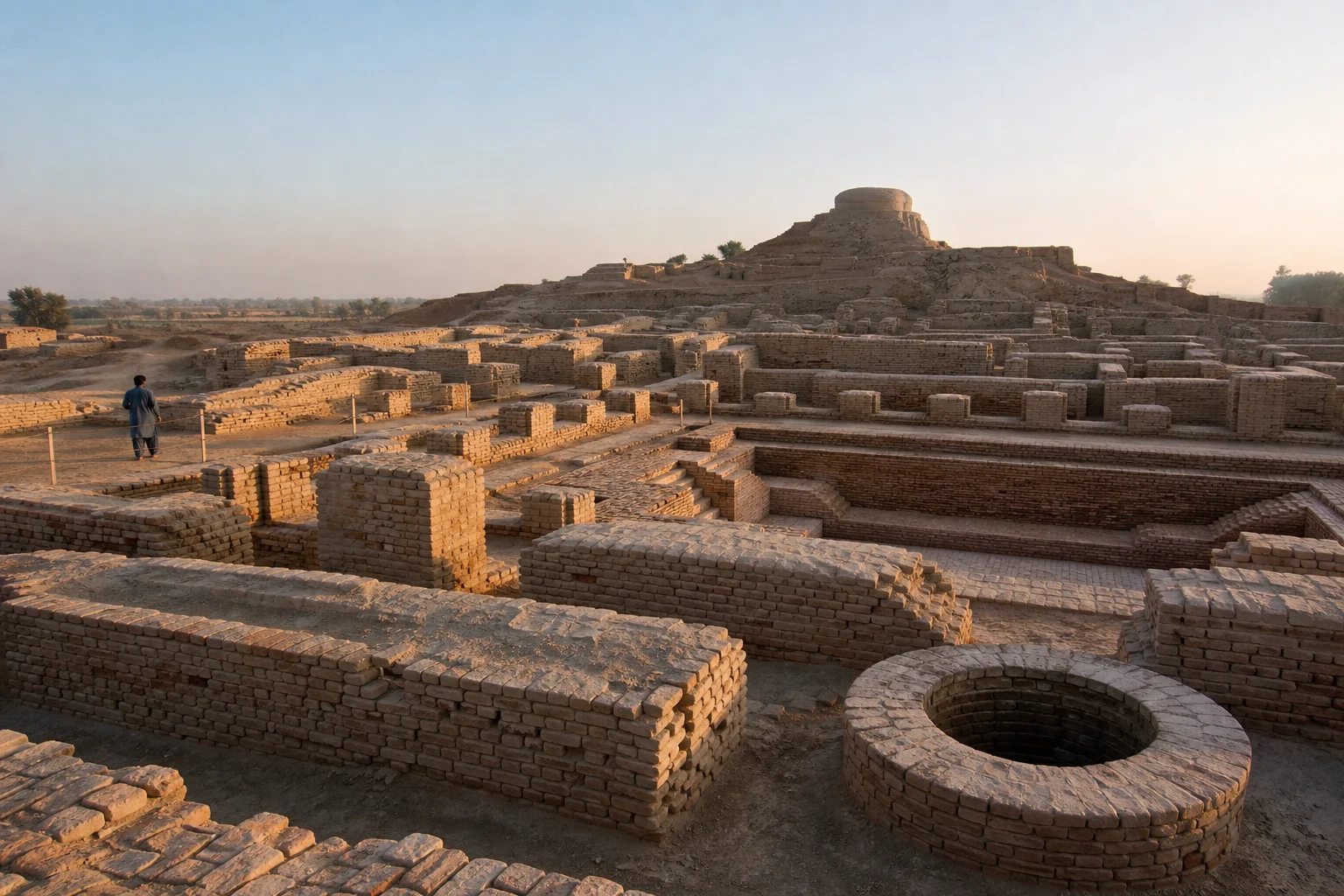
On the plains of northern Sindh, not far from the Indus River, Mohenjo-daro rises from the earth in low, sun-coloured walls. At first glance, its remains can appear austere: bricks, platforms, lanes and the outlines of rooms exposed to a wide sky. Yet this is one of the most eloquent archaeological landscapes in Pakistan. It preserves the plan of a city that flourished more than 4,000 years ago, when the Indus Civilisation was among the world’s great urban cultures.
To walk through Mohenjo-daro is to encounter an unexpectedly familiar idea of city life. There are streets arranged with purpose, houses gathered around courtyards, wells built close to homes, bathing areas, drains, workshops and substantial public structures. The inhabitants are anonymous to us—their script has not been deciphered—but the city they made still speaks clearly of planning, skill and collective organisation.
A city beside the Indus
Mohenjo-daro stands in present-day Sindh, near Larkana, on the right bank of the Indus. Its name is commonly understood as “Mound of the Dead,” a later name for a place whose original name is unknown. The ancient settlement belongs to the Indus Civilisation, also called the Harappan Civilisation after another major site in Punjab. At its urban height, broadly during the third millennium BCE, this civilisation extended across a vast region that included much of present-day Pakistan as well as parts of north-western India and adjoining areas.
This was not an isolated settlement on a riverbank. Mohenjo-daro belonged to a network of towns, villages, craft centres and trading communities connected by movement across river plains, deserts, coastlines and mountain routes. The Indus supported agriculture, while craft production and exchange brought materials from far beyond the city: stone, shell, metals and semi-precious materials all entered the wider Harappan world. Seals and other discoveries also point to contacts with regions to the west, including the Persian Gulf and Mesopotamia.
Its position near a great river was a source of life, but it also demanded resilience. The Indus has always shifted, flooded and remade its landscape. Mohenjo-daro’s builders raised major parts of the settlement on large mud-brick platforms, then constructed extensively in fired brick above them. The result was a city adapted to a dynamic floodplain, though not immune to the environmental pressures of its setting.
The rediscovery of an ancient metropolis
The site came to modern archaeological attention in 1922, when excavations near a Buddhist stupa revealed that the mound concealed remains far older than the visible monument. Subsequent work exposed streets, houses and public buildings on a remarkable scale. Mohenjo-daro transformed understanding of South Asian history: it demonstrated that urban civilisation in the Indus region had developed in the Bronze Age with a sophistication comparable to other early centres of city life.
Excavation, however, is never a simple act of recovery. Once ancient brick is exposed, it must survive rain, heat, wind, salts in the soil and changing groundwater. Only a portion of Mohenjo-daro has been excavated, and that restraint is meaningful. Archaeologists must balance the desire to reveal more with the responsibility to protect what has already emerged. The unexcavated mounds are not empty ground; they are an archive kept in reserve for future research and better conservation methods.
Today, Mohenjo-daro is recognised as a World Heritage site. Its survival depends on sustained, patient care rather than dramatic reconstruction. The ruins are especially vulnerable to salinity, moisture and extreme weather, all of which can weaken the ancient brickwork. Conservation at Mohenjo-daro is therefore part of its story: the city is not only a relic of the past, but a living responsibility in the present.
Order without monumentality
What makes Mohenjo-daro so compelling is not a palace, a royal tomb or a single monumental statue. No confirmed royal residence has been identified, and there is no securely identified temple dominating the city in the way visitors might expect from some other ancient urban centres. Its grandeur lies instead in systems: the repeated decisions that made a large settlement work.
The excavated city is usually described in two broad parts. To the west is the raised citadel area, built upon a massive platform. To the east lay a more extensive lower town, where streets and residential blocks stretched across the plain. This division should not be treated too simply as a separation between rulers and ordinary people; archaeology does not yet provide a complete social map. But the contrast in elevation and architecture suggests that the western mound contained important communal or administrative structures.
Across the site, streets meet in a largely rectilinear arrangement. Buildings were constructed from bricks made to notably consistent proportions. That standardisation is one of the quiet signatures of the Indus Civilisation. It points to shared technical knowledge and agreed practices across a wide geographical area. A brick at Mohenjo-daro was part of a language of building understood far beyond one neighbourhood.
Within the residential areas, homes varied in size and arrangement, yet many were designed around inward-looking courtyards. This made practical sense in a hot climate: a courtyard could provide light, air, household workspace and a measure of privacy. Doorways often opened onto side lanes rather than directly onto the broadest streets. The city’s architecture suggests a life that was at once communal and carefully bounded, shaped by family routines, craft work, water use and neighbourhood movement.
Water, drainage and the everyday city
Mohenjo-daro is frequently celebrated for its drainage system, and rightly so. Its achievement was not merely that drains existed, but that water management was woven into the city’s fabric. Wells supplied households and neighbourhoods. Many homes had areas associated with washing. Drains, often lined or covered with bricks, carried wastewater away from buildings, while soak pits helped manage disposal.
It is tempting to call such arrangements “modern,” but that comparison can obscure what is more interesting: they were appropriate to the needs and knowledge of their own time. The people of Mohenjo-daro understood that dense urban life required attention to water, waste and maintenance. Their city was not simply a collection of houses. It was an organised environment in which private domestic spaces depended on shared infrastructure.
The density of wells is particularly striking. They indicate that access to water was embedded deeply in the city’s neighbourhoods rather than confined to a single central source. Standing among the circular brick shafts, a visitor can sense how essential these structures were. They were not decorative features or isolated engineering feats. They were part of the daily rhythm of drawing water, preparing food, washing, making goods and sustaining households.
The Great Bath and the limits of certainty
The site’s most famous structure is the Great Bath, set within the raised western sector. It is a large brick-lined tank, reached by steps at either end and surrounded by rooms and passages. Its builders made it remarkably watertight, using carefully laid fired bricks and a waterproofing material. The structure’s construction alone makes it extraordinary: this was a major investment of labour, material and expertise.
Its exact purpose, however, remains uncertain. Many scholars have suggested that it was used for ceremonial or ritual bathing, partly because of its prominent setting and careful design. That is a plausible interpretation, but it should remain an interpretation rather than a certainty. The unread Indus script offers no surviving text to explain the building in its inhabitants’ own words.
This uncertainty is part of Mohenjo-daro’s intellectual power. Archaeology can reveal what people built and how they arranged their world; it cannot always recover every meaning they attached to it. The Great Bath invites humility. It reminds us that ancient people were not simply prototypes of later societies, waiting to be translated into familiar religious or political categories. They belonged to a civilisation with its own institutions, symbols and social practices, many of which remain beyond our reach.
Objects that bring people closer
Small finds from Mohenjo-daro make the city feel inhabited rather than abstract. Archaeologists have recovered pottery, tools, ornaments, beads, terracotta figures, shell objects and carved seals. These objects show technical confidence and a vivid material culture. Bead-making, metalwork and seal carving required specialised knowledge, while jewellery and finely made household goods suggest that taste and display mattered as much as utility.
The seals are among the most evocative discoveries. Often small and square, they carry animal imagery and short sequences of signs from the Indus script. Some may have been used to mark goods or establish ownership; their images may have carried social, commercial or symbolic meanings. Yet the script remains undeciphered, and the brevity of most inscriptions makes it difficult to test proposed readings.
That silence has encouraged many dramatic claims over the years. Mohenjo-daro is sometimes presented as a city of solved mysteries, secret rulers or vanished certainties. The evidence is more fascinating than those shortcuts. We know enough to recognise an urban society of exceptional accomplishment. We do not know enough to name its language with confidence, identify its political structure precisely or explain every image on its seals. Responsible attention to the site means allowing both knowledge and uncertainty to stand together.
A place that changes the scale of Pakistan’s story
Mohenjo-daro expands the way Pakistan can be understood. It places the country not at the edge of ancient history, but at one of its formative centres. Long before the later kingdoms, faiths, languages and architectural traditions that shaped the region, communities in the Indus basin were building cities of remarkable complexity.
This does not make Mohenjo-daro a frozen origin point for everything that came after. History is never so neat. Civilisations change, disperse, adapt and leave uneven traces. But the site establishes a profound continuity of place: the Indus basin has long been a landscape of settlement, ingenuity, exchange and cultural imagination. Its ancient urbanism belongs to the deep time of Sindh and to the larger human story of how cities began.
For a visitor, the most rewarding approach is slow looking. Notice the width of a lane, the curve of a well, the threshold between a courtyard and a street, the precision of brickwork. Resist the urge to treat the ruins as a backdrop for a quick photograph or as a puzzle requiring a sensational answer. Mohenjo-daro asks for attention to ordinary things—water, walls, drainage, work and domestic life—because these were the foundations of its extraordinary city.
Anyone travelling there should treat the exposed remains with care: stay on designated paths, avoid touching fragile brickwork, keep the site free of litter and follow the guidance of local heritage staff. Conditions can change with weather and conservation work, so practical arrangements should be checked locally before travelling. To respect Mohenjo-daro is to understand that its survival is inseparable from its meaning.
In the heat and silence of the Sindh plain, the city’s streets do not offer a complete story. They offer something more durable: evidence that urban life, with all its shared obligations and quiet routines, was being imagined here at an astonishingly early date. Mohenjo-daro endures not because it answers every question, but because it keeps asking us to recognise the sophistication of people whose names we no longer know.