The mountain has more than one protagonist
Pakistan’s mountain stories are frequently told from the summit down. K2, Nanga Parbat, Broad Peak and the Gasherbrums loom large in the public imagination, as do the climbers who reached their high points. But an expedition begins much earlier and involves far more people than the names that eventually appear in a climbing report.
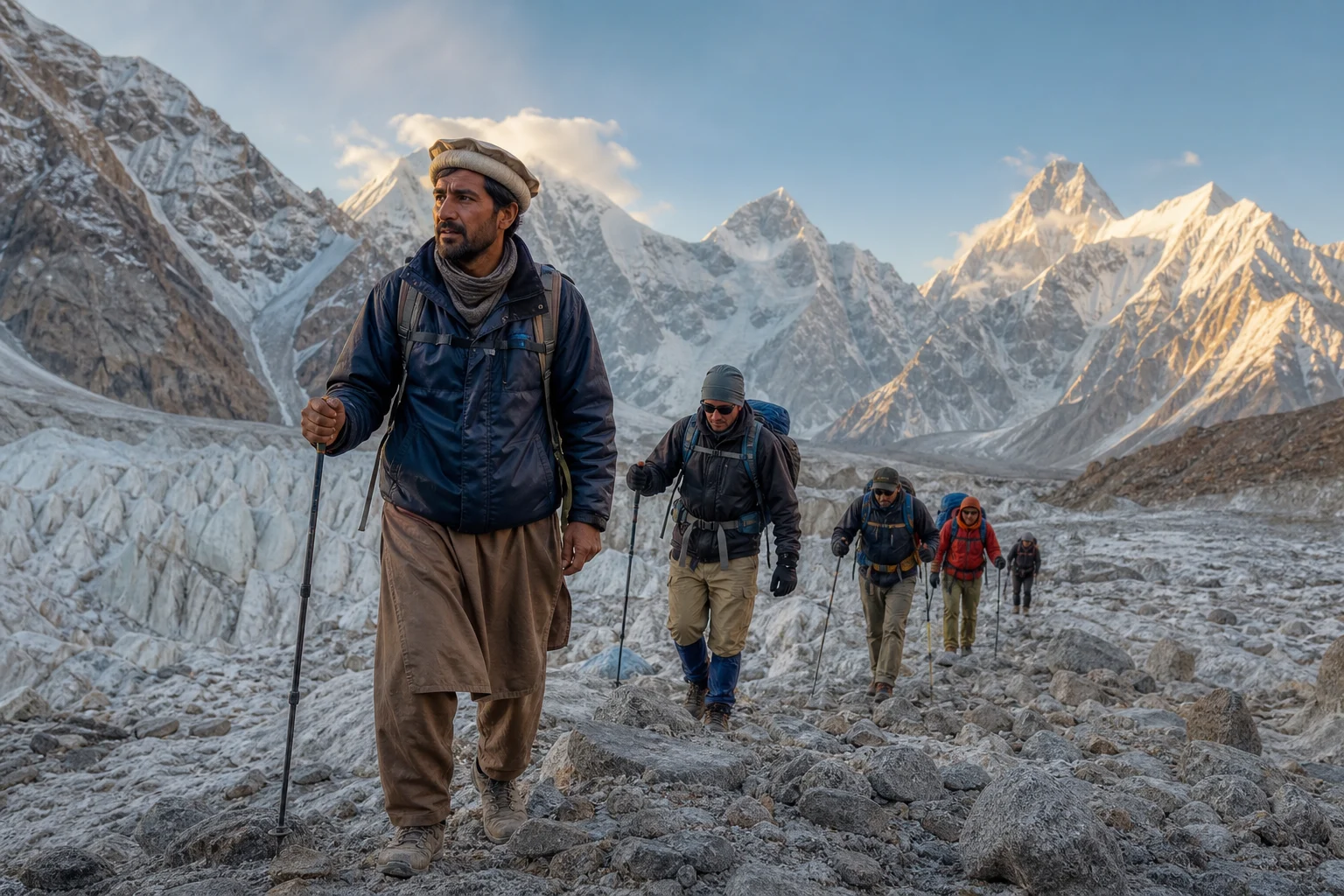
Before a team reaches a glacier, someone has helped translate ambition into a workable plan: weighing the route, season, equipment, food, transport, camp arrangement and ability of each member. On the trail, someone must keep a group moving at a sensible pace, notice when fatigue becomes dangerous, negotiate a difficult river crossing or shift the day’s plan when weather closes in. At high altitude, sound judgement is often more valuable than bravado.
That person may be described as a mountain guide, a high-altitude guide, a climbing guide, a local guide or, depending on the job, a high-altitude porter. The titles are not interchangeable, and the work varies from valley to valley and expedition to expedition. Yet together they point to a body of mountain expertise that has long supported travel in Pakistan’s Karakoram, western Himalaya and Hindu Kush.
To understand Pakistan through its mountains is therefore to look beyond the dramatic skyline. It is also to recognise the people who know how routes connect villages to pastures, how a valley changes after snowfall, how long a group can realistically take to acclimatise, and when the sensible decision is to stop.
Knowledge shaped by place
Many guides come from mountain communities in Gilgit-Baltistan and Chitral, where long distances, steep terrain and seasonal change are part of everyday life. Their knowledge is not simply a romantic instinct acquired by living near peaks. It is built through repeated movement: walking valley paths, working with trekking parties, observing snow and weather, learning camp systems, handling ropes and equipment, and accumulating the experience that makes a person useful when conditions no longer resemble a brochure photograph.
The regional diversity of this work matters. A guide familiar with the Baltoro approaches is not automatically an authority on the routes around Nanga Parbat; experience in Hunza does not replace local understanding in the Hindu Kush. Pakistan’s northern ranges are connected on a map, but their valleys, languages, approaches, climates and mountaineering traditions are distinct. Good expedition planning respects those distinctions rather than treating the country’s mountains as one interchangeable wilderness.
In Baltistan, the long approaches towards major Karakoram peaks have produced a deep culture of expedition work. In Hunza and upper Gojal, generations have encountered mountaineers, trekkers and researchers travelling towards remote glaciers and passes. In Chitral and its surrounding valleys, guides work within the landscapes of the Hindu Kush, where routes and rhythms have their own character. These are not merely service corridors to a summit. They are lived-in mountain worlds.
From expedition support to professional guidance
Pakistan has a long association with international mountaineering. Major expeditions in the twentieth century relied on local teams for access, transport, camp work and movement in difficult terrain. Older accounts did not always give Pakistani mountain workers the prominence they deserved; foreign leaders and celebrated climbers commonly dominated the record. Yet the success of large expeditions depended on many kinds of local labour and expertise.
Over time, the field has broadened. Pakistani climbers and guides have become visible not only as expedition workers but as accomplished mountaineers in their own right. Nazir Sabir’s path, which began with local guiding work in Gilgit in the 1970s before major climbs in the Karakoram and beyond, is one well-known example of how practical mountain experience can lead to elite climbing. Muhammad Ali Sadpara’s progression from porter work to international high-altitude mountaineering is another powerful reminder that the boundary between support role and celebrated climber has never been fixed.
These individual stories should not obscure the collective nature of the profession. Most guides do not become household names, nor do they need to. Their value lies in dependable competence: preparing clients for a trek, helping to run camps, interpreting terrain, maintaining a safe rhythm, resolving small problems before they become crises, and working alongside cooks, drivers, porters, liaison staff and village hosts.
Formal training has become increasingly important. The Alpine Club of Pakistan, founded in 1974, has contributed to mountaineering training and rescue capacity. More recently, professional programmes in Gilgit-Baltistan have focused on high-altitude guide education over extended periods, with instruction intended to strengthen technical ability and professional standards. This is an important development because mountain knowledge and modern technical practice are strongest when they meet each other: local familiarity alone is not a substitute for rescue training, and technical certificates alone do not replace years of careful experience in a particular landscape.
The work that visitors rarely see
For a visitor, the guide’s most visible moment may be a photograph at a pass or a quiet instruction on a steep section of trail. Much of the work happens out of view. A guide may be checking whether a group has the right clothing for a sudden temperature drop, calculating the next water point, making sure camp is not placed in a vulnerable location, or deciding whether an itinerary has become too ambitious for the weather and the group’s condition.
On a trekking expedition, guiding is often an exercise in pace. People arriving from sea level may be fit, enthusiastic and still unprepared for the effects of altitude. A responsible guide cannot promise that determination will overcome physiology. They must encourage a group while also setting limits: allowing time to acclimatise, recognising symptoms that need attention, and refusing the pressure to turn a holiday timetable into a medical gamble.
There is also the human work of the trail. Groups can include experienced climbers, first-time trekkers, photographers, researchers and travellers from different countries. Expectations differ. So do confidence, appetite, sleep, tolerance for discomfort and understanding of local customs. The guide becomes a practical mediator, translating both language and circumstance. This is one reason a guide’s communication matters as much as physical strength.
A mountain guide is not there to make the mountains seem harmless. The profession exists to help people meet real conditions with preparation, humility and better judgement.
Guides, porters and a shared expedition economy
Guiding should be understood alongside, but not confused with, porter work. High-altitude porters carry essential loads, help establish and supply camps, and often possess formidable route knowledge and physical resilience. Some go on to train as guides or climbers; others build long careers in porter work. Both roles are central to expedition culture, and both deserve respect, clear contracts, appropriate equipment and fair treatment.
The difference is not a hierarchy of worth. It is a matter of responsibility and task. A guide may take responsibility for route decisions, client management and technical leadership; porters may carry supplies and undertake demanding camp work, sometimes in exceptionally severe conditions. In many expeditions, responsibilities overlap. The important point is that no visitor should speak of a trek as though the landscape alone delivered it.
Expedition travel also reaches well beyond the mountain team. Earnings circulate through drivers, hotels, cooks, food suppliers, small shops, horse owners and households in staging settlements. This does not make tourism automatically beneficial. It makes thoughtful conduct essential. Visitors should ask who has been hired, whether local staff are properly equipped, and whether their operator has a credible approach to wages, insurance, waste and emergency planning.
Risk, responsibility and the courage to turn back
The grandeur of Pakistan’s mountains can tempt travellers into treating danger as part of the spectacle. Guides live with a more sober reality. Weather can change quickly, landslides can disrupt roads, rivers rise, snow conditions vary and high altitude affects people unpredictably. A plan suitable one week may be unsuitable the next.
For this reason, the finest act of guiding is sometimes a retreat. Turning back may disappoint a client who has invested time, money and hope in a particular summit or viewpoint. But mountain judgement is not a performance of confidence. It is the ability to revise a plan when evidence changes. A guide who calls for an earlier start, an extra rest day, a different camp or a return to lower ground is protecting lives as well as the integrity of the profession.
This ethic also applies to the environment. High mountains are not empty spaces. They contain glaciers, waterways, grazing grounds, wildlife habitat and routes used by local communities. Every expedition leaves some trace unless it is carefully managed. Guides can set the tone by insisting on disciplined waste practices, avoiding unnecessary disturbance and discouraging visitors from treating campsites as disposable.
How to travel with respect
For travellers, choosing a mountain guide should be about more than finding the lowest price or the fastest itinerary. Ask about experience on the specific route, group size, acclimatisation plans, emergency procedures, staff welfare and waste management. Be honest about your fitness and previous altitude experience. Do not conceal a medical condition in the hope that it will not matter.
Once on the trail, listen when the pace is adjusted. Learn a few greetings in the local language where appropriate. Dress with awareness in villages, ask before photographing people, and do not assume that a camp’s workers are invisible simply because they are busy. Their labour is the infrastructure of your journey.
Finally, check current local conditions and official requirements before travelling. Mountain roads, permits, weather patterns and route access can change. The most rewarding expedition is not necessarily the one that reaches the highest point. It is the one that leaves a visitor with a clearer understanding of Pakistan’s mountain communities, and leaves those communities treated with dignity.
The people behind the horizon
Pakistan’s mountains have an undeniable visual power, but their deepest story is human. Behind every orderly camp, carefully timed crossing and safe return is a network of skill that combines local knowledge with hard-earned technical experience. Guides make the mountains more legible without reducing their mystery. They connect visitors to terrain that demands patience, and to communities whose lives cannot be separated from the high valleys around them.
Great expeditions may end in a summit photograph. Their real achievement, however, is usually more collective: a group brought through difficult country with care, work distributed fairly, local knowledge respected, and a landscape left as lightly marked as possible. That is the quiet craft of Pakistan’s mountain guides—and it is as central to the country’s great mountain journeys as any peak on the horizon.