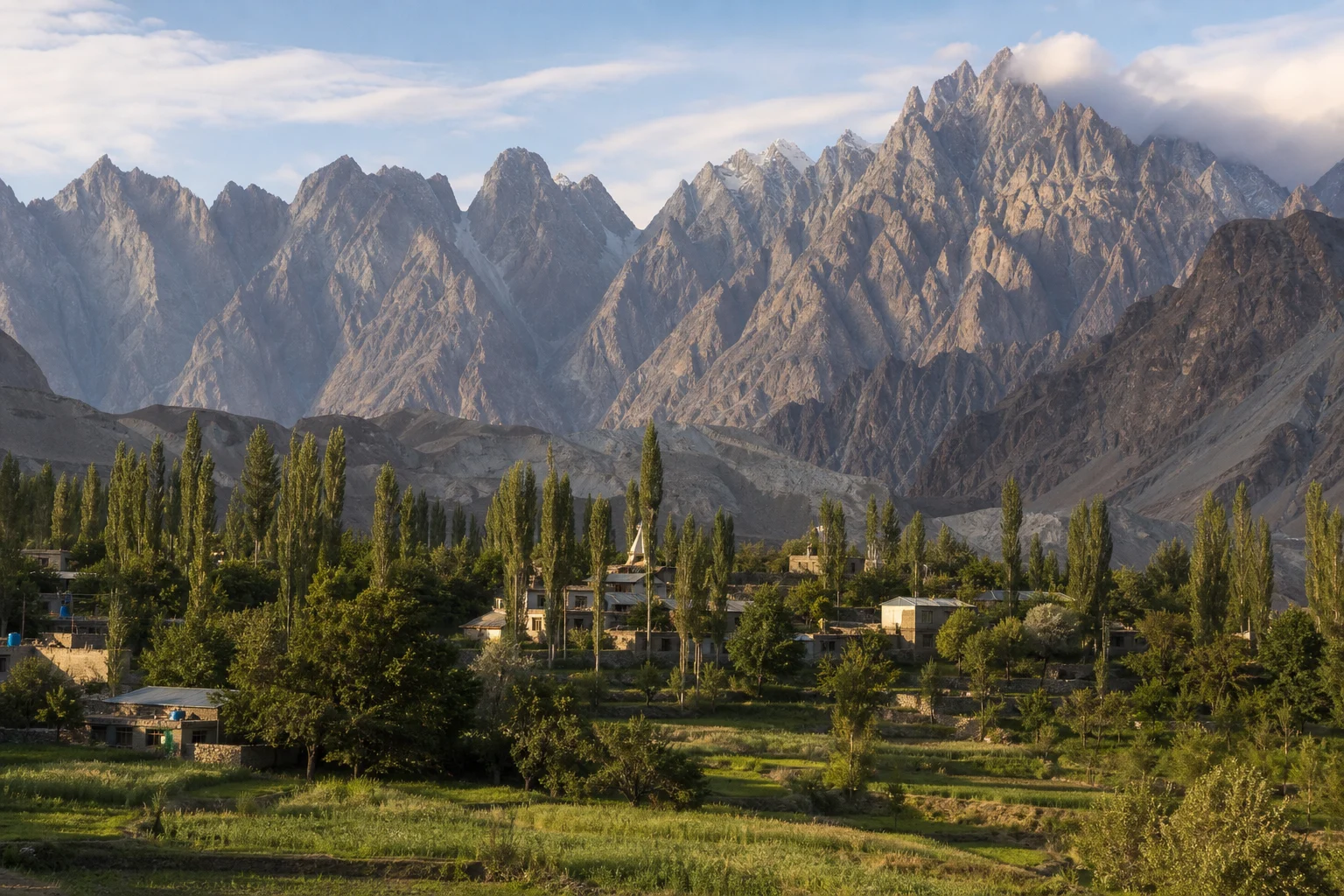
There are mountains that appear gradually, their outlines softening into a distant horizon. Then there are the Passu Cones. In Upper Hunza’s Gojal valley, they arrive as a sudden procession of stone spires: steep, dark, fluted and seemingly too sharp to be natural. Their profile has earned them the alternative name Passu Cathedral, though the local landscape needs no imported comparison to make its force felt. Above the village of Passu, the peaks rise with a theatrical clarity that makes even an ordinary pause by the road feel momentous.
Yet the Passu Cones are more than an image from the Karakoram Highway. They belong to a demanding and inhabited mountain world: a place of narrow cultivated terraces, apricot and poplar trees, glacier-fed water, Wakhi language and families whose routines have long been calibrated to altitude, weather and season. The cones are a visual landmark within that larger world, not a spectacle separate from it.
A skyline made by deep time
The name Passu Cones usually refers to the serrated ridges associated with Tupopdan, a peak rising to more than 6,000 metres in the Karakoram. Their extraordinary shape is the result of structure as much as erosion. Layers of ancient carbonate rock were compressed, tilted and lifted during the immense tectonic processes that formed the Karakoram. Frost, snow, water and gravity then worked patiently on the exposed slopes, cutting gullies and accentuating the steeply angled rock beds.
What appears, from the valley floor, to be a tidy line of matching pinnacles is in fact a complex mountainside. Light rearranges it constantly. At dawn, the ridges may look pale and austere; under a hard midday sky, their folds become graphic and almost black; by late afternoon, shadow settles into every gully. Snow does not simply decorate the cones. It explains their scale, catching in high recesses and tracing the routes through which meltwater descends.
In a region famous for height, the Passu Cones demonstrate that elevation alone does not create memorability. Many higher summits stand nearby, but these spires are unusually legible. Their drama lies in the relationship between the close valley, the cultivated foreground and the sudden vertical sweep of rock. They seem to rise from village life rather than float in a remote wilderness.
Passu in the wider landscape of Gojal
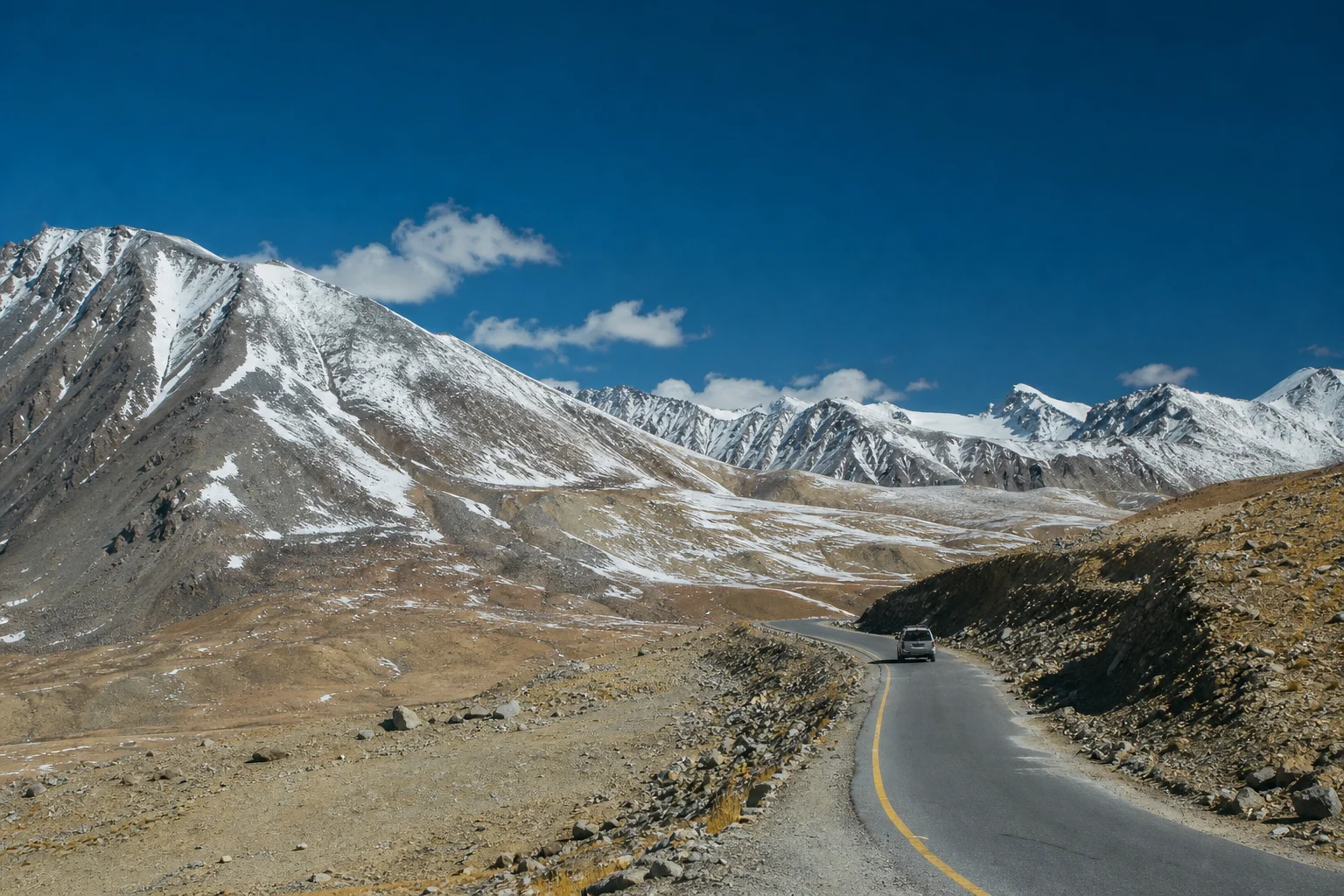
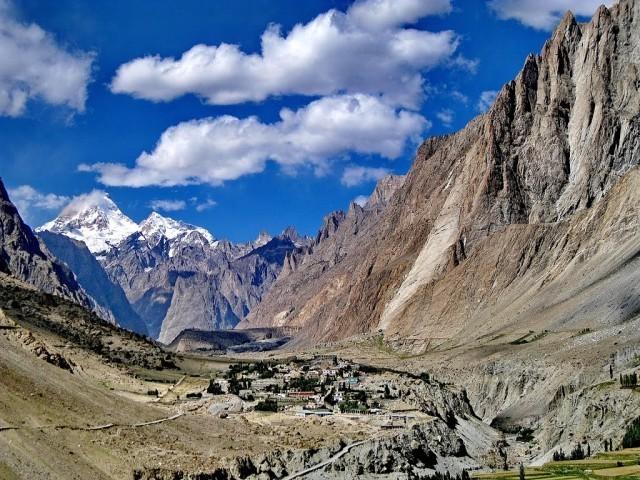
Passu lies in Gojal, the upper part of Hunza District in Gilgit-Baltistan. The village sits within a corridor of river valleys that has connected communities of the high mountains for centuries. Today, the road through the valley makes the cones accessible to travellers, but access should not be mistaken for ease. This remains a landscape where weather, landslides, snowfall and road conditions can change plans quickly.
The setting is defined by water in several forms. The Hunza River runs through the valley, while the nearby Passu and Batura glaciers reveal the colder sources that sustain much of the region’s hydrology. Batura is among the world’s great non-polar valley glaciers, extending deep into the mountains west of Passu. The Passu Glacier, closer to the village, has become one of the best-known introductions to glacier terrain for visitors to Upper Hunza.
But ice is not a static backdrop. Glaciers move, melt, carry debris and reshape the ground around them. Their behaviour varies from place to place and from year to year, and the Karakoram’s glacial systems have often shown patterns more complex than a simple story of uniform retreat. For communities living downstream, the important reality is practical: changing snow and ice affect water, hazards, travel and the delicate balance of mountain livelihoods. A glacier viewpoint is therefore not merely an excursion; it is an encounter with an active landscape.
Village life beneath the spires
The human foreground of the Passu Cones matters as much as the skyline. In and around Passu, cultivated land is precious. Green fields and orchards, sustained by carefully managed irrigation, make a striking contrast with the dry, mineral slopes above them. In summer, a line of poplars may stand like a second, softer forest beneath the hard geometry of the mountains. In autumn, cultivated foliage brings gold and rust tones to a valley otherwise shaped by grey stone and ice.
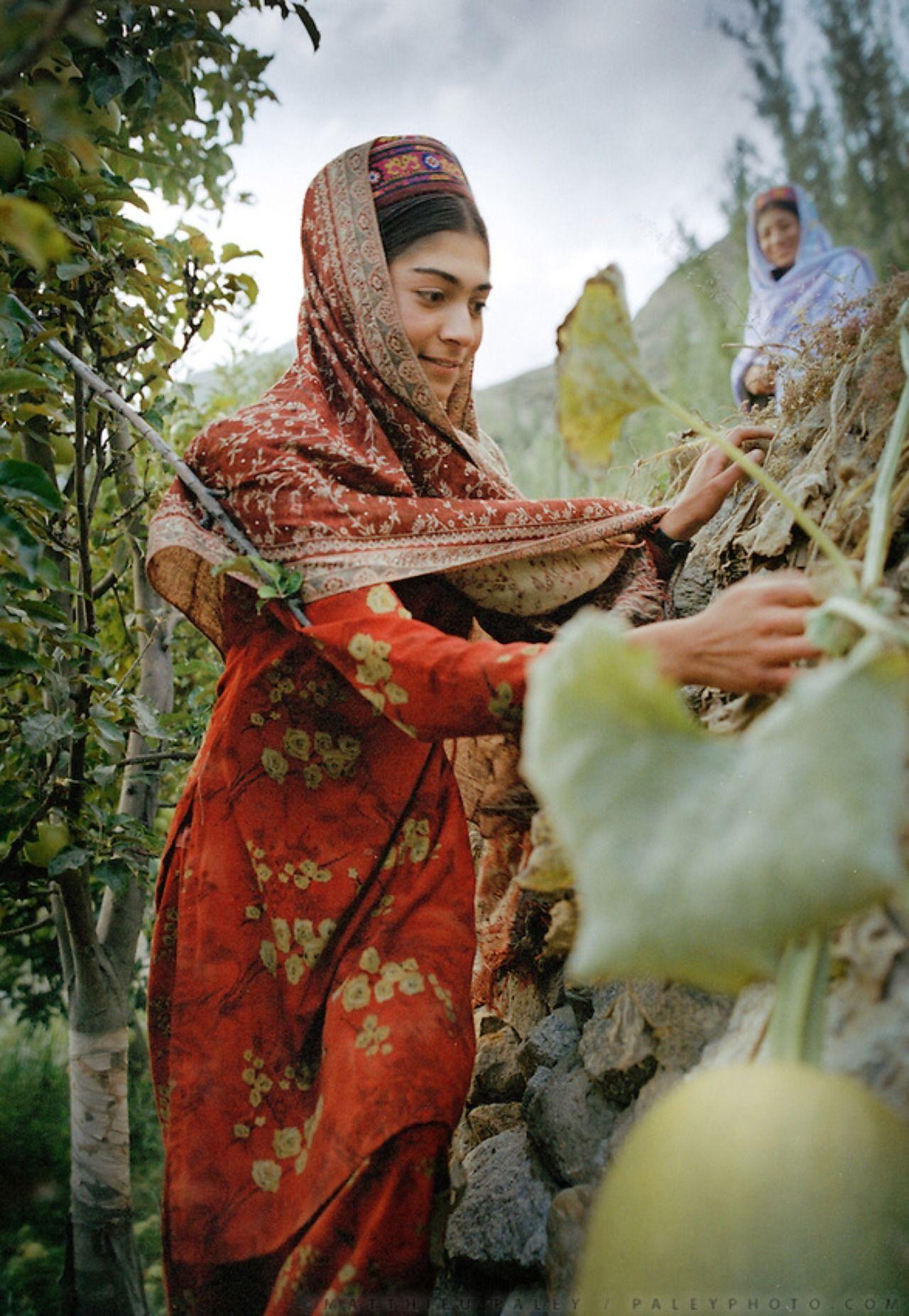
Gojal is strongly associated with Wakhi-speaking communities, alongside the linguistic diversity that characterises Hunza more broadly. Language, food, family networks, seasonal work and local knowledge all give the landscape its social texture. Visitors sometimes describe mountain places as if they were empty before a camera arrived. Passu offers a useful correction. The views that seem untouched are framed by homes, paths, water channels, fields and community life.
This is especially worth remembering when walking beyond the main road. A path through the village may pass close to a household boundary or cultivated plot. An orchard is not a scenic prop; it is somebody’s livelihood. Asking before photographing people, keeping voices low near homes and staying off planted ground are small courtesies that acknowledge the difference between visiting a place and consuming it.
The view is never only one view
The iconic roadside perspective has its place. It reveals why the Passu Cones have become a shorthand for Upper Hunza: the ridge rises cleanly beyond the valley, and the road provides an immediate sense of scale. But Passu rewards a slower way of looking. From the village, the spires are broken by trees, rooftops and stone walls. From higher ground, they begin to converse with neighbouring massifs and glacier valleys. From the water’s edge near Borith Lake, under suitable still conditions, their silhouette may appear in reflection.
Each angle changes the story. A distant view celebrates the skyline; a close view reveals the grain of daily life; a glacial view introduces the unsettled power of ice. The most satisfying experience is not to chase every recognised viewpoint but to spend enough time for the mountain to alter before your eyes. In clear weather, this may mean seeing the cones at first light, returning in the afternoon, then watching the last colour leave the upper ridges.
Photography can be part of that attention, but it need not dictate it. The temptation in a much-photographed place is to search for an image already familiar from screens. A better question is what the day itself is offering: cloud caught in a saddle, a field being irrigated, a local footpath, the slow lengthening of shadow. The mountains will remain; the conditions will not.
Beyond the postcard: a geography of resilience
It is easy to call the Passu Cones dramatic. It is more revealing to recognise what their surroundings demand. High valleys require skill in water management, farming on limited land, maintaining paths and homes, and responding to weather that can change abruptly. The beauty of Passu is inseparable from this work.
That perspective also alters the way travellers understand infrastructure. The Karakoram Highway is often described as a route of spectacular scenery, and it is. But for local communities it is also a lifeline, carrying food, supplies, students, workers and visitors through a terrain where routes can be vulnerable. When heavy rain, slope failure or snow interrupts travel, the effects are not simply inconvenient. They ripple through everyday life.
Travel in the mountains is therefore best approached with humility. Check current road and weather conditions before setting out, keep itineraries flexible, and allow for delays without treating them as a failure of the place. Carry warm layers even when the valley feels mild, take sufficient water, and use experienced local guidance for any excursion near glaciers or onto less familiar terrain. Glacier surfaces, loose moraine and river edges can be hazardous; beauty is not evidence of safety.
A respectful way to encounter Passu
The Passu Cones can be seen without a strenuous trek, but the ease of the first view should encourage care rather than haste. Spend time in the village if possible. Choose locally run accommodation or meals where appropriate. Learn a greeting, accept that prayer times and family privacy deserve consideration, and avoid leaving litter along roadsides, lakeshores or trails.
Do not climb over walls for a better frame, pick fruit without permission, or fly a drone around homes and people without clear consent. In high-mountain environments, waste is difficult to manage and ecosystems recover slowly, so carrying rubbish back is a basic responsibility. If visiting glacier margins, resist the urge to walk onto ice simply because others have done so. Conditions change, and a qualified local guide is far more valuable than an improvised shortcut.
These gestures are not limitations on travel. They are the foundation of a more meaningful kind of travel: one that leaves room for the place to remain itself.
The lasting image
What makes the Passu Cones endure in memory is not only their strange, blade-like silhouette. It is the way they gather the central elements of Upper Hunza into one view. Rock records geological time; glaciers speak of climate and water; the river traces the valley’s passage; cultivated land reveals human persistence; and a living village gives the scene its scale and intimacy.
To stand beneath the cones is to see Pakistan not as a single landscape but as a country of striking ecological and cultural contrasts. Here, the monumental and the everyday are inseparable. A mountain ridge can dominate the sky while irrigation water moves quietly through a field below. A road can carry travellers past an iconic view while also binding remote communities to schools, markets and family.
The Passu Cones do not need embellishment. Their spires are dramatic enough. The deeper story lies in learning to see what stands beneath them: a high valley shaped by stone and ice, and sustained by the people who call it home.