In the public imagination, the Karakoram often arrives as a landscape of absolutes: immense glaciers, serrated rock walls, wind-scoured passes and peaks whose names have become shorthand for mountaineering ambition. But an expedition is never only a story of the people who stand on a summit. It is also a story of those who make the approach possible: the porters who move food, fuel, tents, climbing equipment and personal loads through some of the most demanding walking country in Pakistan.
Across the valleys linked to the great mountain corridors of Gilgit-Baltistan, especially in Baltistan, portering has long connected village life with the outside world. It has brought local men into contact with explorers, surveyors, scientists, trekkers and climbing parties. It has also carried difficult histories of unequal labour, seasonal uncertainty and physical risk. To see porters merely as anonymous strength is to miss the real substance of their work: route sense, pacing, judgement, practical organisation and an intimate understanding of mountain weather.
The Karakoram’s expedition culture becomes more truthful when porters are recognised not as scenery around an adventure, but as skilled workers and fellow travellers whose decisions shape the journey from the first packed load to the final return.
Where the road ends
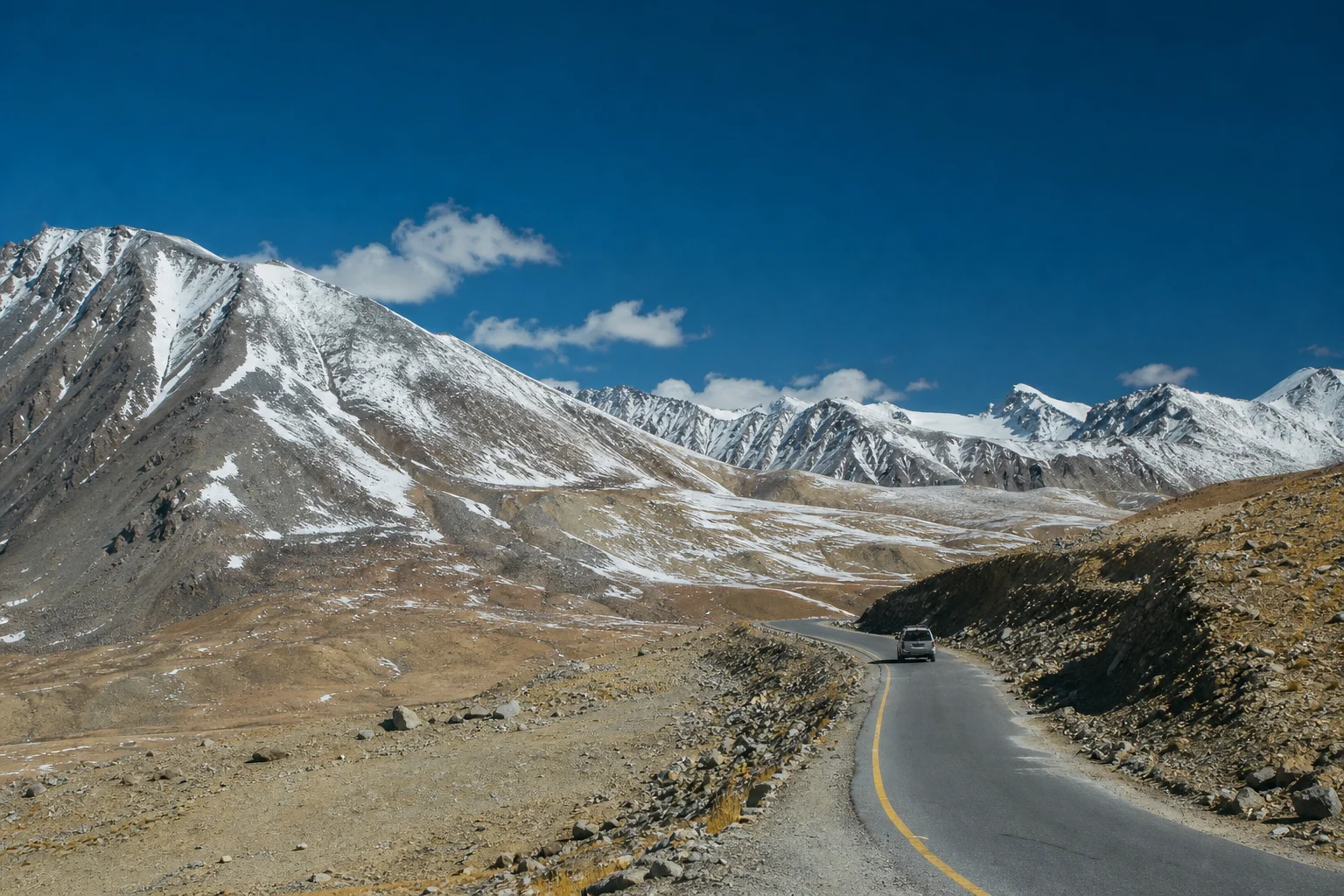
Many of the Karakoram’s most celebrated approaches begin far from the high camps shown in expedition photographs. A journey may start in Skardu or another mountain town, continue by vehicle along narrow valley roads, and then proceed on foot where the landscape becomes too steep, too broken or too glaciated for ordinary transport.
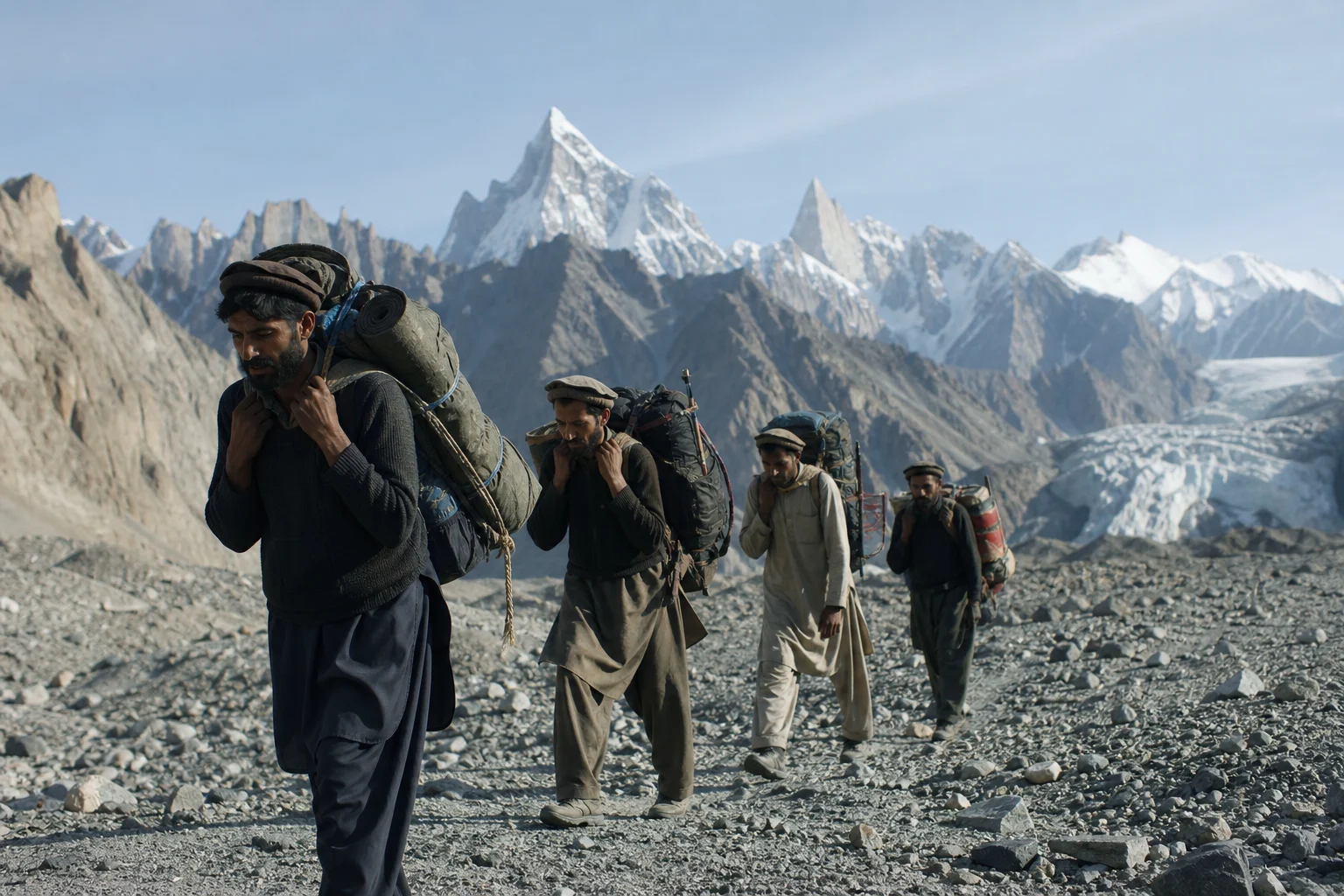
On routes towards the Baltoro Glacier, the Hushe Valley, the Braldu Valley and other mountain corridors, the work of moving an expedition is logistical before it is dramatic. Supplies must be counted, divided into manageable loads, protected from rain and river crossings, and delivered in sequence. A misplaced tent or a delayed food bag can create problems many days from the nearest road. Porters help turn a large, unwieldy collection of equipment into a functioning travelling system.
This is why the word porter, although widely used in mountain travel, can be too narrow. A trekking porter may carry loads between roadheads and base camps; a high-altitude porter may also move equipment above base camp, where snow, ice, fixed ropes and altitude make every task more consequential. In a well-run expedition, there are further roles: experienced local organisers, cooks, assistants and camp workers. Responsibilities differ, and so do the skills required.
The distinctions matter. Carrying on a glacier is not simply carrying on a trail. Loads must be balanced for unstable ground. A safe line may change after snowfall, rising temperatures or a shifting stream. A porter who has returned repeatedly to a route may recognise hazards that a visiting trekker cannot read from a map: a weak snow bridge, a safer place to cross meltwater, a slope that becomes dangerous late in the day, or a camp site exposed to falling rock.
Knowledge carried in the body
Endurance is the most visible aspect of portering, but it is only one part of the craft. The ability to walk steadily for days, manage a load, conserve energy and reach camp with enough strength to organise the next stage comes from experience rather than spectacle. In the mountains, speed is not always wisdom. A measured pace protects the group from exhaustion and helps people adjust to height and terrain.
Porters are often portrayed through a language of superhuman toughness. It may sound admiring, but it can also be reductive. It risks treating difficult labour as natural to certain people rather than as work performed through skill, preparation and necessity. The mountain worker is not a symbol of endurance; he is a person making practical decisions under pressure, often while supporting a household through seasonal income.
In Baltistan, portering has historically fitted around agricultural life, family responsibilities and the short working season available in high valleys. It is not the only occupation of every household, nor is it undertaken by all men. The people who enter expedition work do so within particular village economies and personal circumstances. For some, it has provided an important supplementary income. For others, it has opened paths toward guiding, climbing, cooking, transport work or tourism entrepreneurship.
That complexity should caution visitors against easy assumptions. A person may speak Balti, Urdu and some English; another may have deep familiarity with a glacier but no interest in climbing a summit; another may be developing technical skills in rope work and rescue. Experience cannot be measured by appearance, ethnicity or a romantic idea of mountain life. It should be recognised through clear roles, fair terms and respect for professional judgement.
From caravan routes to expedition labour
Long before modern adventure tourism, mountain valleys were linked by foot travel, trade, herding and local exchange. The Karakoram was never an empty wilderness awaiting discovery. Communities knew its rivers, grazing grounds, passes and seasonal rhythms because these landscapes were part of daily life.
During the nineteenth and twentieth centuries, outside exploration and surveying created a more formal demand for local carrying labour. Later, mountaineering expeditions expanded that demand. The journeys described in classic expedition literature depended on large groups of local workers, even when the published accounts gave their names and experiences only passing attention.
This history has an uncomfortable side. Scholarly research on northern Pakistan has shown that portering developed within unequal relationships between outside travellers, officials, agencies and mountain communities. Colonial-era systems sought to regulate the recruitment and movement of labour. Expedition accounts sometimes described workers in patronising terms, while overlooking the knowledge and bargaining power that made the journey possible.
Porters were not passive figures within that system. They negotiated pay, assessed conditions, withdrew labour and made their own choices about whether a journey was worth taking. Their refusals and work stoppages, recorded in parts of the historical literature, are reminders that a mountain expedition has always been a relationship between people, not a one-sided enterprise commanded by visitors.
Today, the language of travel has changed, but the ethical question remains: who carries the risk, who receives the recognition, and who has a genuine voice in the decisions made on the mountain?
The changing meaning of expertise
Modern expeditions have brought new equipment, satellite communication, commercial guiding and more specialised expectations. They have also made clearer the need to distinguish between a porter hired for an approach march and a trained worker operating in technical, high-altitude terrain.
High-altitude work can involve carrying loads through crevassed glaciers, assisting with camp placement, moving gear between camps and travelling on fixed lines. Such work should never be treated as an informal extension of ordinary trekking. It requires appropriate clothing and equipment, training in rope systems and rescue, realistic load planning, acclimatisation, insurance and the authority to decline unsafe tasks.
In recent decades, training initiatives in Gilgit-Baltistan have supported mountain workers in areas such as rope handling, knots, rappelling, crevasse rescue and environmental care. These efforts point toward an important shift: the future of expedition culture should depend less on the assumption that local workers will simply endure danger, and more on recognised qualifications, safer systems and pathways for professional advancement.
The goal is not to erase the porter’s role by replacing it with a generic international model. It is to value mountain expertise properly. Workers who know local routes and conditions should have access to the equipment, training and decision-making power that match the responsibility they carry. A culture of safety is strongest when it is built with local communities rather than imposed upon them at the last minute.
Life at camp
Much of portering’s skill is quiet and repetitive. There is the morning distribution of loads, the adjustment of straps, the patient waiting when weather stops travel, the choice of a place to pitch tents, the collection of water, the making of tea, the repair of a damaged bag, the recovery of scattered equipment after a rough crossing. These actions rarely become the headline of an expedition. Yet they are what allow a group to continue.
Camp is also where an expedition’s social character is revealed. Does the whole team share information about the next day? Are workers provided with suitable shelter, food and rest? Are loads planned before the journey rather than increased casually in the field? Are individual names learned and used? Is the local organiser heard when conditions change?
Respect is not a ceremonial gesture. It is expressed in practical habits: written agreements understood by everyone, payment made transparently and on time, appropriate insurance, proper equipment, reasonable loads and an unambiguous right to refuse dangerous work. It also means recognising that the person who carries gear is not automatically available to carry every burden created by poor planning.
Visitors should avoid the old habit of calling every mountain worker a “Sherpa.” Sherpa is the name of a distinct Himalayan people, not a universal label for altitude labour. In the Karakoram, workers have their own regional, linguistic and personal identities. Using someone’s actual name, role and preferred description is a modest but meaningful form of respect.
A more honest way to travel
For trekkers, the best way to honour Karakoram porters is not through exaggerated praise after the journey. It is through responsible choices before and during it. Choose operators that explain employment conditions clearly. Ask how loads are allocated, whether workers are insured, what equipment is supplied and how safety decisions are made. Carry your own day pack where appropriate, pack thoughtfully and do not treat extra belongings as someone else’s inevitable burden.
On the trail, remember that landscape is lived space. Follow local guidance at river crossings and on glacier sections. Keep camp waste under control and carry out what the route cannot absorb. Do not press a group to move in poor weather simply to preserve an itinerary. Mountain conditions change; flexibility is part of travelling well.
There is also a deeper lesson in the porter’s perspective. The Karakoram does not yield to individual ambition alone. Its routes are sustained by cooperation: between villages and agencies, cooks and organisers, climbers and workers, people carrying different kinds of knowledge. The summit photograph may show one or two figures against a vast horizon. The real expedition is the larger human chain behind it.
Beyond the heroic silhouette
Pakistan’s mountain heritage is often presented through its grandest outlines: K2, the Baltoro, the great towers of rock and ice. But heritage also resides in labour, memory and skill. It lives in the people who know how to move carefully through a difficult landscape, who understand that a load must arrive dry, that a camp must be safe, that weather can reorder every plan, and that the mountains demand patience from everyone.
The porters of the Karakoram deserve to be seen in full: not as nameless figures bent beneath expedition baggage, and not as symbols of impossible stamina, but as workers, neighbours, organisers and mountain professionals. Their knowledge has helped shape the culture of exploration in northern Pakistan for generations. Any honest account of the Karakoram begins by acknowledging that the route has never been carried by climbers alone.