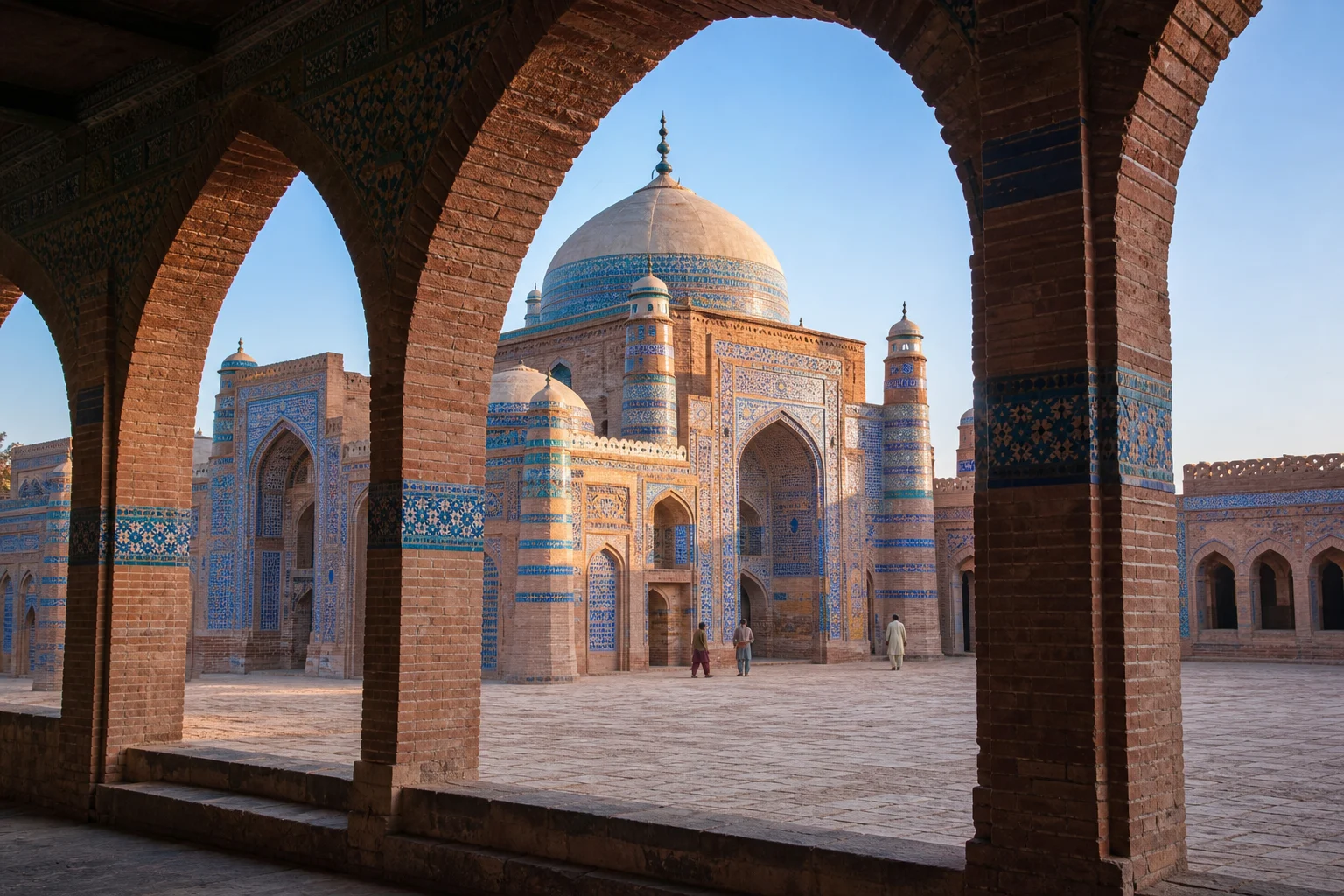
At Thatta, south-east of Karachi, the Shah Jahan Mosque appears at first as an exercise in restraint. Its exterior is built largely of warm, earth-coloured brick; its low domes rise in a broad, measured field rather than competing for attention with towering minarets. Then one passes through its arches and the building changes register. Blue, white and turquoise surfaces gather above the eye line. Brickwork becomes pattern. Domes turn into circles of colour. A spoken word seems to travel farther than expected.
Known also as the Jamia Masjid of Thatta, the mosque was built in the reign of the Mughal emperor Shah Jahan and is generally dated to 1644–47. It belongs to the period when Thatta was an important urban centre of Sindh, with commercial, religious and intellectual connections extending across the Indus region and the wider Indian Ocean world. The mosque is often described as an imperial gift, linked in tradition to Shah Jahan’s earlier association with the city. Yet its lasting character comes from something more complex than royal patronage: it is an architecture in which Mughal authority, Sindhi workmanship and older Timurid-Persian visual ideas meet without becoming identical.
This is what makes the mosque so revealing. It does not resemble the marble-centred image many visitors associate with Shah Jahan’s architecture. Here, brick is the principal material, colour is concentrated in glazed tile, and grandeur lies in multiplication: arch after arch, bay after bay, dome after dome. The result is both monumental and deeply local.
A Mosque Made from Repetition
The Shah Jahan Mosque is organised around a large rectangular courtyard, with the principal prayer hall on the western side, facing the direction of Mecca. Covered galleries line the north and south, opening towards the courtyard through rhythmic arcades. The plan establishes a sequence of thresholds: bright open court, shaded arcade, dimmer vaulted passage, then the richly ornamented interior of the prayer spaces.
Its geometry is felt before it is calculated. The courtyard measures roughly 169 by 97 feet, and the principal prayer chamber is of comparable scale. Heavy square piers and substantial walls give the complex an almost fortified calm. But the mass is continually softened by arches, vaults and domes, which divide the interior into smaller, legible units. Rather than one overwhelming central volume, the visitor encounters a carefully ordered congregation of spaces.
The mosque is commonly associated with ninety-three domes. They range from the larger domes above the major chambers to the smaller domes that roof the surrounding bays. Seen from inside, this repetition does more than cover a large building. It creates a visual rhythm: each dome is a circular pause after the pointed rise of an arch, each bay a measured interval in a larger composition.
Such planning has a social as well as aesthetic purpose. A congregational mosque must receive a community, direct attention towards prayer and allow people to move between open and enclosed space with ease. At Thatta, geometry does not stand apart from use. The courtyard admits daylight and air; the galleries provide shade; the prayer hall gathers worshippers beneath a roof whose divisions make a very large interior feel comprehensible.
Brick as Structure, Brick as Ornament
One of the mosque’s most distinctive qualities is its unapologetic use of brick. In many celebrated Mughal monuments, cut stone, marble inlay and polished surfaces dominate the visual impression. Thatta takes another path. Brick gives the building its body, its colour and much of its decorative intelligence.
The arcades around the courtyard reveal this especially well. Bricks are arranged to produce patterned surfaces and emphatic outlines, allowing a modest unit of construction to become a source of visual complexity. The effect is not merely decorative. Repeated brick courses underline the curves of arches, register the depth of recesses and make the walls appear at once weighty and finely articulated.
This treatment has affinities with architectural traditions that flourished across Central Asia and Iran, where brick could be used with remarkable sophistication. But the mosque should not be read as a distant imitation. Thatta had its own established language of masonry and ornament, developed in a region where brick was an important building material and where local craftspeople had long adapted outside influences to Sindhi conditions. The Shah Jahan Mosque is persuasive precisely because imported artistic ideas have been absorbed into a building that belongs to its place.
Look closely and the ornament never abandons structure. There is no hard divide between the wall that carries the roof and the wall that pleases the eye. Brick ribs frame tile panels; arches create fields for floral decoration; domes transform construction into pattern. The building’s beauty emerges from this collaboration of material and form.
Blue against Earth: The Language of Tile
If brick gives the mosque its gravity, tile gives it lift. The interiors contain one of the subcontinent’s most celebrated displays of glazed tilework. The contrast is central to the experience: red and ochre masonry establishes a grounded frame, while blues and whites open a cooler, more luminous world within it.
The great domes and important chambers carry especially elaborate decoration. Blue-and-white tiles radiate across curved surfaces in star-like and circular arrangements, turning the ceiling into an ordered sky. Elsewhere, square tiles are assembled into geometric panels, while the spandrels of major arches carry floral motifs. These are not incidental embellishments placed on an otherwise complete building. They animate the architecture’s proportions, making the eye travel from arch to dome, from panel to vault, from one measured surface to the next.
The palette links the mosque to the broad family of glazed-tile traditions often associated with Iran and Central Asia. Floral arabesques and geometric compositions evoke the seventeenth-century world of Persianate design, in which artisans, materials and motifs circulated across long distances. Yet the tiles at Thatta have their own personality. Their colour does not attempt to erase the building’s masonry; it intensifies the dialogue between glaze and brick.
For a visitor, the most rewarding approach is to slow down. From a distance, tilework can look like a continuous wash of blue. At closer range, its construction becomes visible: individual units, repeated shapes, joins, borders and shifts in scale. A dome may feel like a single celestial image, but it is built from countless decisions about line, colour and placement. Geometry here is not cold abstraction. It is patient craft made visible.
What the Echo Reveals
The mosque is famous for its acoustics. Its many domes, vaulted chambers and connected interior spaces create a notable carry of sound, allowing speech from the prayer area to be heard across much of the complex. The effect has encouraged a popular description of the mosque as an acoustic marvel, and it is easy to understand why. A voice released beneath one dome seems to find companions in the domes beyond it.
It is tempting to describe this as a precisely calculated acoustic device, but caution is useful. The relationship between the mosque’s form and its echo is clear; the exact intentions and technical methods of its seventeenth-century builders are harder to prove. What can be appreciated without exaggeration is the extraordinary fit between architecture and worship. The domes shape sound as they shape light and vision. They help turn a large brick complex into a place that can still feel intimate when occupied by voices, recitation and prayer.
Echo also changes the visitor’s sense of time. In a busy city, sound usually disperses quickly into traffic, markets and conversation. Inside the mosque, it lingers. A footstep, a quiet greeting or the recitation of a verse becomes part of the building’s atmosphere. The architecture asks not for silence alone, but for attentiveness.
A Provincial Masterpiece, Not a Peripheral One
Thatta is sometimes approached as a stop beside the better-known funerary landscape of Makli. That comparison can be useful, but the mosque deserves its own attention. Makli records centuries of rulers, saints, scholars and families in stone. The Shah Jahan Mosque records another aspect of Sindh’s past: an urban religious space made through brick, glaze, proportion and collective use.
Its importance also lies in the challenge it offers to simplified ideas of Mughal architecture. The mosque was commissioned under a Mughal emperor, but it does not reproduce the visual formula of imperial centres such as Lahore, Agra or Delhi. Its broad domed roofscape, extensive use of brick and tile, and links to older regional and transregional traditions make it a distinctive provincial work. “Provincial” here should not mean secondary. It means rooted in a particular landscape of skills, materials and cultural exchange.
That is part of Pakistan’s architectural richness. The country’s heritage is not a single style travelling unchanged from a capital to its edges. It is a collection of places where local makers interpreted larger currents in their own materials. In Thatta, blue tile and fired brick became the medium for that interpretation.
Seeing the Mosque with Care
The Shah Jahan Mosque remains a sacred place, not a museum set apart from religious life. Visitors should dress modestly, remove shoes where required, keep voices low and avoid entering prayer areas in ways that disrupt worshippers. Photography should be guided by discretion, particularly when people are praying or when a caretaker requests restraint.
The decorative surfaces also call for a different kind of care. Historic tiles and brickwork can appear durable, but they are vulnerable to weather, moisture, salts, careless touching and improvised repair. The most respectful way to look is to look closely without handling surfaces, leaning equipment against walls or climbing for a better image. Heritage survives not only through formal conservation but through ordinary restraint.
Before travelling, it is sensible to check local conditions and any site-specific guidance. But the deeper preparation is intellectual: arrive ready to see more than a beautiful monument. See a mosque that makes devotion spatial; a city’s history condensed into material; and a Sindhi work of art in which geometry is never merely mathematical. At Thatta, the line of an arch, the curve of a dome, the glint of a tile and the afterlife of a voice all belong to the same enduring design.