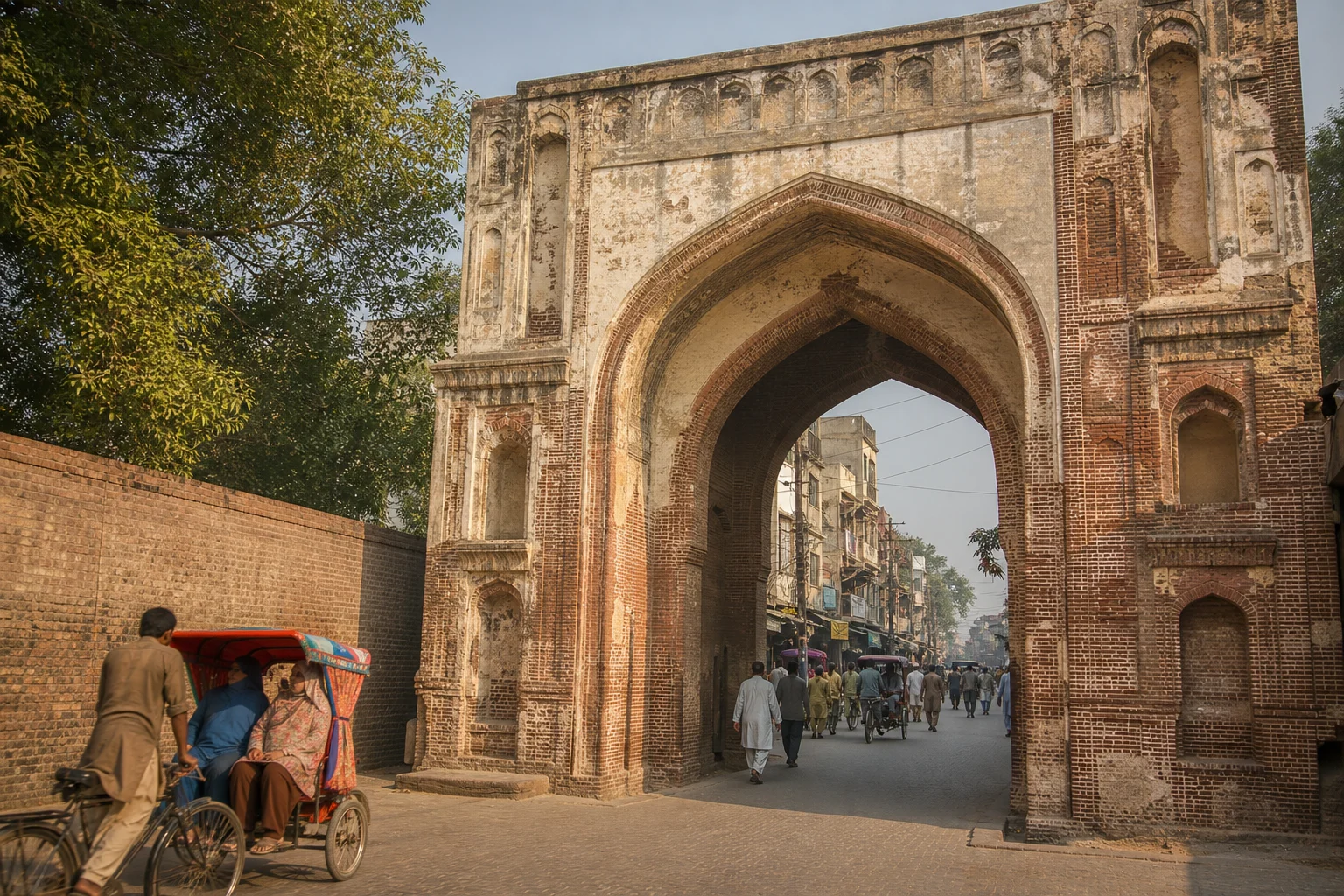
At the edge of Lahore’s old city, a gate can appear almost suddenly: an arch rising above the traffic, a pair of heavy-looking bastions, a narrow passage opening towards a bazaar thick with carts, pedestrians and shopfronts. It is tempting to see these structures as isolated relics, decorative survivors from a more picturesque past. But the gates of the Walled City were once part of an entire urban system: a fortified perimeter, a network of roads, markets arranged around specialised trades, neighbourhoods known as mohallas, and routes reaching far beyond Lahore.
The phrase “thirteen gates” remains one of the city’s best-known historical refrains. The count usually includes twelve principal gateways and the small Mori Darwaza, an opening rather than a grand gate. Today, only a handful of the gateways stand in substantial physical form. Yet the vanished gates have not entirely disappeared. Their names still organise the geography of everyday Lahore: Shah Almi, Mochi, Taxali, Masti and Akbari are not empty historical labels but places of commerce, worship, craft, food and family life.
This is why the gates matter. They are not a museum sequence around a frozen old town. They are thresholds into a city that has repeatedly rebuilt itself while keeping hold of its older vocabulary.
A city made porous by its gates
Lahore’s historic core developed over many centuries, but the fortified city is closely associated with the Mughal period, particularly the expansion of Lahore under Emperor Akbar in the late sixteenth century. The city stood at an important crossroads between Central Asia and the plains of northern South Asia. Its walls offered protection, but they did not make Lahore inward-looking. Gates controlled movement while also enabling it: caravans, grain, textiles, visitors, pilgrims, courtly processions and news all entered through them.
Two names make this outward orientation especially clear. Delhi Gate faced the route towards Delhi, while Kashmiri Gate opened in the direction of Kashmir. Other gateways referred to rulers, local communities, nearby institutions or working life. Their names are a compressed map of the city’s social history.
The gates also gave surrounding districts their identities. A person did not merely live in Lahore; they might belong to Bhati Gate, Mochi Gate or Shah Almi. Around each entrance, lanes developed their own rhythms, occupations and institutions. In the old city, place names often preserve the memory of the people who made a livelihood there: metalworkers, bookbinders, healers, traders, cooks, musicians and artisans.
The wall and its gates changed with political transitions. Lahore was reshaped during the Sikh period, when Maharaja Ranjit Singh’s court made the city a major capital again. Following British annexation in 1849, much of the defensive wall was dismantled and the city’s edge was recast by the Circular Road and newer urban expansion. Several gates were rebuilt in the nineteenth century, often in forms that did not replicate the earlier Mughal structures exactly. What visitors see today, therefore, is not one untouched layer of history, but an urban palimpsest.
Roshnai: the gate of light
Among the surviving gateways, Roshnai Darwaza is the most evocative reminder of Lahore’s royal landscape. Its name means the Gate of Light. Positioned near Lahore Fort, the Badshahi Mosque, Hazuri Bagh and the samadhi of Maharaja Ranjit Singh, it occupies a remarkable meeting point of Mughal, Sikh and later Pakistani heritage.
Roshnai Gate once served the royal quarter. Court officials, retainers and visitors connected to the fort passed through this side of the city, and the gate’s name recalls an evening illumination associated with ceremonial movement. Unlike several other surviving gates, Roshnai retains a particularly strong sense of its older form. Yet even here, the experience is inseparable from the modern city: vehicles move close by, visitors cross the open spaces around the fort, and the great monuments nearby continually alter the scale of the view.
Roshnai is a useful corrective to the idea that Lahore’s history belongs to a single dynasty. Within a short walk are Mughal imperial architecture, Sikh-era memorial architecture and the dense life of a modern Pakistani metropolis. The gate is not only a passage between streets; it is a passage between historical periods.
Delhi Gate and the royal route
Delhi Gate is perhaps the most legible entrance for a first encounter with the Walled City. It stands on the eastern side, near the route that once connected Lahore with Delhi, and leads into one of the old city’s most important historic corridors. Its large portal and flanking structures still convey something of the controlled arrival that a fortified city once demanded.
Beyond it lies the route known as the Shahi Guzargah, or Royal Trail. This passage carries the visitor through a dense civic and commercial landscape towards the Wazir Khan Mosque and Lahore Fort. The path reveals a central truth about old Lahore: monumental architecture and ordinary life were never completely separate. Shops were incorporated into religious and civic complexes; courtyards opened from crowded streets; houses, workshops and markets stood beside buildings of exceptional artistic ambition.
The restored Shahi Hammam near Delhi Gate makes this relationship visible. Built in the seventeenth century as a public bathhouse, it was not an isolated luxury but part of a working urban environment. Its heating, drainage and water systems speak of the practical intelligence required to sustain public life in a dense city. Conservation along this route has shown that heritage work is most meaningful when it includes streets, services, homes and livelihoods as well as celebrated monuments.
The gates that became neighbourhoods
Bhati Gate, Lohari Gate, Kashmiri Gate and Sheranwala Gate remain standing in altered or rebuilt forms. Each offers a different clue to how the city was organised.
Bhati Gate, in the south-western part of the old city, is associated with the Bhatti community and became known for literary, artistic and intellectual life. In the late colonial period, it had close connections with Urdu publishing, poetry gatherings, music and the early film world. Its lanes still lead towards institutions and houses that reward a slower, more attentive walk. The nearby Faqir Khana Museum, housed in a family home, is a reminder that private collections and domestic spaces have also safeguarded Lahore’s cultural memory.
Lohari Gate, sometimes called Lahori Gate, stands near an old market district. Explanations of its name vary: some connect it with Lahore itself, while others point to ironworkers who once worked in the vicinity. Such uncertainty is common in old cities, where official records, oral accounts and later retellings overlap. The present structure is largely a nineteenth-century reconstruction, but its bastions and central passage still suggest the scale of the former boundary.
Kashmiri Gate faces north towards the old route to Kashmir. Its comparatively plain, colonial-era appearance is itself historically revealing. Heritage is not always made of the most ornate structures. Sometimes it resides in a functional building that records an era’s materials, engineering habits and ideas of civic order.
Sheranwala Gate was earlier known as Khizri Gate, a name associated with Khizr, a revered figure linked in tradition with water. Its later name refers to the lions said to have been kept nearby by Maharaja Ranjit Singh. That shift in naming captures a familiar Lahori pattern: places accrue identities instead of exchanging one history for another.
What has vanished, and what remains
Some of the most resonant gates no longer survive as structures. At Akbari Gate, the gateway itself has disappeared, but Akbari Mandi remains one of Lahore’s important grain markets. The enduring market gives the absent gate a daily presence: sacks, scales, traders and wholesale commerce continue to define the district.
Mochi Gate survives above all as a locality. Its name has several proposed origins, including a possible association with a guard named Moti Ram and another with morchi, a trench soldier. Whatever its linguistic source, the area is long associated with public gatherings, food, religious observance and a distinctive civic energy. Nearby Mochi Bagh has been an important open space for public meetings.
Shah Almi Gate, named for the Mughal emperor Bahadur Shah I, was destroyed amid the violence of 1947. The gate is gone, but Shah Almi remains among the city’s busiest wholesale districts. Its streets make a difficult point plain: a historic landscape can carry the memory of loss while remaining economically indispensable.
Masti Gate stands in name behind Lahore Fort. Its title may be a shortened form of Masjidi, referring to the nearby Mariam Zamani Mosque, though another local explanation links it to a gatekeeper. Taxali Gate recalls the royal mint that once operated nearby; the mint and gate have vanished, but the surrounding area is still known for food, footwear and musical-instrument making. Yakki, or Zakki, Gate preserves the name of a saint in local tradition. And Mori Darwaza, the smallest opening, was historically associated with service access and refuse removal—an unglamorous but essential reminder that every great city depends on hidden systems of labour.
More than an architectural inventory
The lost gates should not be treated simply as a roll call of missing monuments. They reveal how Lahore has absorbed change. Walls were dismantled; roads widened; populations shifted; businesses adapted; old houses became warehouses, workshops or shops. In every period, the city faced the difficult balance between movement and preservation, commerce and residence, renewal and memory.
That balance remains urgent. The Walled City is intensely lived-in, and its value cannot be protected by turning it into a stage set. Conservation must respect residents, small businesses, religious spaces and the practical needs of a dense historic neighbourhood. It must also acknowledge that age alone is not the only measure of worth. A repaired façade, an inherited craft, a market route or a family-held memory may all form part of the city’s cultural fabric.
How to read the gates today
For a thoughtful visitor, the best approach is not to rush from arch to arch. Begin at Delhi Gate and walk inward, allowing the street to explain the gate. Notice how a broad entrance contracts into lanes; how a mosque, hammam, shopfront and house can form one connected urban composition; how trade still gives districts their sound and tempo.
At Roshnai Gate, look beyond the gateway itself to the relationship between fort, mosque, garden and memorial. In Bhati or Taxali, pay attention to the survival of cultural work and local commerce. At Shah Almi or Akbari, recognise that the absent structure has not erased the place. Its name still directs deliveries, meetings, businesses and belonging.
Dress and behave respectfully around homes and religious sites, ask before photographing people or private façades, and avoid blocking narrow working lanes. Conditions in the old city can change with weather, traffic and local events, so it is wise to check current arrangements before setting out. Most of all, arrive with patience. Lahore’s gates offer their deepest story not as a checklist of ruins, but as an invitation to understand the city as its residents do: in routes, names, thresholds and return journeys.