Sindh is often described through the Indus: its riverine plains, its delta, its desert margins and the ancient settlements that rose along its waters. Yet Sindhi culture is not simply a backdrop to this geography. It is a living way of making meaning from it. In homes, shrines, workshops, fields and city neighbourhoods, language, hospitality, music and craft form an interwoven social vocabulary—one in which memory is shared aloud, worn on the body, offered at the table and carried in song.
To understand Sindh is to resist the temptation to reduce it to a single image. The province includes the immense urban world of Karachi, historic river towns, agricultural settlements, coastal communities and the distinctive cultures of Tharparkar’s desert. Sindhi culture belongs especially to Sindhi-speaking people, but it has long developed alongside the languages, faiths and livelihoods of many communities. Its strength lies not in stillness, but in its capacity to hold continuity and change together.
A landscape of deep time, without easy shortcuts
The archaeological ruins of Mohenjo-daro, in Sindh, preserve one of South Asia’s earliest and best-known urban settlements. UNESCO dates the Indus civilisation represented there to roughly 2500–1500 BCE and notes the site’s sophisticated town planning, brick architecture, wells and drainage. () The presence of this ancient city gives Sindh an extraordinary historical depth, but it should not be used as a shortcut for explaining everything that is Sindhi today. Millennia separate the civilisation of Mohenjo-daro from modern regional identities, languages and customs.
What the site can offer is a sense of the long human relationship with this landscape: settlement, water management, exchange and skilled making. Later periods added their own layers. At Makli, near Thatta, an immense necropolis associated with a former centre of Islamic culture records Sindh’s history between the fourteenth and eighteenth centuries in carved stone, brick and glazed tile. UNESCO describes the monument complex as a local architectural language shaped by multiple influences rather than a single, sealed tradition. () That layered quality remains a useful way to approach Sindh itself.
Poetry as a common inheritance
At the centre of Sindhi literary imagination stands Shah Abdul Latif Bhittai, the eighteenth-century poet whose work is gathered in Shah Jo Risalo. His verses draw on the emotional force of regional folk narratives—stories of separation, loyalty, arduous journeys and longing—and turn them towards spiritual and ethical reflection. The women at the heart of many of these narratives are not decorative figures: they travel, wait, endure, choose and speak with moral authority.
Bhittai’s achievement was not merely literary. He made the landscapes of Sindh—desert tracks, river crossings, coastal journeys and grazing lands—into a language of interior life. Love can become devotion; distance can become a test of courage; the search for a beloved can become the search for truth. This is why the poetry continues to move so readily between page, memory and performance. It is encountered not only by specialists in literature but by listeners who recognise its landscapes and emotional terms.
The shrine of Shah Abdul Latif Bhittai at Bhit Shah gives this inheritance a physical home. The existing complex was built in 1772 to contain the poet’s tomb, with a mosque, mausoleum and courtyard framed by domed arcades. () For visitors, it is important to remember that a shrine is first a place of devotion and community, not a stage set. Dress modestly, follow the guidance of caretakers, ask before photographing people, and allow the rhythms of worship and listening to take precedence over sightseeing.
Sindhi poetry has never belonged to one voice alone. Earlier devotional poets and later writers expanded the language’s range, while oral storytellers, singers and readers have kept poetic expression close to daily life. The written tradition matters, but so does recitation: a poem learned by ear, repeated in a gathering or sung to a familiar melody remains part of culture’s active circulation.
When verse becomes music
In Sindh, the boundary between poetry and music is deliberately porous. The singing of Bhittai’s verses at Bhit Shah is associated with established melodic practice, while the provincial culture department distinguishes a traditional shrine-based style of vaaee singing from classically inflected performance. () The point is not to force this tradition into a narrow genre label. Its power comes from voice, repetition, melodic shape and the listener’s familiarity with the words.
Music also lives far beyond the shrine. Wedding songs, lullabies, work songs, devotional recitation and folk performance each give sound a social task: to mark a passage, tell a story, sustain attention or bring people into a shared emotional space. Instruments are part of that ecology, but they cannot be separated from the people who make, tune, teach and hear them.
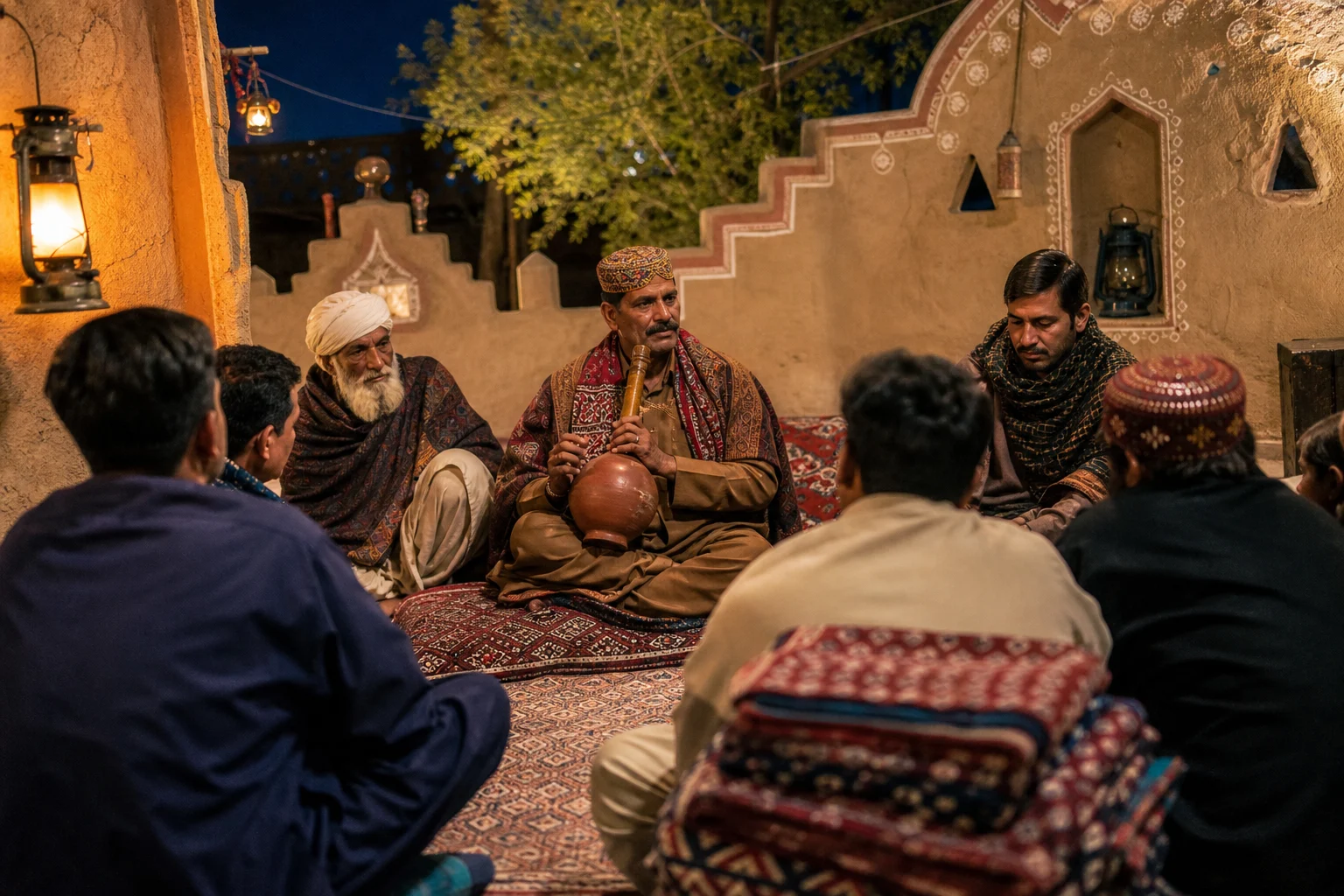
The boreendo, also known as the bhorindo, reveals how intimate that relationship can be. This small clay wind instrument is rooted in Thari village life; UNESCO records that it is traditionally made from sun-dried and kiln-fired clay, played at winter bonfires, weddings and festivals, and decorated by women with clay paint. In 2025, it was inscribed on UNESCO’s List of Intangible Cultural Heritage in Need of Urgent Safeguarding. () Its vulnerability is a reminder that heritage is not preserved merely by displaying an object. It survives when younger people can learn the skill, when makers can obtain materials, and when a community still has occasions to play and listen.
That lesson applies equally to celebrated voices and humble local repertoires. A recording can preserve sound; it cannot entirely preserve the exchange between performer and audience, the pause before a refrain, or the place-specific knowledge that tells a singer when a verse should be heard.
Hospitality as dignity, not performance
Visitors to Sindh often notice the quick offering of tea, water or a meal. It is tempting to call this simply friendliness, but Sindhi hospitality is better understood as a practice of dignity. Welcoming a guest acknowledges their presence and establishes a temporary relationship of care. In rural settings and close-knit urban neighbourhoods alike, an invitation to sit and share refreshment may carry more meaning than a formal introduction.
Hospitality does not mean that every home is automatically open to every stranger, nor should it be romanticised as an obligation without cost. It is shaped by household resources, gendered spaces, etiquette and circumstance. The respectful guest understands this. Accept an offer graciously if you can; decline gently if necessary; do not treat a private invitation as a cultural entitlement. If food is shared, follow the lead of hosts about seating, serving and photographs. A small attentiveness to these details is often more meaningful than grand praise.
Food itself tells a story of place. Grain, rice, fish, seasonal vegetables, dairy, dates and spices appear in varied combinations across Sindh’s riverine, coastal and desert environments. No single dish can stand for the whole province. The more revealing experience is to notice how a meal is arranged around season, household knowledge and the pleasure of feeding others.
Cloth, colour and the work of the hand
Ajrak is perhaps Sindh’s most recognisable textile: a block-printed cloth associated with rich reds, deep indigoes and carefully repeated geometric pattern. It is worn, gifted, draped and used ceremonially, but its significance is not exhausted by symbolism. Ajrak represents demanding knowledge of cloth preparation, resist processes, dyeing, printing and washing. It deserves to be valued as skilled labour rather than bought as a generic souvenir.
The Sindhi topi, with its distinctive front opening, is another familiar marker of regional dress. Yet symbols become meaningful through use: at family occasions, cultural gatherings, formal events and ordinary acts of presentation. Pakistan’s intangible-heritage documentation lists both ajrak/Sindhi topi craftsmanship and rilli, the traditional patchwork quilt, among cultural elements identified for safeguarding. () A rilli, assembled from pieces of cloth through quilting and patchwork, is especially eloquent because it joins beauty to utility. The British Museum’s documentation of a Sindh-associated quilt notes its roles as bedding, a sitting mat, an animal cover and, sometimes, part of a dowry. ()
These textiles also caution against the idea that tradition is untouched by commerce. Craft can support livelihoods, but only if makers receive fair recognition and buyers understand that a handmade piece reflects time, expertise and local design knowledge. Ask where an item was made, avoid bargaining to the point of disrespect, and distinguish workshop-made craft from mass-produced imitation.
Living traditions, carried forward
Sindhi culture endures because it is practised in ordinary settings: a grandparent reciting a verse, a musician teaching by repetition, a family preparing guests’ tea, a block printer aligning a pattern, a craftswoman piecing a quilt, a child hearing a story for the first time. These are not minor details beneath the headline events. They are the conditions that make a cultural world durable.
They also require care. Historic places such as Mohenjo-daro and Makli face conservation pressures, while living traditions need support for practitioners, apprentices and community spaces. UNESCO’s recent work with Thari communities has emphasised community-based inventorying, educational links and support for artisans as part of safeguarding living heritage. () The principle is sound: culture is strongest when the people who carry it help define how it is represented and sustained.
For a reader trying to understand Pakistan beyond its headlines, Sindh offers a generous beginning. Here, a river landscape becomes poetry; poetry becomes melody; melody gathers people; and welcome becomes a quiet ethic. The most lasting encounter is not a checklist of motifs, but an awareness that culture is being made in the present tense—by people who keep finding ways to turn memory into company.